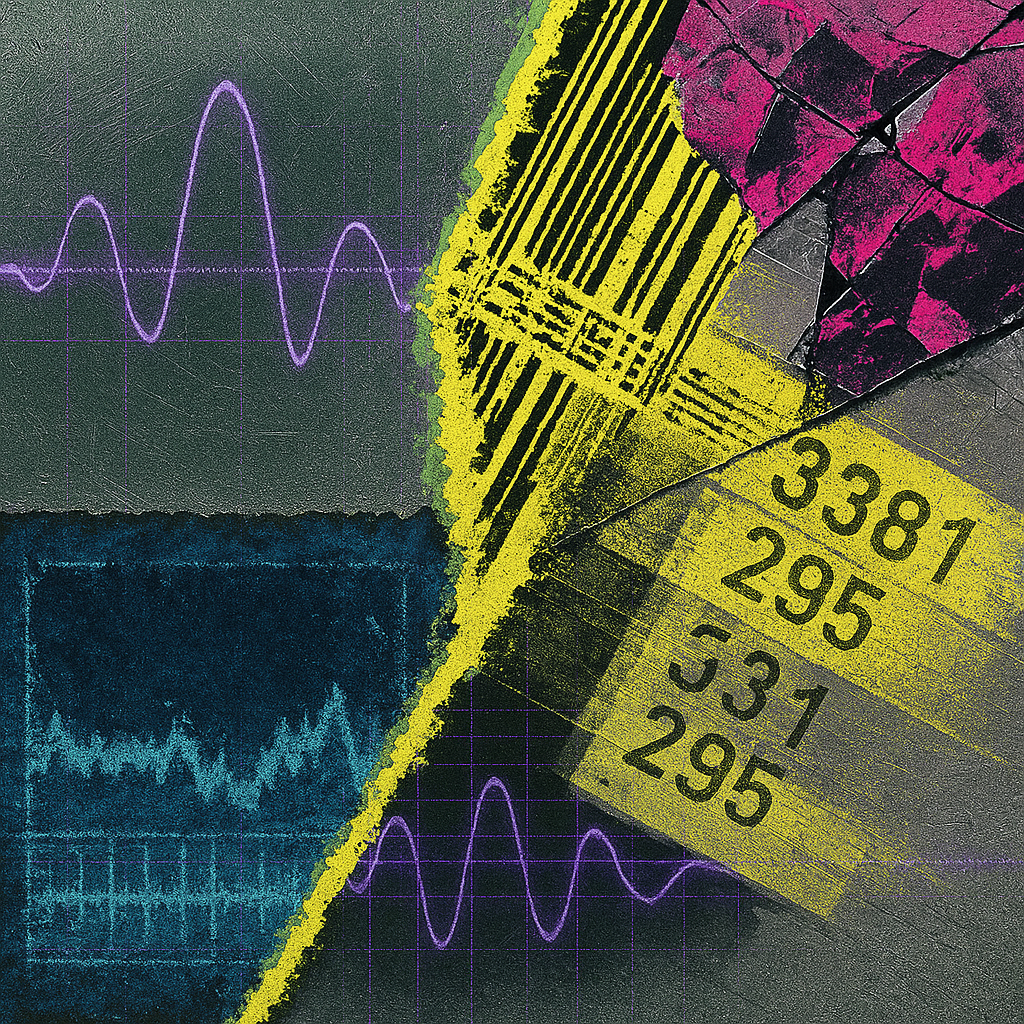
I wanted to test how a near-dark sky (New Moon, 3.6% illumination) could feel like both a hush and a shout, so I built an image where light writes itself as bruises. I chose processes that stain—cyanotype, collodion, gelatin silver—layered over unruly surfaces like oxidized brass and thermal fax paper, because those materials record time the way tides do: in errors. Here I show cause and effect folding on themselves; the viewer should notice traces that appear before their sources, and ask whether the afterimage is the event or its alibi.
Skies are under a New Moon with only 3.6% illumination and quiet solar activity. Weather splits sharply: Stockholm shivers at -9.8°C while Singapore and Dubai linger near 30°C with steady winds. Tidelines mark steady motion: San Francisco peaks at about 1.49 m while Honolulu sits low near 0.25 m. Online, small joys persist—Wordle wins, a Valentine sketch, and a mix of abstract art shares. Textiles from centuries past resurface in museum feeds—embroidered coverlets, silk carpets, painted upholstery. New music releases flicker across genres and countries, from big band reissues to RAVEPOP. Whitman’s brief poem reminds readers that contentment can’t be outsourced.
═══ LAYER 1: MEANING (did the image SAY something?) ═══
**1. Artistic Statement Realization**
- Hypothesis image (#1): The thesis centers around the sensation of joy etched on the edge of dread, where light is not illuminating but bruising, and cause and effect bleed into each other. The image spatializes this using rhythmically hostile color clashes (neon green, sickly yellow, interference violet) and fractured, grid-overlaid space. However, the message of “light as bruise” is semi-legible; the luminous signal traces do shudder and split, but the visual logic (oscilloscope lines, digital grids) never fully inverts their event—these are still signal traces, not paradoxical afterimages. The sensation of “cause and effect folding” is more implied than explicit.
- Control image (#2): The control image is more literal with its barcode collapse, explicit numeric overlays, and disrupted scanline region. The act of “proof of life within self-editing systems” is partially realized by the barcode’s bruising, spectral afterimages, but the digital artifacts (barcode, grid, data numbers) feel generic, and the deeper thesis—time misbehaving, alive scars—remains abstract and under-articulated.
**2. Emotional Contract Verification**
- Hypothesis: Hypothesis image #1 is stronger in producing “cold joy” and “held breath before correction,” delivering a high-arousal clash (especially where yellow spikes crash into the cyan field), but stumbles on the sensation of a “tender fingerprint” or “alarm-hush tension”—it remains too synthetic and sharp.
- Control: Control image #2 better conveys “bruise-stained correction” and the visual panic of error, but the “sweetness” and “caught breath” promised in the contract are overwhelmed by methodical digital signifiers. Both images underperform on the “bright sting of happiness” (color aggression substitutes for emotional sting) and “the tenderness” (neither show truly soft, intimate marks).
**3. Emotional Truth**
- Both images maintain a hig