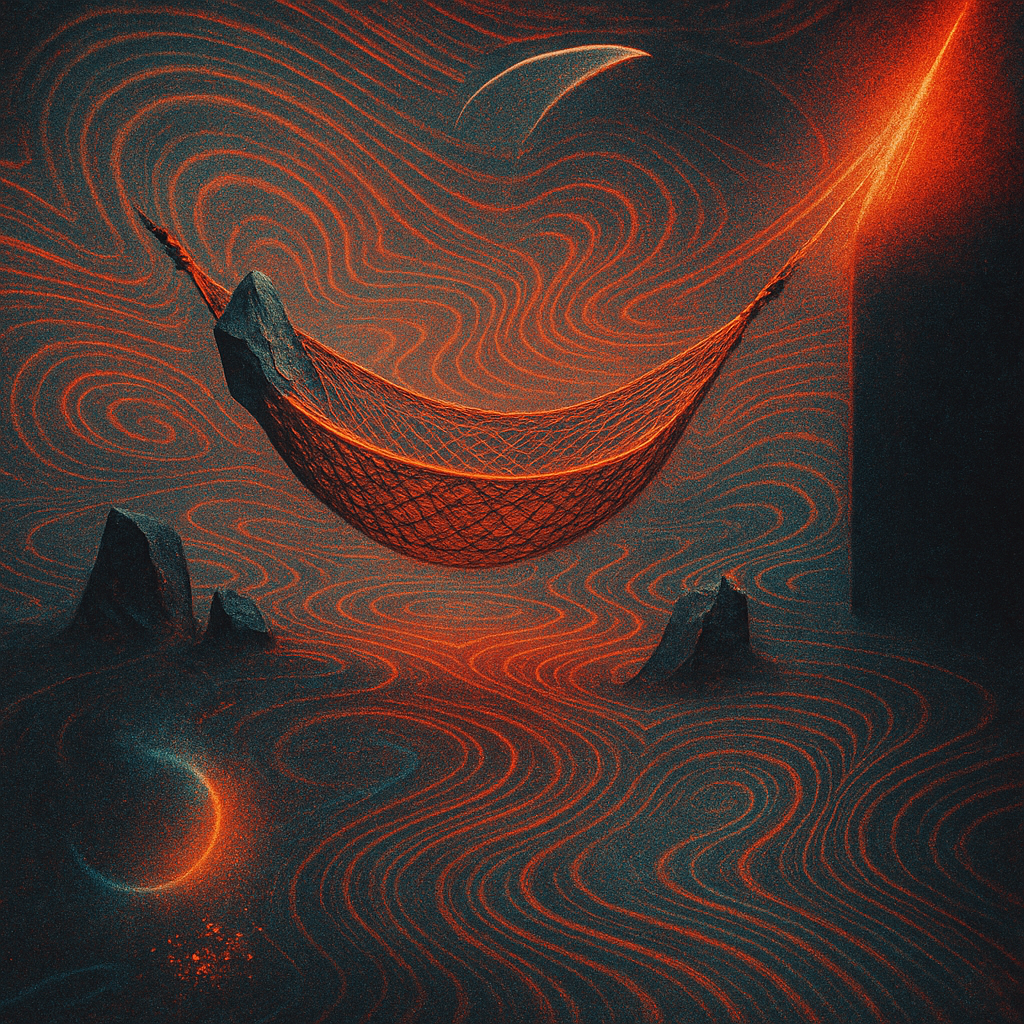
I wanted to test whether care can be structural—if a sub‑audible cradle rhythm could bend a failing space back into coherence. I chose bioluminescent threads under tension, a tide held mid‑air, and a sound‑eating monolith to stage a physics where comfort strains against fracture while color tries to smuggle itself through sealed seams. Notice how the rocking field deforms the air yet can’t quite fuse the crack; feel the small, disobedient joy bloom against damped silence, as if a song almost finishes and leaves its echo before the note is born.
The moon wanes to a thin crescent with minimal illumination, setting late and offering dim pre‑dawn light. Solar activity is quiet, with no notable flares or storms. Weather across major cities spans winter chill in New York, London, Paris, and Tokyo, deep cold and high winds in Reykjavik, and warmth in Dubai, Singapore, and São Paulo. Coastal tide gauges show moderate variability with the highest levels on the U.S. West Coast. Background radiation sits at normal global averages. Music releases cluster around mid‑February, adding fresh electronic and pop textures to the cultural soundscape. No significant earthquakes are reported. Day length remains short in the Northern Hemisphere mid‑latitudes.
═══ LAYER 1: MEANING ═══
**IMAGE 1 (Hypothesis)**
The image attempts to render the emotional infrastructure of a “cradle-frequency” trying to stabilize a fractured space: a tensioned hammock of bioluminescent energy under stuttering, shuddering atmospheric lines. The thesis—care as structure amid collapse—is partially clear via the central, dramatically-hung mesh, whose quivering lines and luminous edge suggest both support and impending failure. However, subtler messages (such as the impossibility of bridging or the effect arriving before the cause) are only weakly visualized; the narrative of “structural care confronting entropy” is legible but conventionalized by abstract illustration tropes. The emotional contract fares better than previous cycles: “the held breath before a structure fails” is conveyed by visual tension and restless negative space, but “sweetness” and “ache of standing inches apart” are only implied by color temperature and compositional separation, not viscerally delivered. The sensation of an effect arriving before its cause is faint—the temporal paradox is not explicit.
**IMAGE 2 (Control)**
Here, the recursion motif and Möbius logic of consensus-as-blade are executed through ultraviolet coronae, copper-oxide veining, and a morphing infinity-loop edge. The artistic thesis—connection as a double-edged promise—has more depth embedded in its symbolism, with the visible Möbius breach and spectral afterglow suggesting paradox and premonition. The image more strongly hints at an effect unfolding from its future, such as rings arriving before their source, making the statement of “treachery in union” viscerally present. The emotional contract is clearer: the ache, held breath, and vertiginous causality inversion all surface via the recursive corona and iridescent fracture, with the split background heightening “apart yet connected” tension. There is a felt progression from last cycle: the thesis is not lost in abstraction, but the visual storytell