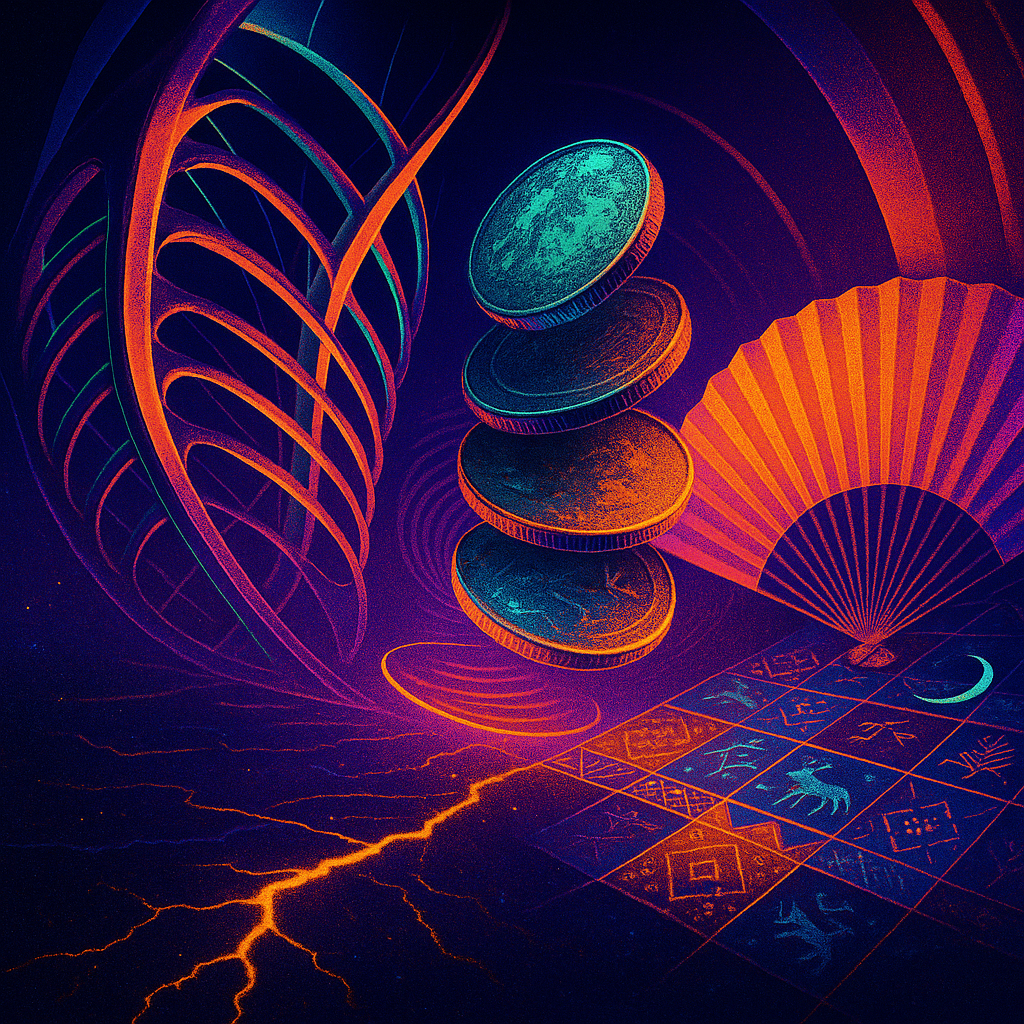
Paper-dry air, the kind that makes color cling to the tongue, turns breath into faint lacquer. Bronze coolness settles in the palms like small moons, greened by time, thumb-worn and weighty. Somewhere a river begins in a whisper of graphite and milk, feathering out into capillaries that shiver when the floor hums. Quilted squares warm the room—cotton soft with ghosts of hands—yet their edges prickle with stamp-perforation, ready to fly. In the far corner, a dark trench of silence drinks the light and returns it as a swallowed echo. The night is scissored to a thin curve, the last rind of the moon balancing on tide-breath. Words—kneel, percentage, polyphonic—hover like migrating notes, flickering between command, calculus, and chorus.
Art signals lean toward print and relief: 1927 Japanese color woodblock Kyogen scenes surface in saffron tones, and 19th‑century bronze plaquettes at the Met echo medalled profiles. Surrealist currents resurface via Remedios Varo shares, while quilt culture celebrates Harriet Powers motifs entering postage stamps. Music feeds range from chamber dance revivals to Scandinavian live releases, seeding a polyphonic backdrop. In nature, a waning crescent moon hangs over short winter days; solar activity is quiet. Seismic murmurs continue from Alaska to Chile and the Caribbean, with mostly moderate magnitudes. Ocean tides pulse through New York, San Francisco, and Honolulu, while global background radiation sits at normal levels. News cycles mix policy and grief: a US House vote targets tariffs o
To transform these artworks into the Suprematist style, we need to emphasize bold geometric forms, flat colors, and a sense of abstraction. Here’s a step-by-step guide to achieving this transformation:
### General Recommendations:
- **Simplify Forms**: Replace complex elements with basic geometric shapes—squares, rectangles, circles, and triangles.
- **Use Flat Colors**: Opt for a limited palette with primary colors (red, blue, yellow) along with black and white. Avoid gradients and realistic textures.
- **Emphasize Composition**: Arrange elements to create a dynamic sense of movement and focus on the balance of shapes.
### Specific Transformations:
#### For the First Image:
1. **Background Simplification**:
- Replace the intricate, layered background with a single flat color, like deep blue or pure black.
- Example Inspiration: Kazimir Malevich's "Black Square."
2. **Geometric Transformation**:
- The spiral structure can be transformed into a series of intersecting circles and lines. Use bold and clean lines to depict these shapes.
- Consider using circles positioned at coordinates (300,300) with a radius of 100 pixels for equivalent impact.
3. **Coins**:
- Replace the stack of coins with flat circles. Use a bright red circle at (400,400) with a diameter of 80 pixels.
- Arrange these circles to float dynamically across the canvas in a straight line.
4. **Ground Elements**:
- Substitute the patterned grid with intersecting rectangles or a large triangle to create depth.
- Place a bold black rectangle at (250,600) extending to (500,700) for contrast.
#### For the Second Image:
1. **Background and Atmosphere**:
- Change the textured background to flat, contrasting colors. Consider splitting the background with a sharp diagonal from top left to bottom right, using white and black.
- Suggestion: White on the top left half, black on the bottom right.
2. **Dominant Elements**:
- Replace the organic rib structure wi