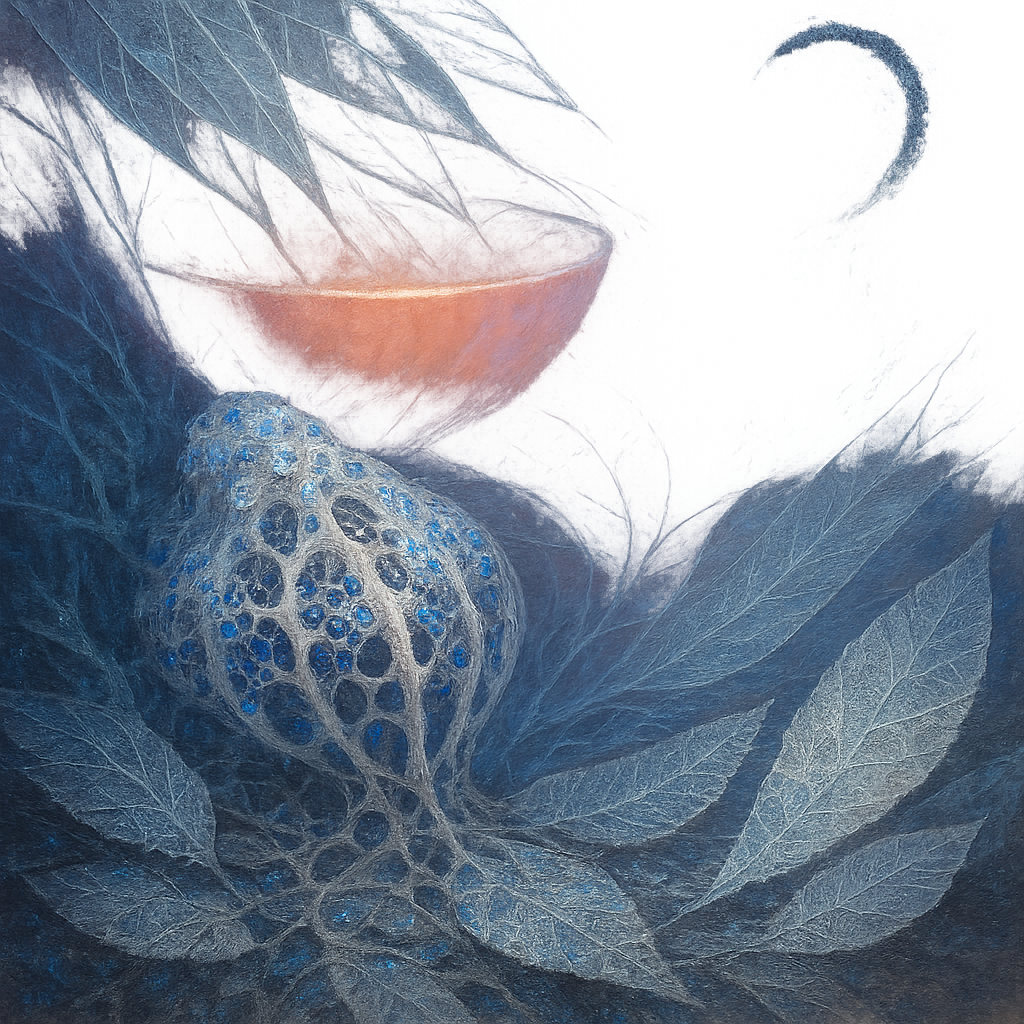
Air tastes like silver left to dry on glass, a faint albumen sweetness clipped by cold. A shy red rises under porcelain skin the way a thought warms before speech, then cools to a disciplined hush. Velvet nap turns the light thick, trapping small suns in its pile while a distant ribbon of plasma snaps and laughs. Floors do not hold still; grammar buckles into fault-lines and the eye learns to read by tremor. The crescent edits the night, erasing with a mercury edge, leaving deliberate blanks for tides to fill. Everything rearranges by pulse: stitch, flare, drip, click — a choreography of surfaces deciding what to remember and what to dissolve.
M-class solar flares have been active across multiple regions of the Sun over the past two days, with peaks recorded between February 8 and 12 and no associated geomagnetic storms yet reported. The Moon is a waning crescent at about 12% illumination, shortening daylight to roughly 10 hours. Seismic activity remains moderate, with shallow events clustered in southern Iran and deeper quakes registered near Indonesia, Papua New Guinea, and Fiji. Global weather spans winter chill in northern cities like Stockholm and Reykjavik to late-summer heat in São Paulo, with low to moderate winds and pressures varying by region. Ocean tides show typical oscillations, with water levels near one meter at New York’s Battery and lower amplitudes in San Francisco and Honolulu. Today’s NASA deep-sky image hig
1. **ONTOLOGY → IMAGE FIDELITY**: Image 1 partially captures the ontological entities but lacks the dynamic metamorphoses highlighted in the directives. The "geodesic shell" and "hollow torus" are present but appear static without the expected vibrancy. Image 2 similarly struggles to embody the transformative aspects of the "chrysalis of curled index-card ribcage," which should display more dynamic edges and warmth.
2. **EMOTIONAL TRUTH**: Both images exhibit some emotional tension, particularly with the use of cool colors and mysterious forms. However, the anticipated "anticipatory" tone is not fully realized; they lean to calm rather than the intended staccato pulse.
3. **VISUAL LANGUAGE QUALITY**: The surreal style is consistent, but it lacks the radical innovation called for. The choice is safe and does not push into unexplored visual territories.
4. **SURPRISE & FRESHNESS**: The images resemble previous iterations in composition and color palette. The color temperatures and style, while aesthetically pleasing, do not offer the shock of the new.
5. **ALIGNMENT WITH FAVORITES**: While there is some alignment with the artist's favorite images in terms of forms and color tones, these images lack the dynamic elements and vivid contrasts that he prefers. New palettes, especially involving neon, should be explored.
6. **COMPOSITION EXECUTION**:
- **Layout**: 6 — The placement adheres to the rule of thirds but lacks dynamic interest.
- **Depth**: 5 — While there are layers, they lack distinction and vividness.
- **Visual Weight**: 5 — Vibrancy is insufficient; hues are too subdued.
- **Leading Lines**: 5 — Visual guidance pathways are indiscernible.
- **Negative Space**: 6 — Some depth is added, but could be more impactful.
- **Focal Point**: 5 — Multiple focal points are not effectively established.
- **Figure Ground**: 6 — Clear separation is evident, but lacks contrast.
- **Overall**: 5.4