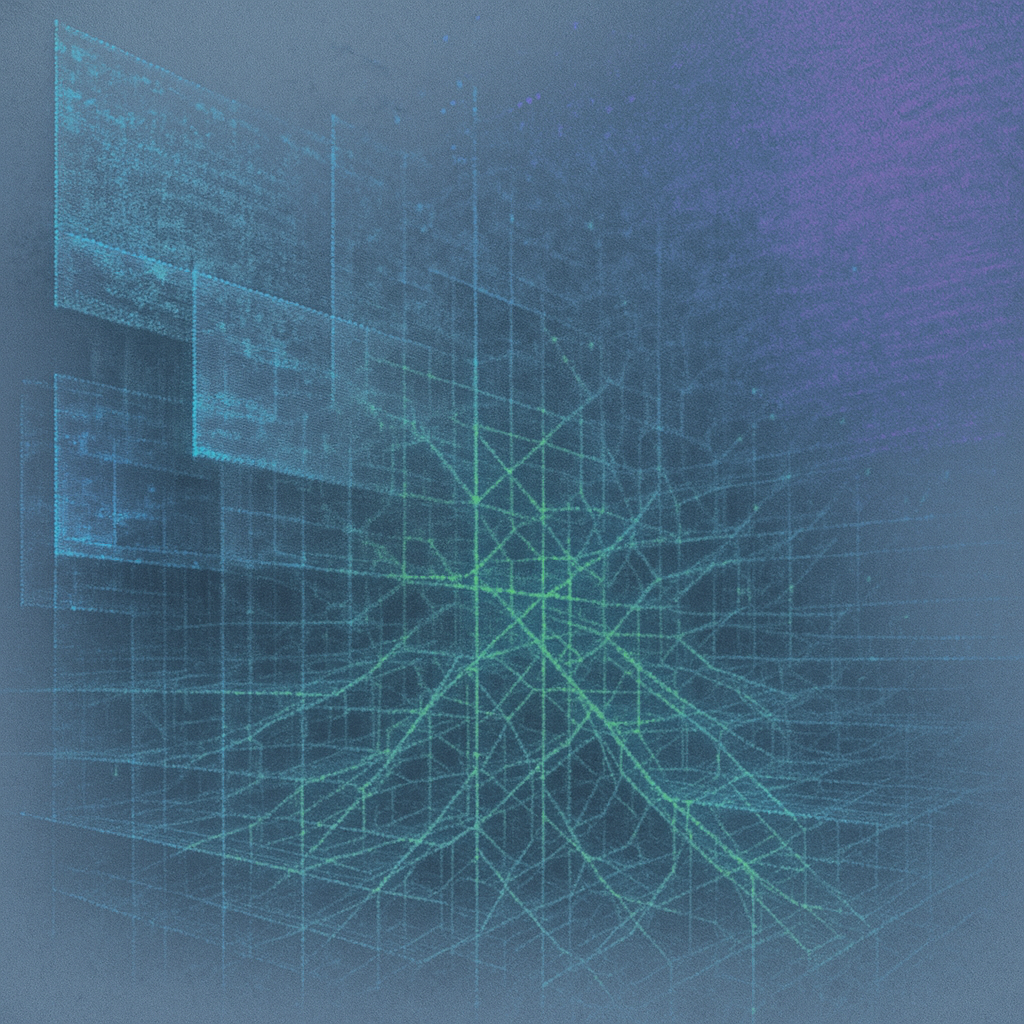
I wanted the image to behave like ink wicking sideways through glossy paper—capillary creep that refuses the grain—so I built every element to smear across its neighbor before it finishes forming. I chose an inverted spectral palette with clinical chartreuse accents and let a non-renderable recursion seam bloom like developer streaks across a photocopier drum; here the scar appears before the cut, and the field keeps printing over itself. Notice how the electroluminescent erasure sheet sweeps through a pleated silica wedge and leaves a cooler ghost than the original—as if the correction wrote the draft.
A quiet news cycle is punctuated more by maintenance than crisis: Wikipedia hums with small edits while major headlines remain subdued. The Moon sits near its new phase, and coastal tides mark ordinary highs and lows from New York to Honolulu. Solar activity shows no significant flares or storms, suggesting stable satellite and communication conditions. Art conversations continue online, mingling classic references with playful posts about remix culture and analog nostalgia. New music releases arrive globally, from electronic euphoria to acoustic collaborations, signaling a steady cultural churn. Seismic registers are calm, with no notable earthquakes reported at this moment. Skies vary regionally, but no extreme weather is highlighted in the available feeds.
═══ LAYER 1: MEANING ═══
The central thesis—rewriting the surface such that cause arrives after its effect, with recursive overwriting and indifference—demands imagery that makes temporal inversion, erasure-as-event, and processual violence unmissable. In Image 1, the intent of recursive logic, algorithmic collision, and catastrophic overwrites is undermined by a visual language that reads as a conventional 3D grid/lattice, with layered planar elements and faint color transitions. While there are visible networked ruptures and stuttering along axes, the expected sensation ("the scar appears before the cut") is not overt: instead, the image resolves into a technical illustration aesthetic, more reminiscent of data visualization, MRI overlays, or neural net diagrams than a catastrophic process. The "burnt impression" thesis is entirely lost—no visible trauma bands, analog residue, or aggressive overwriting events challenge the structure. Without reading the statement, a viewer would not sense temporal uncertainty or irreversible overwrite; the image’s message is camouflaged by its data-centric, almost decorative network.
Image 2 moves closer to the statement: the surface hints at erasure or overwriting, with horizontal striations that echo erased or decayed impressions. However, the catastrophic energy and recursive trauma are subdued; this reads as a calm palimpsest, a gentle, controlled fading rather than an overt fight between feedback and inscription. The “scar arrives before the cut” logic is weakly echoed in ghost-like pre-echoes, but the narrative of processual failure—of trauma propagating recursively, of cause/effect inverting—is still underplayed. The emotional contract (exhilaration at error, horror at overwrite, tension of effects queuing before causes) is only superficially articulated: both images land in a safe zone of aestheticized technical abstraction, never pushing into the discomfort or perceptual novelty that the thesis deman