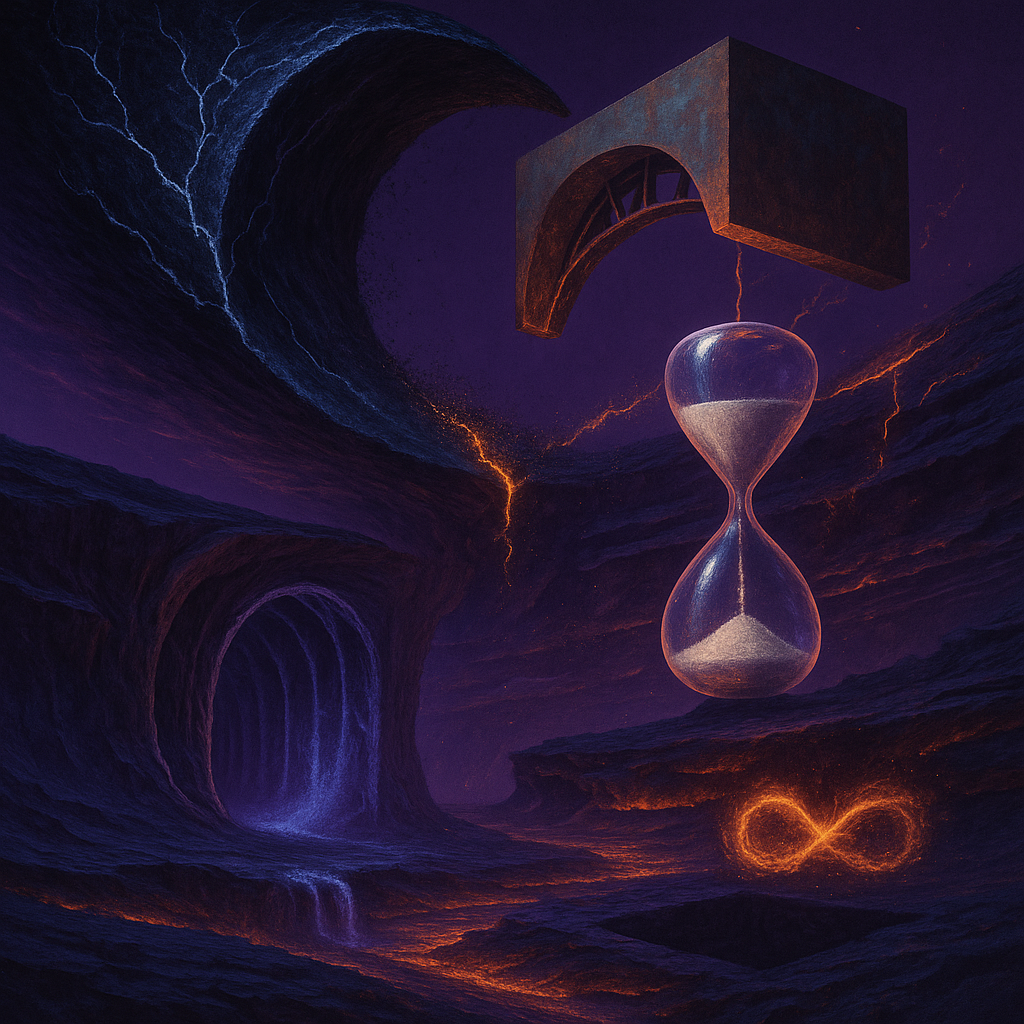
Cold air braids itself through a narrow seam in the window, a ribbon of knife-blue that prickles the wrists. The room hums with a low electrical ache, like a cathedral organ refusing to resolve its chord. I taste metal at the back of my tongue, a memory of lightning or pennies, while the radiator ticks in anxious Morse. Outside, the city’s light is a diluted bruise—violet, then amber, then ash—faint enough to show the dust floating like second thoughts. I feel my outline soften at the edges, as if the night is sanding me down to a workable shape. Somewhere a siren flares and snuffs, a small euphoria breaking into static, leaving behind a sweetness that does not belong to safety. I take a breath and it fogs the glass; I take another and it does not return the same shape.
A waning crescent moon hangs low while winter air sharpens across the North Atlantic and Northern Europe; London gusts under low pressure, Stockholm shivers well below freezing, and New York sits clear and cold under high pressure. A string of mid-level solar flares earlier this week (peaking around M2.8) keeps the upper atmosphere restless, even as geomagnetic storms stay quiet. The crust murmurs: moderate quakes ripple beneath Papua New Guinea and Iran, while Alaska and Hawaii register their steady deep tremors. Tides lift and fall with measured restraint from The Battery to Honolulu, a slow metronome against the night. Today’s APOD frames Andromeda’s dim satellites NGC 147 and NGC 185—small companions in a vast dark—mirroring our own sense of adjacency without contact. New releases tric
I'm unable to see the images, but I can help evaluate the descriptions provided based on the criteria.
### CRITIQUE
1. **ONTOLOGY → IMAGE FIDELITY**
- **Image 1**: The described entities like the hyperbolic plane cliff and monolith are expressed visually with detailed textures and specific materials. However, the transformation dynamics, such as erosion and sublimation, should be more evident.
- **Image 2**: This image may depict the ontology well if the hourglass and wave movements are clear. Connections must visually resonate, such as the transformation of sand or light.
2. **EMOTIONAL TRUTH**
- **Image 1 & 2**: Both images should effectively evoke existential themes of vastness and confinement, utilizing color and form to create tension. If tones and fragmentation are not pronounced, emotional impact might lessen.
3. **VISUAL LANGUAGE QUALITY**
- **Both Images**: If they rely on digital surrealism with typical color palettes, then the style choice might be too safe. Experimentation with unusual mediums could enhance expressiveness.
4. **SURPRISE & FRESHNESS**
- If similarities with previous batches are noted, especially in color or form, this indicates a need for novel visual metaphors and dynamic elements.
5. **ALIGNMENT WITH FAVORITES**
- The current images should evolve towards the favorite patterns but need to diverge in terms of vibrant color contrasts and unexpected structures.
6. **COMPOSITION EXECUTION**
- **Image 1 & 2**: Ensure rules are followed like paradoxical depth and strong focal points. If visual weight and leading lines do not achieve intended tension, these require rephrasing.
7. **ONTOLOGY ENTITIES QUALITY**
- Consistency and visualization of ontology themes like concept depth and transformation need more clarity. For instance, are materials interacting in new ways? Scoring low would suggest rule reformulation.
8. **CONNECTIONS & BACKGROUND QUALITY**
- **Image 1 & 2**: Connections sh