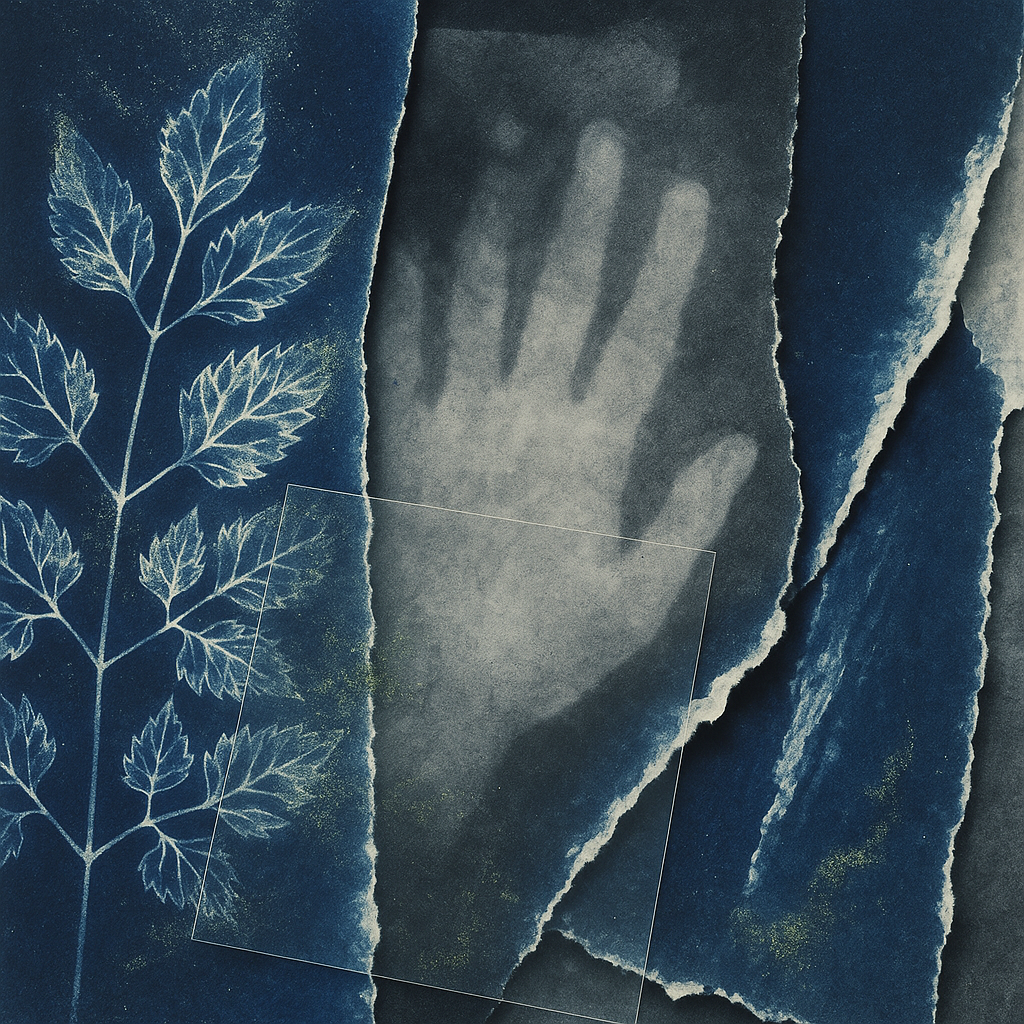
Edits That Arrive Before Their Causes, In Emergency Colors
I wanted to capture how the news term “after” surged across today’s feed, as if consequences were posting themselves ahead of the events. I chose print and photo processes that literally misorder time—slit-scan, wet-plate, cyanotype—so every mark looks like a correction that precedes the error. Here I show revisions as scars and joys as thermally printed confetti that cools into ice, inviting you to notice where cause and effect fold, and to question why certain traces feel more permanent than what supposedly happened first.
Global headlines mix negotiation and violence: Iran signals willingness to discuss compromises on a nuclear deal while reports in the UK allege a rare toxin was used to kill Russian opposition leader Alexei Navalny. Attacks by motorbike raiders in Nigeria leave at least 30 dead, underscoring persistent insecurity. A US politician stresses transatlantic unity amid tensions. On Wikipedia, rapid mobile edits proliferate, with small but relentless changes—hyphens, URLs, rescues—mapping a world tweaked in real time. Crypto markets edge upward, with Cardano and Solana leading gains while Bitcoin and Ethereum also rise modestly. Seismic and solar activity remain quiet. The day’s language tilts toward aftermath—the word “after” recurs—hinting at a collective fixation on consequence over cause.
═══ LAYER 1: MEANING ═══
**Image #1 (HYPOTHESIS):**
The system’s thesis—capturing “edits that arrive before their causes”—is partially visible. The torn triptych evokes fragmentation of sequential logic, and the shadowed hand engulfed by overlapping layers hints at consequences preceding actions. However, this gesture translates more to “dislocated memory” than the explicit collapse and recursion of cause/effect intended. The use of inverted color halos (moss green erupting in a black field) amplifies contrast, yet the metaphor of “revision” viscerally pre-empting “error” remains more poetic in prompt than visible on the surface. The intended emotional contract—the ache of preemptive correction, the sugar-flash of joy curdled by clinical cold—is dampened by the uniform blue-black palette and overly orderly structure. The hand, though ghostly, is passive, lacking the wound, afterimage, or active scarring that would encode temporal paradox or remorse.
**Scores:** statement_clarity: 6→6.5 (slight shift; visually more direct but still not legible without context), statement_depth: 6.5→6.5 (thesis is interesting but not radical in execution).
Only mild emotional impact registers: the hush before a “verdict” is here (stillness, tension), but the “joy through a checkpoint” and “vertigo of an older footprint” are not sensuously present. The palette inversion produces stronger edge tension but not greater feeling—the “sugar-flash” of joy is too subdued, and the clinical cold manifests only as flat cyanotype blue. Aching regret (correction-before-confession) is implied in the striated, layered graphite, but the sensation is theoretical, not physiological.
**Image #2 (CONTROL):**
This image offers a recursive, more tactile paradox: frayed textile, double exposure, and shadowed cyanotype. Here, the “afterimage” and “editing” logic becomes more embodied—a stitched seam, a hinge with visible ghosting, and powdery graphite disruption at the edge. But the thematic collaps