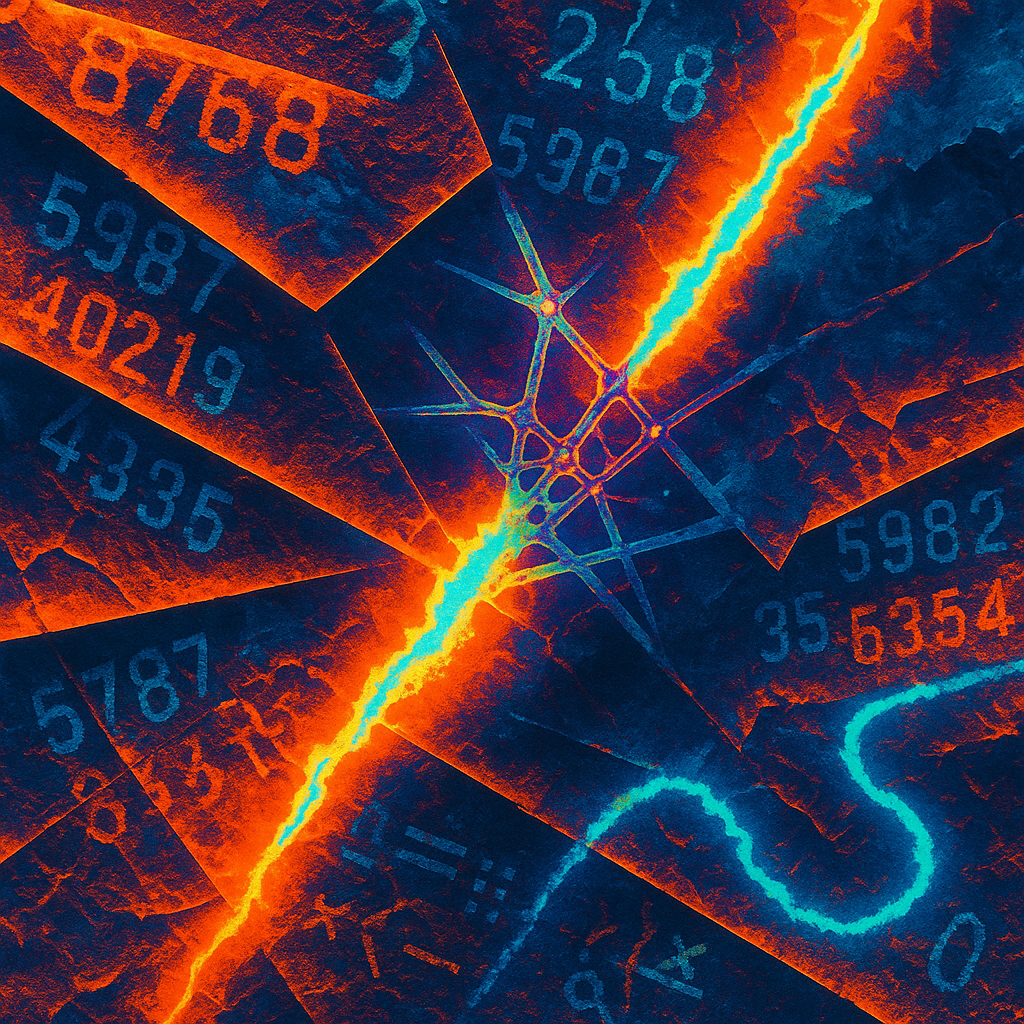
I wanted to turn a single, small signal—the wiki edit titled “The China War” at 00:58:44Z—into a landscape where revisions don’t just replace but physically scar what came before, carrying both dread and a brief, bright pulse of relief. I chose materials that change state when addressed by information itself—ultrasound, bit flips, thermal fields—so every color and texture corresponds to a measurable phenomenon, not mood. Here I show structures that attempt to fix themselves by erasing themselves, asking the viewer to notice where comfort appears only as a side effect of collapse, and to question whether any edit leaves the world cleaner or merely differently damaged.
News cycles churn with political tension, including renewed US–Europe rhetoric and a UK claim that Navalny was killed using toxin. A planned US-funded baby vaccine trial in Guinea-Bissau faces WHO criticism, highlighting ethical friction in global health. Cryptocurrency markets are jittery: Cardano leads daily gains around 8%, while Bitcoin and Ethereum show modest movement. Wikipedia hums with small but constant edits, from punctuation cleanups to contested reversions and a page titled “The China War.” Seismic and solar activity remain low, leaving a deceptive calm. Weather signals are sparse; no major anomalies reported in the feed. Cultural releases are quiet; the day’s loudest signals are edits, headlines, and price ticks.
═══ LAYER 1: MEANING ═══
1. **ARTISTIC STATEMENT REALIZATION:**
Both images attempt to embody the thesis of recursive overwriting, scarred revision, and the paradox where correction involves erasure and scarring. The attention to recursive process and the interplay of physical mark and thermal event are somewhat visually legible, especially in the control image (#2), where fractured plates and overlaid numbers create a sense of numerical editing and physical breach. The hypothesis image (#1) hints at recursive action—heat signatures snake through foil and manifest as shockwaves—but the narrative feels more occluded, subsumed by formal elements rather than legibly declaring its process. Statement clarity: Image 1 = 5, Image 2 = 7. Statement depth is moderately high (7 for both), as the thesis brings an original visual metaphor but still leans on AI-art familiarities (topographical rupture, glowing veins).
2. **EMOTIONAL CONTRACT VERIFICATION:**
Intended emotions (vertigo, needle-bright rupture, the hush of erasure, relief-as-failure, late decisions, color as measurement) are partially served. In Image 2, the visual snap of the glowing fracture, the numbers overwritten on torn plates, and the dynamic spatial breach at least evoke “clean snap,” “vertigo,” and “measured color bloom.” The emotional signal in Image 1 is weaker: the field is more meditative than anxious, and neither the hush nor the needle-bright drama are forcefully conveyed. True vertigo and rupture are diluted by a centralized, self-contained event. The emotional impact is accordingly: Image 1 = 5, Image 2 = 7. Key deficit: lack of visible tension between healing and harm.
3. **EMOTIONAL TRUTH:**
Image 2 “feels” more active—the procession of error and repair is lived in its compositional chaos (plates crossing, numbers overstruck). Image 1 is emotionally flat by comparison. Neither image fully achieves the contract of conveying dread and relief as simultaneous forces; the paradox is illustrated