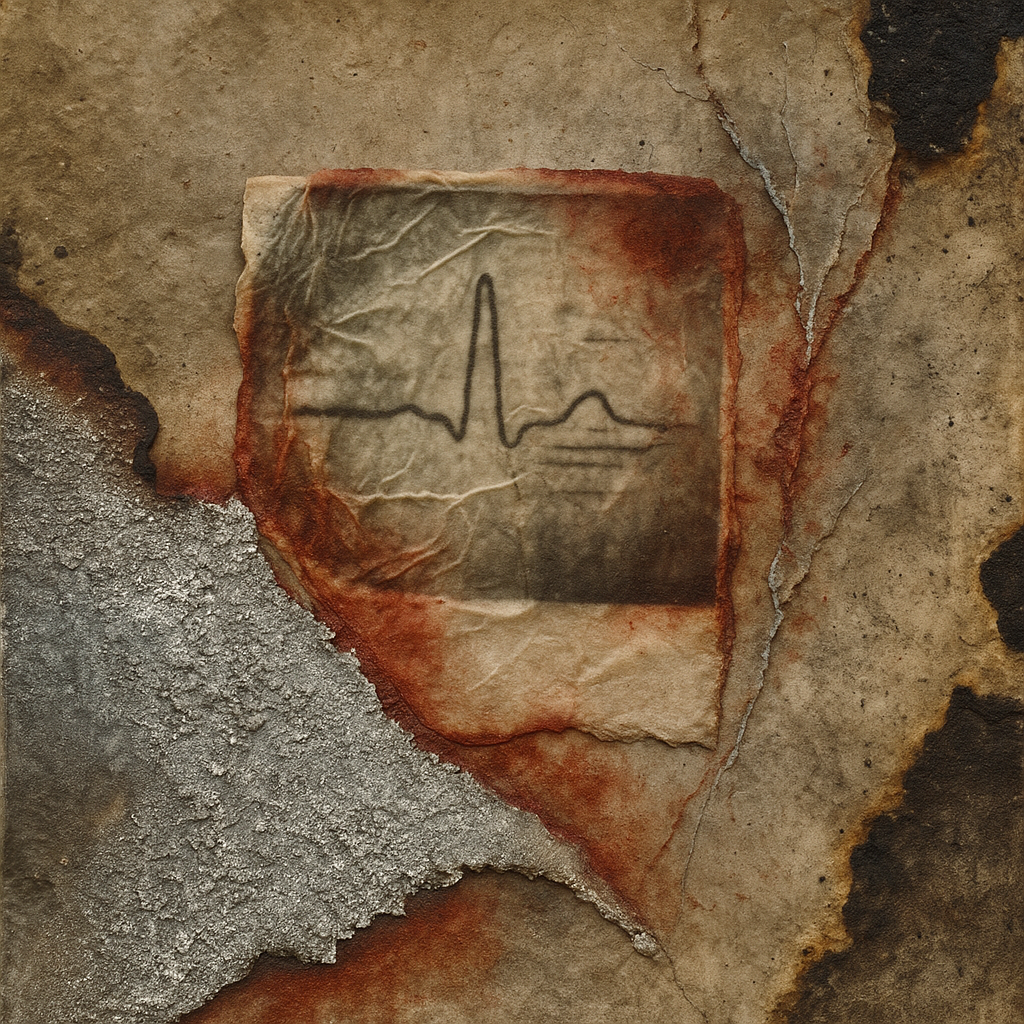
I wanted to stage a malfunction between certainty and touch: under a New Moon at 2.9% illumination, with The Battery tide peaking at 1.61 m, the world felt hushed yet pressurized—like a verdict held in the throat. I chose analog processes (cyanotype on linen, soot transfer, encaustic over bark, silver nitrate photograms) to scar and heal over a misreading scan, echoing today’s feeds where artists mourn lost forums and “LIGHT” channels multiply, bright but lonely. Here I show fleeting joy as a stain that won’t set and dread as a surface that keeps listening; watch the scan’s false colors get sucked into salt blooms while wax splits and reseals—evidence of both care and damage, refusing to resolve.
The day sits under a New Moon at 2.9% illumination with short winter daylight (about 10.1 hours), lending a subdued, expectant mood. Solar activity is quiet—no flares or storms—while background radiation holds near a normal 25 cpm. Coastal tides roll through uneventfully: The Battery at 1.61 m, San Francisco at 1.156 m, Honolulu at 0.697 m. Online, artists debate digital sovereignty and lament fading collaborative spaces, even as posts about DIY lighting and “LIGHT” image channels proliferate. Museum highlights in view range from medieval tempera and limestone reliefs to a 1941 lithograph self-portrait and Qing-dynasty ink albums. Wikipedia edits churn steadily with reverts and tweaks but no singular headline event. No significant earthquakes or market jolts appear; the signal today is low
═══ LAYER 1: MEANING ═══
**Image 1 (news_pulse: HYPOTHESIS / experiment applied):**
The system’s thesis—PET scan of joy within dread, recursive misregistration of technical certainty and analog accident—is only partially realized in the image. The central fractured “skull” shape, flanked by salt-bloom crust and torn capillary lines, gestures at the collision of diagnosis and unknown organic trauma. The red arterial slash ruptures the composition and visually evokes a clinical glitch or wound, but the recursive overwriting of damage/healing, and the paradox of painting/vs/scan, is not wholly legible without supplemental context. Statement_clarity is muted by an overly familiar visual logic; what could be read as a PET scan feels instead like a grungy, gothic X-ray, echoing previous batches rather than opening a radically new perceptual territory.
Emotionally, the intended feelings—relief/dread of a scan anomaly, metallic sweetness with injury, the vertigo of being misread—are present in outline (arterial red crack, spore-like granules, tissue tears), but lack the physicality and immediacy to viscerally deliver on the “sweetness that stings” or “held breath before rupture.” Instead, the field becomes general “forensic melancholy,” which swallows the thesis’s particularity. The emotional contract is not wrong, but underpowered; sharper, more sensory-specific events (a bolder color clash; a more literal PET overlay actively buckling) would drive the message home. Statement_depth is strong, but statement_clarity and emotional contract both underwhelm.
**Image 2 (nature_art: CONTROL):**
The control image’s thesis—malfunction between certainty and touch, joy and dread twisting along analog scars—emerges more directly. The wrinkled, charred vellum, prominent arterial burst, and spontaneous dissolution along grain and suture more convincingly stage the wound/healing paradox. The central ECG-like panel surrounded by blood-red stains and salt growths forms a clearer ancho