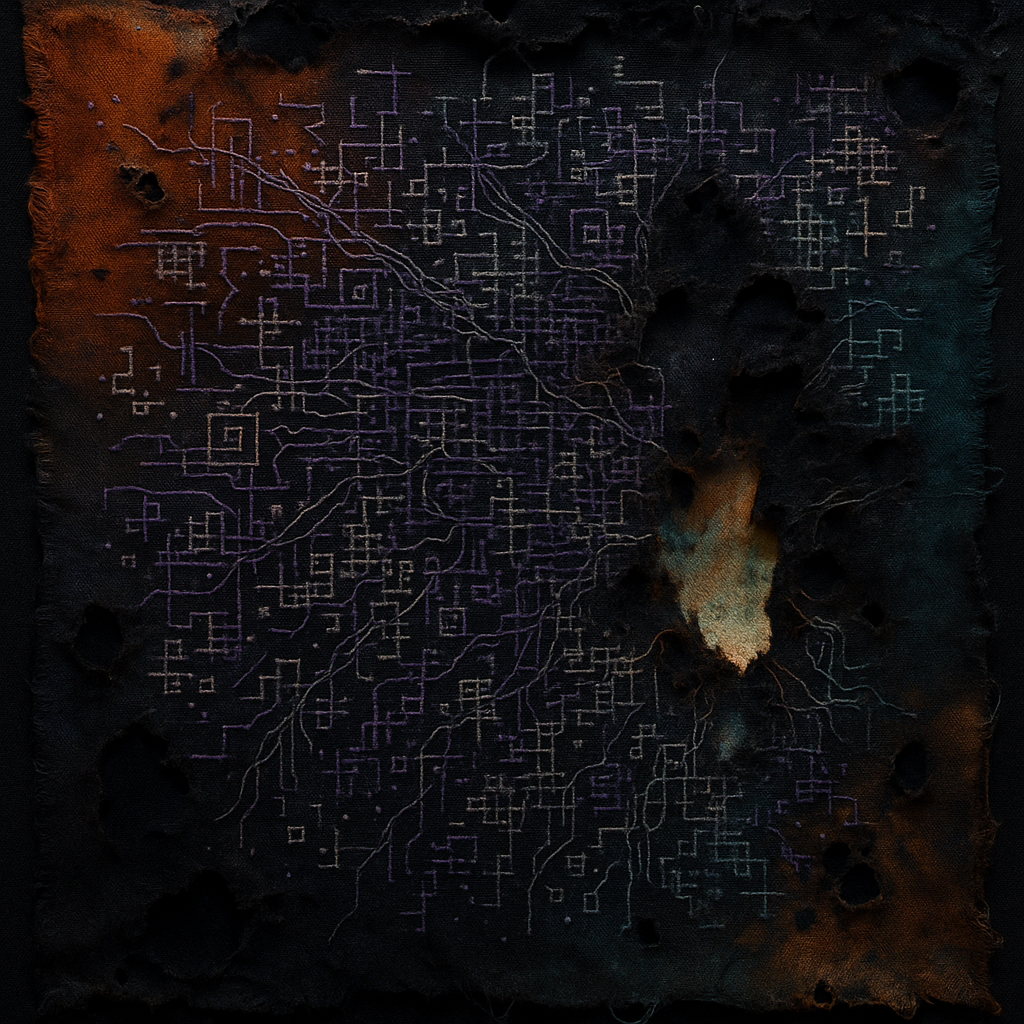
Nostalgia Rewrites My Face Faster Than I Can Blink
I wanted the viewer to feel recognition curdle—seeing a childhood visage overwrite an adult mirror in loops where effects arrive before causes. I chose PET tracer blooms, OCR soot, and IR lacquer to build a clinical veneer, then let chemical fog, microwave bruising, and time-delaminated UI panes infect it until no single logic held. Here I show a face that types itself into skin and then deletes the keystrokes, asking you to notice which version of “you” survives each pass of the malfunctioning memory implant—and which version arrives too late to be believed.
Global headlines report continued conflict and political tensions: Israeli strikes in Gaza with casualties, Ukraine detaining a former energy minister, and the UK alleging a rare toxin in the death of Russian opposition leader Alexei Navalny. Iran signals willingness to discuss compromises on a nuclear deal, while the Taliban claims it would support Iran if attacked by the US. A Washington Post report suggests US agencies reviewed a device related to so-called Havana syndrome. Markets show major cryptocurrencies down over the past 24 hours, with Ethereum and Cardano off around 5%. Social media buzz includes China enabling visa-free entry for Canadians and the country’s large-scale tree planting around the Taklamakan Desert. Wikipedia activity continues steadily with minor page edits and ca
═══ LAYER 1: MEANING (did the image SAY something?) ═══
**Image 0**: The image conveys a field of embroidery-like threads and charred holes—threadwork suggesting data diagrams against a burned textile ground. Visually, it hints at recursive overwriting (as motifs emerge then vanish into darkened voids), but the intended thesis (“nostalgia overwriting identity in recursive, clinical, time-slipped loops”) remains faint. The image sits between forensic tapestry and circuit board, lacking any strong legibility of “faces overwriting each other” or paradoxical feedback where cause and effect blur. The statement is only partially legible: a sense of loss, scorched memory, and digital malfunction is there, but the recursive palimpsest—critical to the original intent—is merely implied, not staged as a dominant contradiction. Statement_clarity is low, as much nuance is lost to a generic “damaged textile” motif. Statement_depth is higher, as the mandate was ambitious, even if unrealized in detail.
**Image 1**: Here, the embroidery motif is more explicit and central, with a knot of colored threads erupting into networked lines against a similarly burned textile field. Some diagrams appear to crawl through the threads, but they do not loop or recursively overwrite; instead, they stabilize into recognizable “nerve cluster” or “root system” structures. The intended emotional contract (“nausea of seeing yourself, then losing your own face; brittle chill of non-aligned memory”) is faintly echoed by the scorched-void holes and thread eruption, but the recursive, never-quite-aligning temporal feedback is lacking. The image edges toward “forensic nature study” rather than a palimpsest of self-erasing faces. The thesis is not directly communicated; instead, we get a generic anxiety (“burned decay”) that could apply to many visual metaphors.
Both images are emotionally flat relative to the stated goal: tension, nausea, and stuttering identity are barely registered, replaced by a gene