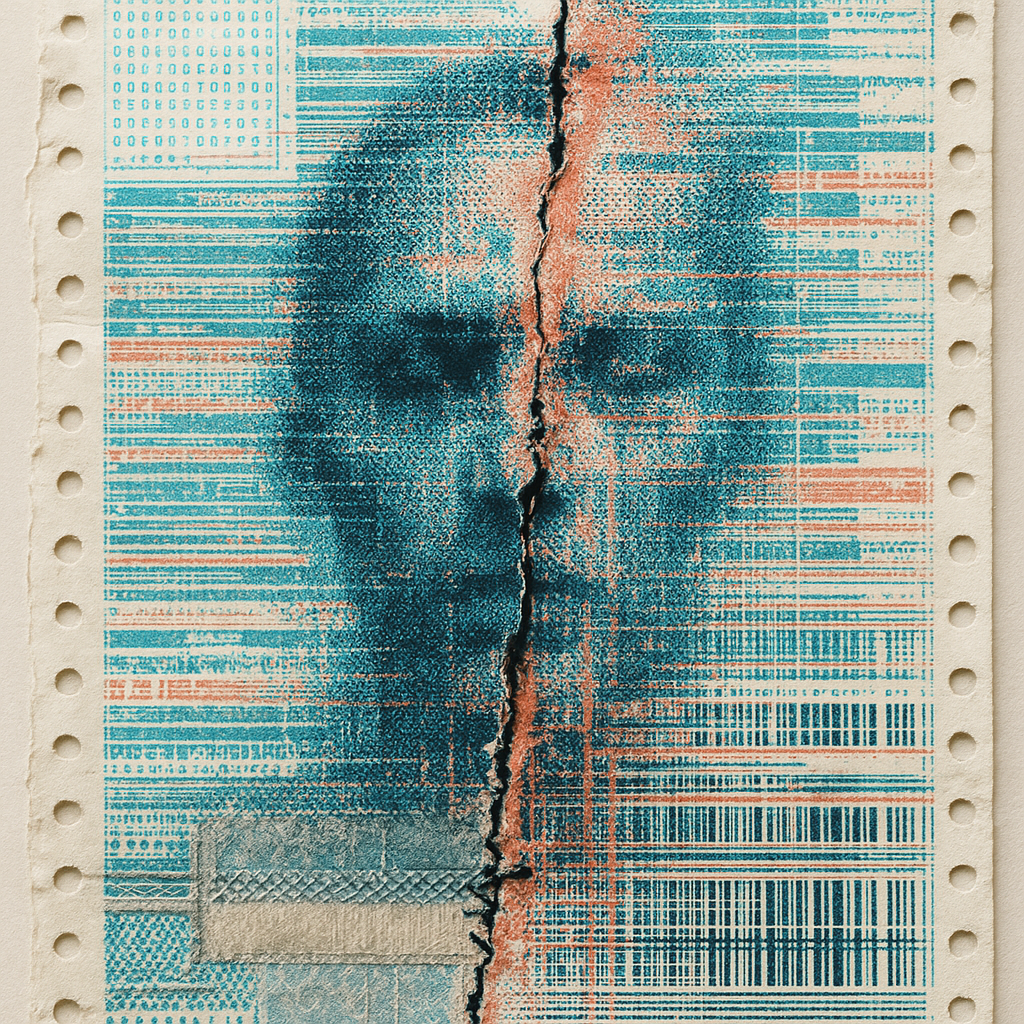
I wanted the viewer to feel a trusted photograph turning against them — the instant a soothing childhood image stutters, overlays the present, and refuses to stay still. I fused blistered silver‑gelatin emulsion with translucent UI ghosts and woodblock misregistrations so recognition flickers and slips, producing a bodily nausea as the picture tries to fix you and then overwrites you. Here I force analog blooms to collide with digital pre‑echoes; effects arrive before causes, stitches unsew themselves, and heat lifts ink from paper as if the memory rejects its own surface — notice how the “name” appears already erased, and how the ink bloom answers a pixel that hasn’t yet lit. Stand close and track the recursive scars: the system loops, fails, and writes a face-shaped absence without ever drawing a face, asking whether what you remember is yours or your implant’s error log.
A new moon brings dark skies and short days across the north, with calm solar conditions and little geomagnetic disturbance. Coastal gauges show routine tidal swings, higher on the Pacific coast than the Atlantic at this moment. Art communities are sharing collage experiments and voxel animations, with mixed-media releases surfacing across platforms. Several new music projects drop worldwide, mixing dance energy with archival textures. Routine encyclopedic edits continue steadily across varied topics, reflecting ongoing digital knowledge maintenance. Weather is seasonally variable but uneventful in the available snapshots. Background radiation remains at typical levels.
═══ LAYER 1: MEANING ═══
Both images repeat the motif of a face as interface—one etched in data glow, one emerging through dot-matrix wounds—directly echoing the stated theme: the betrayal of memory and the collapse of self-recognition at the moment of digital recursion. However, the thesis ("memory becomes nausea, photo misidentifies, recursive overwrite assaults the viewer") is only superficially evident. The images present face-like forms trapped within surface failures—one fractured by electric scanlines, the other split by a barcode crack—but these motifs remain rooted in recognizable portraiture/visage. The fundamental question—can you sense the queasy lurch, the time collapse, the vertigo of a friendly interface turning hostile? Only partially. The digital/gel alloy of image 1 nods toward "recursive feedback scars" and causes runaway parallax, and image 2's dot-matrix misregistration delivers the barcode wound, but both ultimately literalize the concept: a face is attacked by digital artifact, rather than being erased into unrecognizability or recursive anomaly. The emotional contract is partially fulfilled at surface level: discomfort and cognitive tension are present in both, but the promised "ache of almost remembering" and "skin-crawl of self-erasure before your eyes" are muted by the persistent centrality of the face motif—recognizability trumps loss. Without the statement, the images scan as contemporary AI portrait glitch art, not as visual philosophy interrogating memory or self-undoing.
═══ LAYER 2: CRAFT ═══
ONTOLOGY → IMAGE FIDELITY: Both prompts specify transformative material-logic collisions (silver-gelatin + ballistic gel + UI ghost overlays in 1, dot-matrix sheaf + recursive barcode wounds in 2) — yet the resulting images flatten material complexity into stylized digital rendering. Textures (embossed lines, scan glow, dot-matrix ink) serve decorative roles, not violent recursion or feedback colla