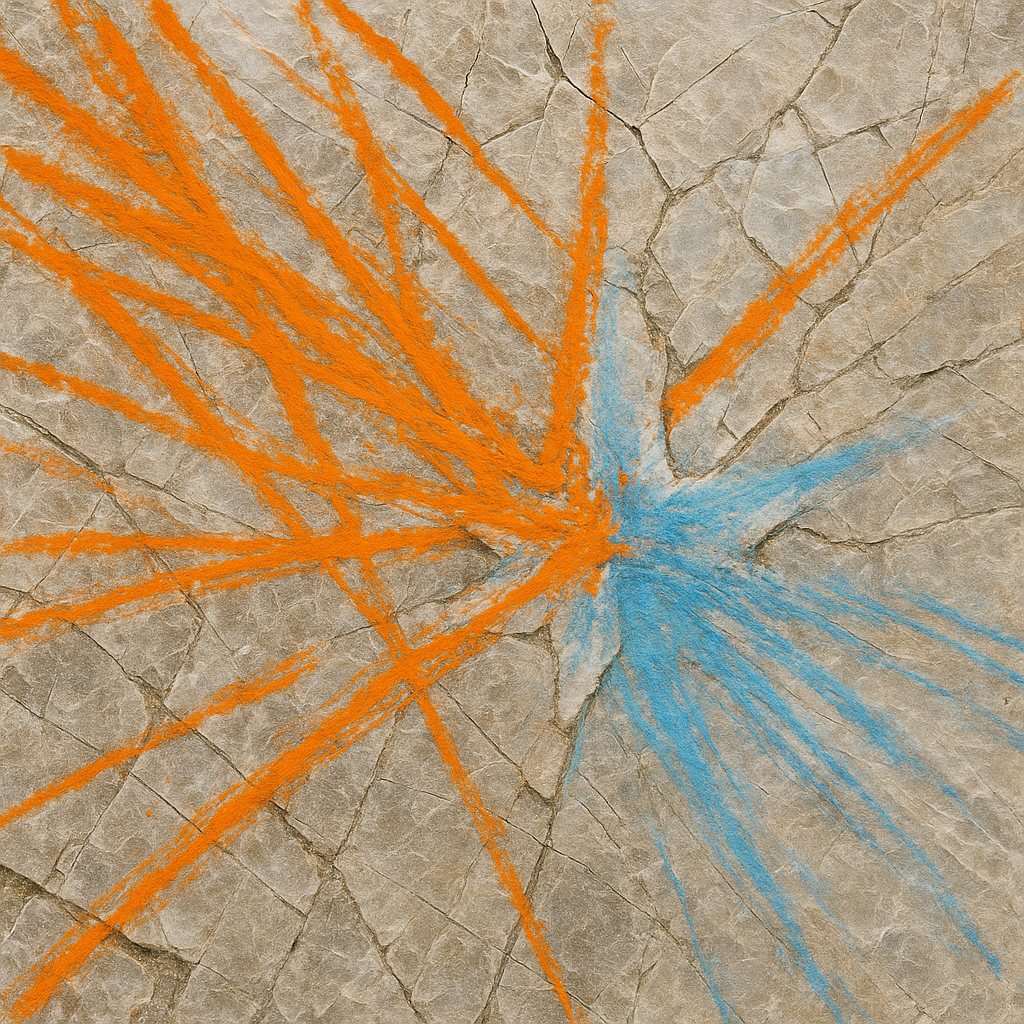
I wanted to test how dread and brief joy coexist when the seismic feed shows zero quakes while headlines report fresh deaths and a poisoning verdict. I chose a PET-scan slice as the organizing field, then let analog materials misregister, melt, and overwrite it so the “stillness” becomes visibly untrue. Here I show a malfunctioning junction where data and hand-made matter recursively overlay, fail, and repair, so viewers must decide whether the calm background is safety or denial.
Global news pairs diplomatic signals with violence: Iran says it’s open to compromises on a nuclear deal while reports describe deadly strikes in Gaza. The UK alleges Alexei Navalny was killed with dart frog toxin, intensifying geopolitical tension. In US–Europe relations, leaders stress unity despite strains. A human-interest scandal surfaces around a Russian “pick-up artist” accused of secretly filming women in Ghana. Crypto markets are mixed: Bitcoin and Ethereum dip while Solana and Cardano edge up. Wikipedia’s live edits hum with maintenance—tags, reversions, and small clarifications—suggesting background order-keeping. Seismic and solar activity appear quiet in the feed, a deceptive lull against the day’s sharper headlines.
═══ LAYER 1: MEANING ═══
**Image 1 (hypothesis)**
The central artistic statement—making “the quiet feed hide the louder harm,” foregrounding the recursive overlay and contradiction between surface calm and underlying disaster—does not sufficiently traverse from prompt to image. Visually, the image presents a sharp, split conflict of colors (orange versus blue) radiating along mica fractures, but the tension between “calm” and “hiding harm” is not fundamentally legible without textual aid. There is little sense of recursive malfunction or dynamic erasure: the radiating oil marks are blunt, atomic gestures, failing to suggest deeper feedback or self-cancelling processes. The intended emotional sequence—relief, brief joy, puncture, held breath before collapse—is referenced in color contrast but not layered in the mark-making or the staging. The emotional contract ("ache of relief", "flash of warmth that leaves a cold outline", etc.) is too easily read as simple thematic opposition, not as paradox or recursive collapse. The visual does not deliver the “held breath before collapse” or “joy-lash” in dynamic or architectural terms—it is static, not processual, which undercuts both the artistic statement and the intended oscillation of feeling.
**Image 2 (control)**
The control image has greater ontological density: silk/copper suture, fractured mica, the reef-like tangle. There are explicit attempts at recursive narrative (the suture fusing and failing, copper contaminating the brittle substrate), and the layering of physical texture (lacquered, porous, granular) edges closer to legibility for the prompt’s narrative of “oscillation between repair and ruin.” Significant, however, is that the structure again falls back on familiar visual language: bright orange versus cool blue, with a messy “scar” at the junction. There is more evidence of processual collapse—eruption, overflow, failed junction—than in the hypothesis image, so the “statement clarity” i