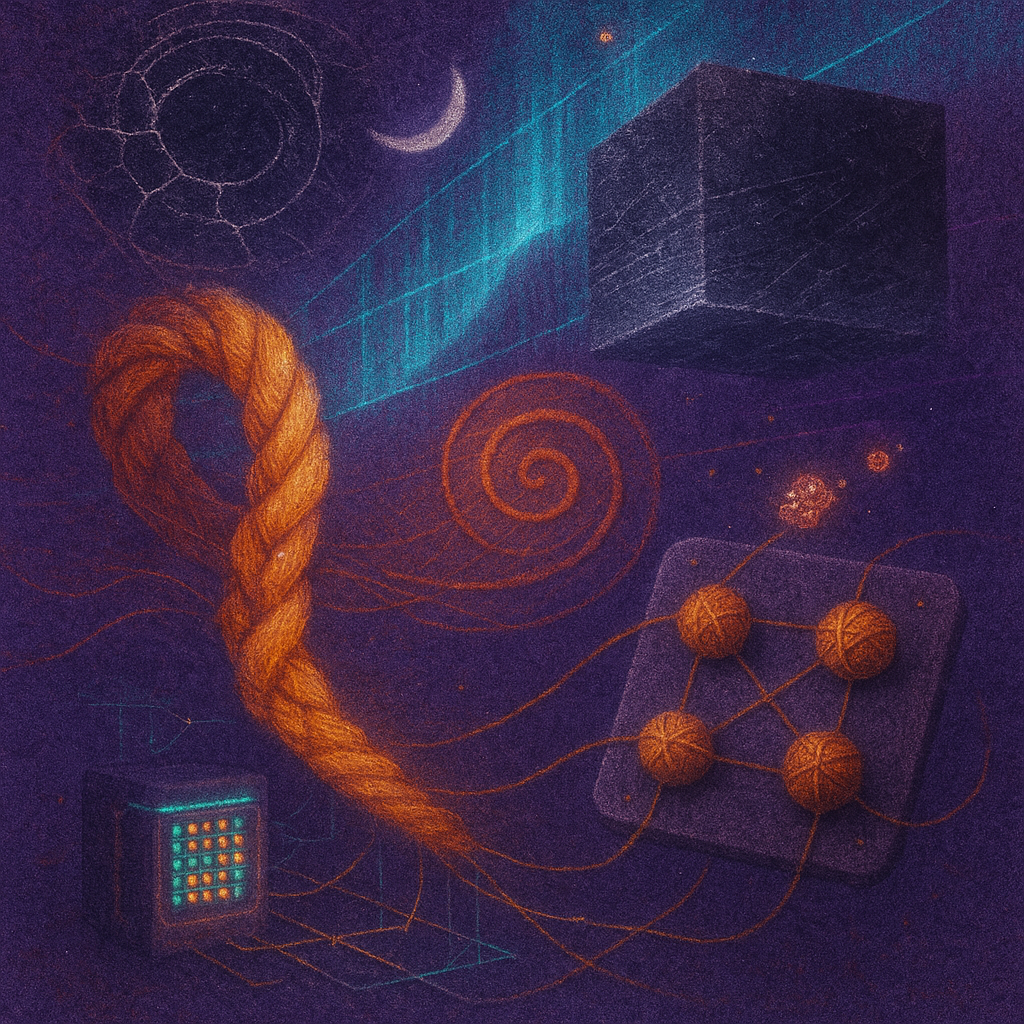
Warm wool radiates like a pocket ember against a room edged with cold glass. Red chalk dust hovers in the air, a dry breath tracing tendons before the body moves. Pixels flicker like street‑stall neon, tiny currencies of attention pulsing in candy colors. A blue curtain of sound lifts and settles, leaving phosphorescent fingerprints on the ribs. The moon thins to a silver rind; light slips, becoming hush. Somewhere below, a slow shiver travels through stone, a bowl‑deep resonance that makes the tabletop hum. On the surface, a spark touches metal and sweetness floods the mouth, quick then lingering.
Art signals today skew tactile and luminous: mid‑century textile studies by Claire Zeisler (braids, suede, needle‑lace spheres, orange‑red wools) sit alongside a Renaissance red‑chalk figure study, while community feeds share pixel‑art resources, a frosty motel render, and small‑batch craft accessories. The moon is a waning crescent at roughly 20% illumination with short winter day length, casting softer night light. Seismic activity includes a magnitude 6.2 event near Ovalle, Chile, felt broadly, plus several mid‑ocean and high‑latitude quakes; no tsunami reports. Ocean gauges show moderate tides: about 1.33 m at San Francisco, 0.57 m at The Battery, and 0.24 m at Honolulu at the sampled hour. Solar weather is quiet with no notable flares or storms. New music drops range from electronic a
To enhance the first two artworks by incorporating elements from the favorite images, bold transformations should emphasize dynamic composition, interplay of light, and expressive textures. Here's how to achieve these:
### Artwork 1 Transformation:
1. **Kinetic Influence:**
- Introduce dynamic kinetic lines in the background using a bold neon blue (RGB: 0, 150, 255). Position these starting from the top right (coordinates: 800, 100) sweeping down towards the humorously tied knot at (450, 400).
- These could mimic the motion trails, creating a sense of propulsion akin to Futurism's focus on speed.
2. **Contrast and Spatial Dynamics:**
- Replace the dark cubes with transparent, Op Art-inspired grids. Starting at the top left (coordinates: 200, 200), these grids can ripple downwards, with light greys and whites, enhancing spatial dynamics as seen in Victor Vasarely's work.
3. **Color Contrast and Light Play:**
- Alter the celestial elements (e.g., the crescent) using a gradient transition from cool blue (RGB: 50, 100, 255) at the top to warm orange (RGB: 255, 150, 0) at the bottom, simulating the cosmic depth.
4. **Texture and Form:**
- Add texture to the rope using a metallic sheen to echo the futuristic metallic surfaces from the third reference (artist's favorite). Focus on highlights along the rope's twists at coordinates (400, 500).
### Artwork 2 Transformation:
1. **Remove and Replace Blocks:**
- The static block at coordinates (600, 100) can be reimagined as an illuminated orb, casting radiant colored lights similar to Op Art’s luminescence, with a central bright zone radiating outward.
2. **Incorporate Geometric Patterns:**
- Integrate geometric matrix patterns on the bottom right fabric using warm colors. These could start from (500, 500) and expand like a hairline grid in all directions.
3. **Light and Shadow Play:**
- Expand upon the swirling orange tendrils to reflect light patterns seen in the fifth