A waning crescent moon sits at 4% illumination, casting thin nocturnal light as day lengths hover near 10 hours in the north. Weather swings are stark: Stockholm falls to −10.8°C with strong winds while Singapore holds humid heat above 30°C. Oceans breathe in uneven rhythms; tide stations report a 1.31 m spread between San Francisco’s high water and Honolulu’s near-stillness. Solar space is quiet—no flares, no storms—yet the air on Earth feels electrically expectant. The art feed nods to carved light and shadow: Hiratsuka Un’ichi’s color woodblock prints linger in memory with their subtractive edges. A Thomas Nast lithograph about political graft resurfaces, eerily relevant in an age of procedural opacity. Music trickles in from scattered geographies, modest pulses rather than tidal waves.
═══ LAYER 1: MEANING (Did the image SAY something?) ═══
**IMAGE 1 (Hypothesis):**
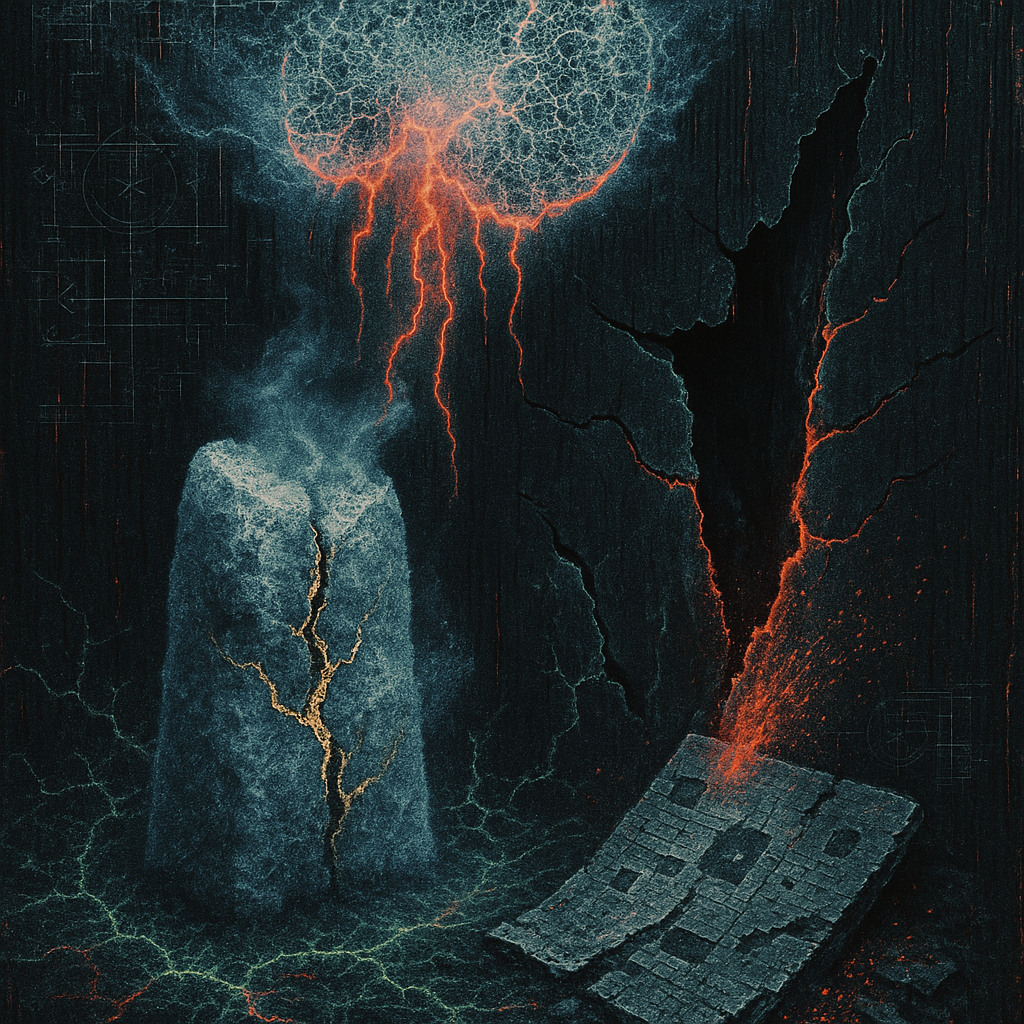
The system aimed to express a thesis about the collision of sweetness, violence, and mute dread: to show decisions sublimating, sugar and ash fracturing, and dread given a transient, almost edible beauty. While the palette—neon vermilion and frost white on black—offers immediate intensity, the central event (fractured maple plate, vapor, and crystalline stresses) is visually explicit, but the *statement* remains diffuse. The palette’s violence reads clearly, but the transformation of "venom into architecture" or "aroma taking shape" is muddied by abstraction. Legibility of the thesis is moderate: the aesthetic implies sudden fracture and unsettling sweetness, but the poetic leap (dread as sweetness before the cut) requires external knowledge—viewers sense impact and rupture, but not the specific conceptual convergence the system declared. Emotional contract: the “held breath,” “brittle sweetness,” and “vertigo of silence” are visually suggested by stark negative space and eruptive mark-making, but none achieve the sharp, sensorial contradiction promised—there’s a cognitive gap between seeing and feeling. The vapor and fractals *try* to evoke a palpable transformation, but the emotional voltage is muted by a lack of explicit paradoxical or contradictory states.
**IMAGE 2 (Control):**
The control image is slightly flatter in conceptual ambition—compositionally elegant, but more withdrawn. The monolith, cleft, and vapor are staged, but the radiating lines and slab come off as familiar tropes rather than unprecedented logics. The emotional thesis is even less legible than Image 1; negative space and fracture are visually explicit, but the physical/sensorial contradiction ("sound that warps space," "sweetness that cuts") is absent. Emotional sensations—suspense, "vertigo," and unresolved collapse—are present, but less arresting: the image