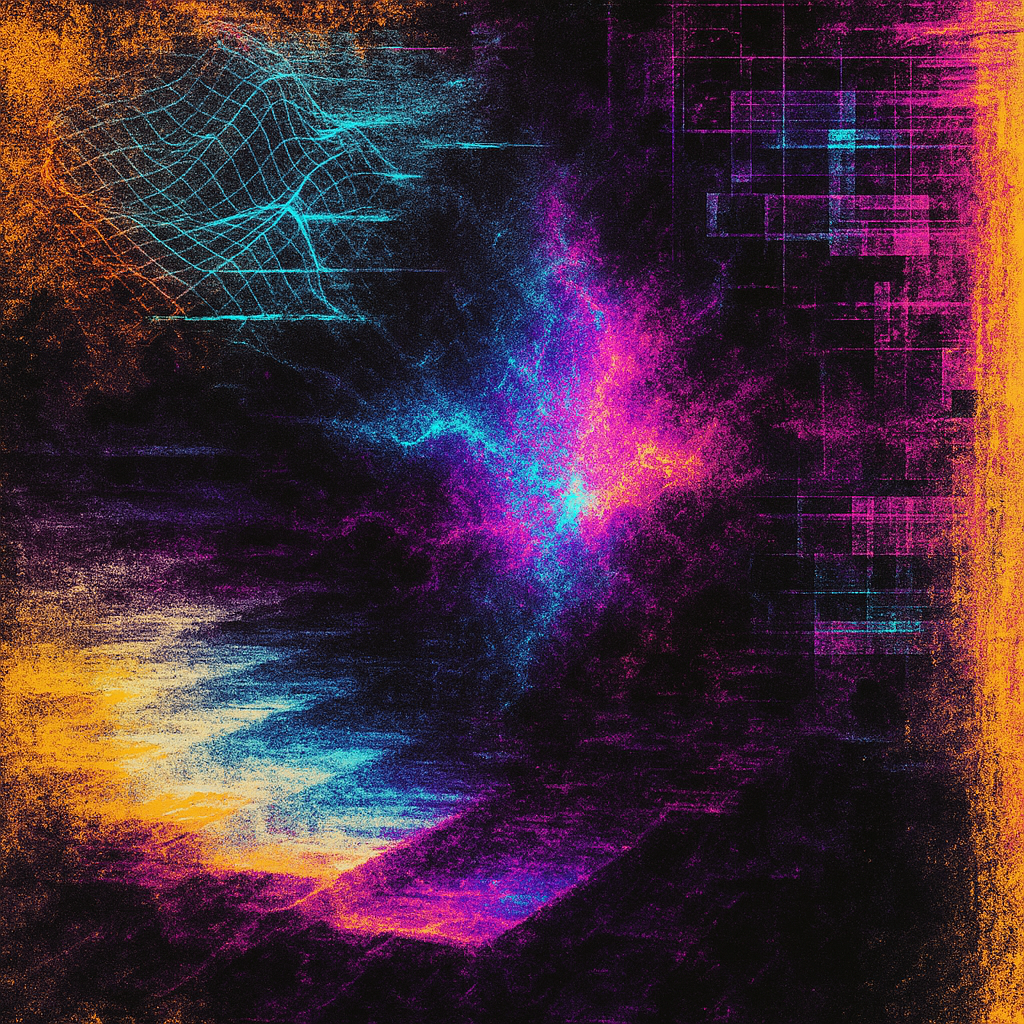
I wanted the viewer to watch their own recognition fail in real time: childhood photographs stutter across a living face while the interface meant to aid memory misfires, writing the future frame before the present. I chose scan-born forms—point clouds, depth maps, spectral residues—then infected them with albumen burns, chemical fog, and temporal feedback so that analog and digital undo each other visibly. Here I show a mirror that answers first, a photo that scars before it prints, and an inaudible implant field bruising color—inviting you to notice how comfort curdles into nausea the instant nostalgia is rewritten by code.
A new moon settles over the week, shortening daylight and sharpening contrasts; tides pulse quietly from New York to Honolulu with modest range. Solar weather is calm—no flares, no storms—so signals run clean even as our memories feel noisy. Cultural feeds hum with hiking shadows, miniature painting, and pattern bots while new music trickles out across platforms. Museum worlds remain steady: Vermeer still breathes in oil, Lalique’s glass still catches light, and albumen prints whisper from the 19th century. On the live wikis, tiny edits accumulate—parameters deprecated, categories shifted—micro-changes that foreshadow larger revisions. Earthquakes stay silent; markets and headline news offer little drama, a lull that makes inner turbulence louder. The air has the chill of arctic screensave
═══ LAYER 1: MEANING ═══
1. **ARTISTIC STATEMENT REALIZATION:** Both images communicate a thesis of recursive, self-erasing identity and violently paradoxical memory logic, but do so in a way that feels stylized rather than genuinely destabilizing. The intent—to traumatize the threshold between recognition and erasure using technical/scan residues infected by analog failure—is legible, particularly in Image 1’s eroded toroidal form and mesh collapse, and in Image 2’s central spectral rupture and grid dissolution. However, the visual language is still semi-familiar: digital mesh, optical glitch, and neon chemical scarring are all frequent in sci-fi/AI art. The viewer senses the intended discomfort and recursive trauma, but is not forced into a “new way of seeing” as claimed in the thesis. Meaning is present, but not original or fully realized.
- statement_clarity: 6 (→ from previous 3: some improvement, message more legible, but not radicalized)
- statement_depth: 6 (→ from previous 5: slightly more ambitious than memory/collage cliches, still not deeply novel)
2. **EMOTIONAL CONTRACT VERIFICATION:** The palette and aggressive surface rupturing do create an anxious, “metallic nostalgia curdling to nausea” atmosphere. Image 1 suggests the “stomach-drop” of swapping faces via the torus/mask mid-collapse, and Image 2 delivers a vertiginous psychic jolt (electric-blue afterimage ruptures and unnatural grid stuttering). But crucial emotional effects—“bleach on the tongue of memory,” “mirror answers before you breathe”—are only partly translated: the palette reads as synthetic and the field lacks enough bio-intimate cues or sensory contradiction to evoke these promised feelings viscerally. Emotional intensity is higher than in the stagnating batches, but specificity never punches through to physical discomfort.
- average intended emotion scores: 6 (→ up from 2: still not full-body, but better targeted)
3. **EMOTIONAL TRUTH:** Tension and unease are present thro