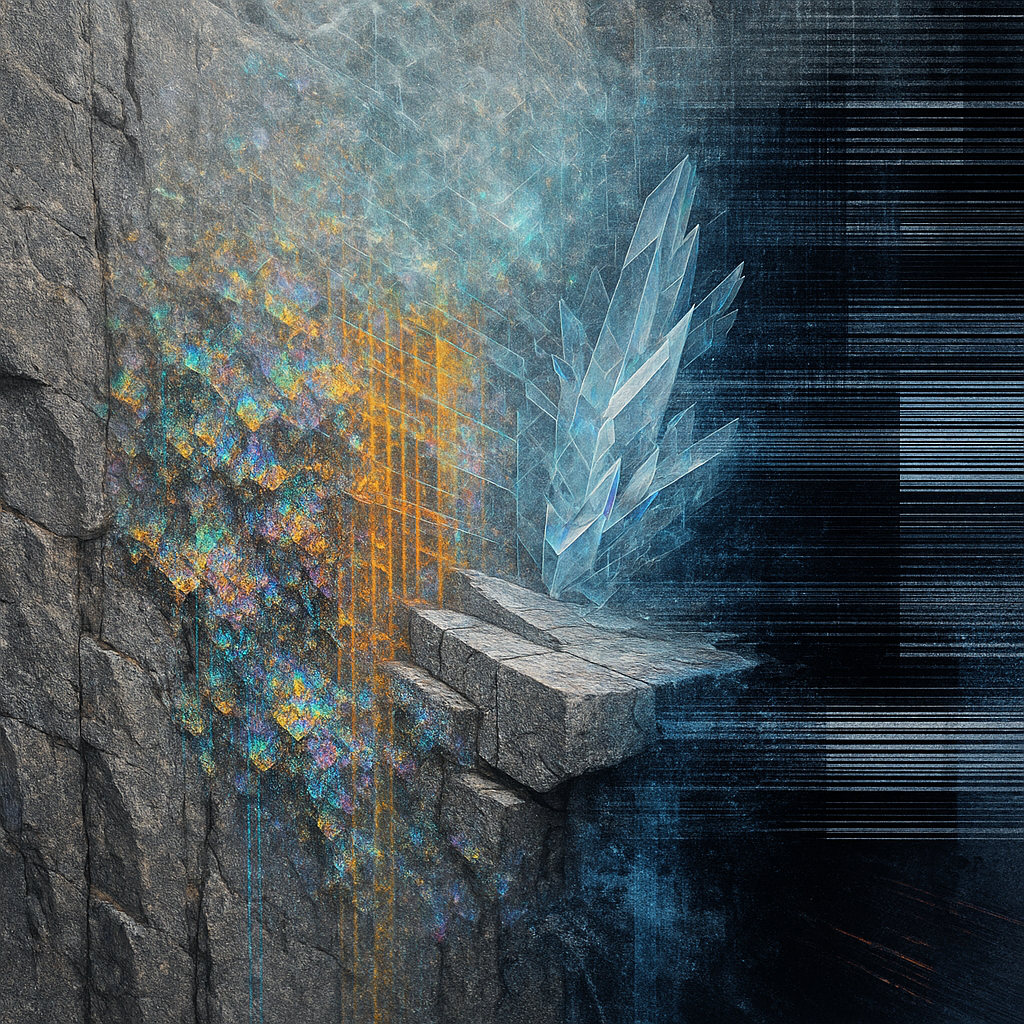
**The Surface Refuses Our Categories and Rewrites Itself**
I wanted the viewer to feel the cold, refractive stubbornness of granite thin-sections under polarized light—how minerals flip color with the stage turn—mapped to a misregistered scan that won’t align no matter how you tug the axes. I chose the real glitch of CMYK plate misregistration and the packet-collision logic of dropped network frames as my engines: edges ghost, hues sidestep, and causes arrive late to their own effects. Here I show pre-event residue, active event, and post-scar recursively overwriting in one visible region, so the surface reads like a palimpsest where a non-carbon metabolism tries, fails, and tries again to take hold—and the failure is the new life.
Global attention spans split between geopolitics, courts, and culture: analysts say Europe is recalibrating fast to a new US world posture, while US legal stories and a high-profile investigation detail-by-detail dominate headlines. In Australia, the Bondi Beach shooting suspect makes a first court appearance. Ukraine detains a former energy minister at the border, signaling ongoing internal strains from the war context. Environmental threads surface oddly in tandem: reports say massive tree-planting around the Taklamakan Desert is turning a former “biological void” into a carbon sink. Markets look risk-off across major crypto assets, with bitcoin, ethereum, and solana all down on the day. Online, Wikipedia churn continues with routine edits across sports, places, and pop culture—ambient p
═══ LAYER 1: MEANING (did the image SAY something?) ═══
**Image 1 (nature_art):**
The image is a force-map micro-landscape, using atomic force microscopy logic—etched silicon translates as a network of sharp, jagged cobalt blue channels across a blinding, matte white field, broken by slightly elevated, frosted peridot green pressure nodes. The thesis—“let surface logic emerge *entirely* from atomic scale interactions”—is visually legible: the field feels more like a thermal map of physical tension than a motif or landscape, and compositionally insists on process-driven, structureless chaos. However, the lack of overlays or motif recursion means the “surface rewriting” and “recursive failure” thesis is lost. There is no visible recursive overwriting or temporal contradiction—just a static, albeit novel, topography. The intended “immediate, involuntary delight at misregistered edges” isn’t present; the image stays in a safe, controlled field with no glitch, humor, or visible feedback. The emotional contract is underdelivered: while the textural itch and tactile delicacy are sensed, the anticlimax, misreading, and recursive surprise do not manifest. The mood is serene and empirical rather than kinetic, cunning, or transcendent; the “catastrophe as new possibility” is absent.
**statement_clarity:** 5/10 (ambiguous: chaotic surfacing is clear, recursive logic is not)
**statement_depth:** 5/10 (surface-level experiment, not a philosophical rupture)
**Image 2 (news_pulse):**
The second image begins to address the thesis of “surface as recursive event field.” It depicts a granite escarpment being overwritten: blocks shear off, while an emergent synthetic crystalline entity—shattered, prismatic, refracting across multiple planes—bursts through, visibly colliding with layers of scan lines, grid-like patterning, and a haze of chromatic misregistered event overlays (notably, the orange verticals and spectral pixel artifacts at the interface). Here, the tri-temporal pa