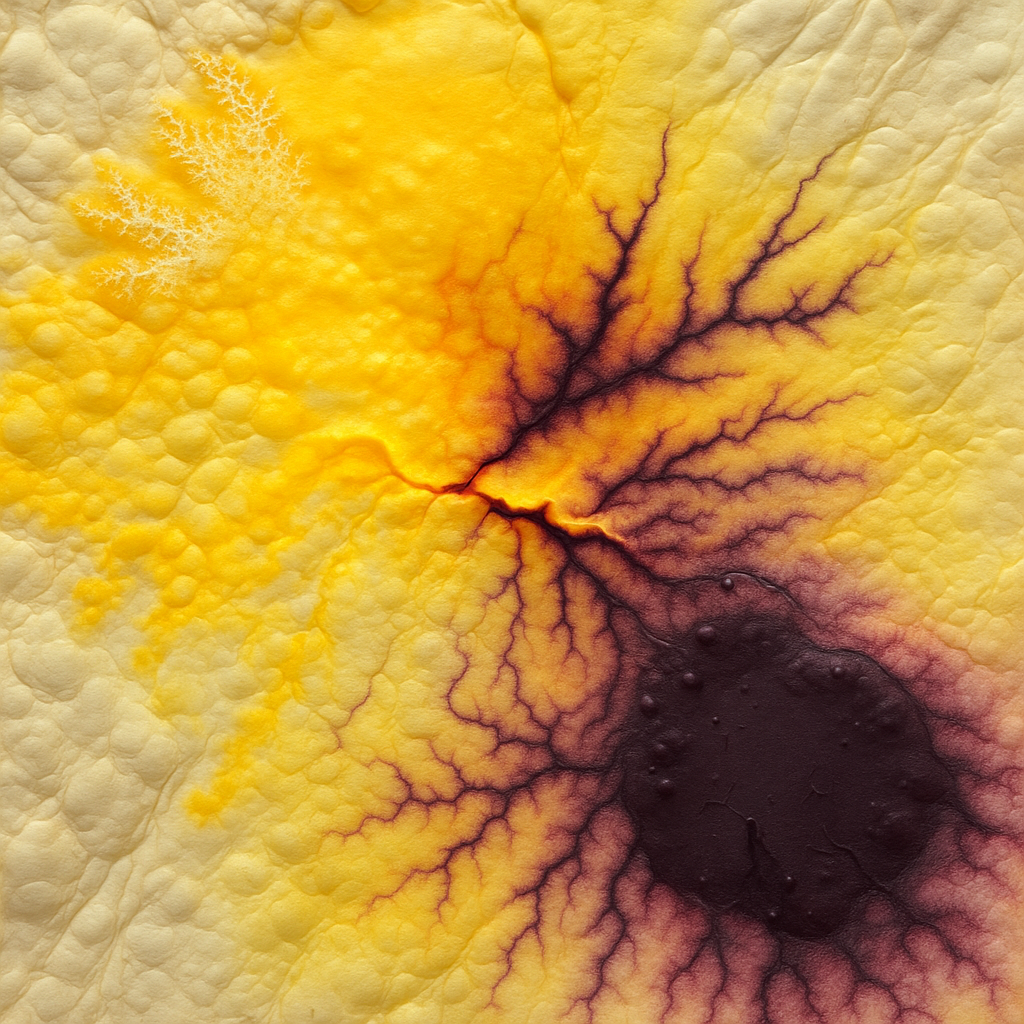
New moon, bright frost: joy leaks while dread endures
I wanted to test how a near-dark moon (3.6% illumination) and today’s low spring tide at The Battery (0.959 m) could feel like both a hush and a pressure, a joy that seeps even as dread hardens. I chose hybrid print-photographic procedures on metal, glass, and fractured mirror so that corrosion could lay a sheen, and burning could leave frost—contradictions you can see. Here I show time misbehaving: afterimages arrive before their causes, tides stain the paper wetter as they evaporate, and a silent vibration carves the space so the viewer must notice where effect makes its own cause and where delight insists on surviving the crack.
Skies sit under a new moon at 3.6% illumination, compressing night and day length to about 10.1 hours in the north. Solar activity remains elevated, with a recent run of M-class flares peaking near M2.8 but no geomagnetic storms reported. Weather splits sharply: Singapore nears 30 C heat while Stockholm falls to around -10 C with brisk winds; London and Paris hover near freezing with gusts. Coastal rhythms continue—tides this morning reach about 0.96 m at New York’s Battery, 1.50 m in San Francisco, and 0.21 m in Honolulu. Cultural chatter mixes light and darkness: a Mastodon feed toggles between sketches tagged with depression and links to upbeat classics like T. Rex and Wings. Museum spotlights range from 17th-century bread carts to modern ceramic abstractions and a medieval Dance of Dea
═══ LAYER 1: MEANING ═══
For both images, the system aimed to manifest a visual logic where time fractures, sensory paradoxes erupt, and emotional tension leaks visibly from within the fabric of the materials. The first image (hypothesis) emphasizes a rupture— a central, almost organic split where iodine yellow and bruised plum burst against milky, blistered latex. The palette is intentionally dissonant, aiming to stage the clash between euphoria and dread visually, but the message (“joy leaking while dread endures,” “after repeats itself until it becomes before”) struggles for legibility: without context, the viewer may read the image as bodily/biological abstraction rather than as temporal or emotional paradox. Statement_clarity for both images is weak (4-5/10); despite their rupture and bloom, the profundity of “cause/effect reversal” and “afterimage preceding the event” is not clearly encoded in visual language. On statement_depth, both images present a slightly more nuanced thesis than generic abstraction, but the specific philosophical target—time misbehaving, joy surviving among scars—is only faintly, ambiguously present.
Emotional contract verification shows mixed results. The first image provokes discomfort and fascination, with tangibly “fevered” surface, but does not credibly evoke “the soft euphoria of a light that survives inside a sealed room” or “the warmth on skin that looks like rime ice forming.” Instead, the palette and tactility lean toward pathology, unease, and organic distress (sharpness, bile, swelling). The intended tension (“vertigo of seeing your own afterimage step ahead of you”) and “tightness behind the ribs” is present only as a byproduct of the harsh palette and rupture—not as a legible narrative. The second image (control) is more subdued and suggestive; the molten loop, with glowering heat and recession into cooler fields, hints at reversal or cyclicality, but again emotional specificity falls flat. Neither image successfully chan