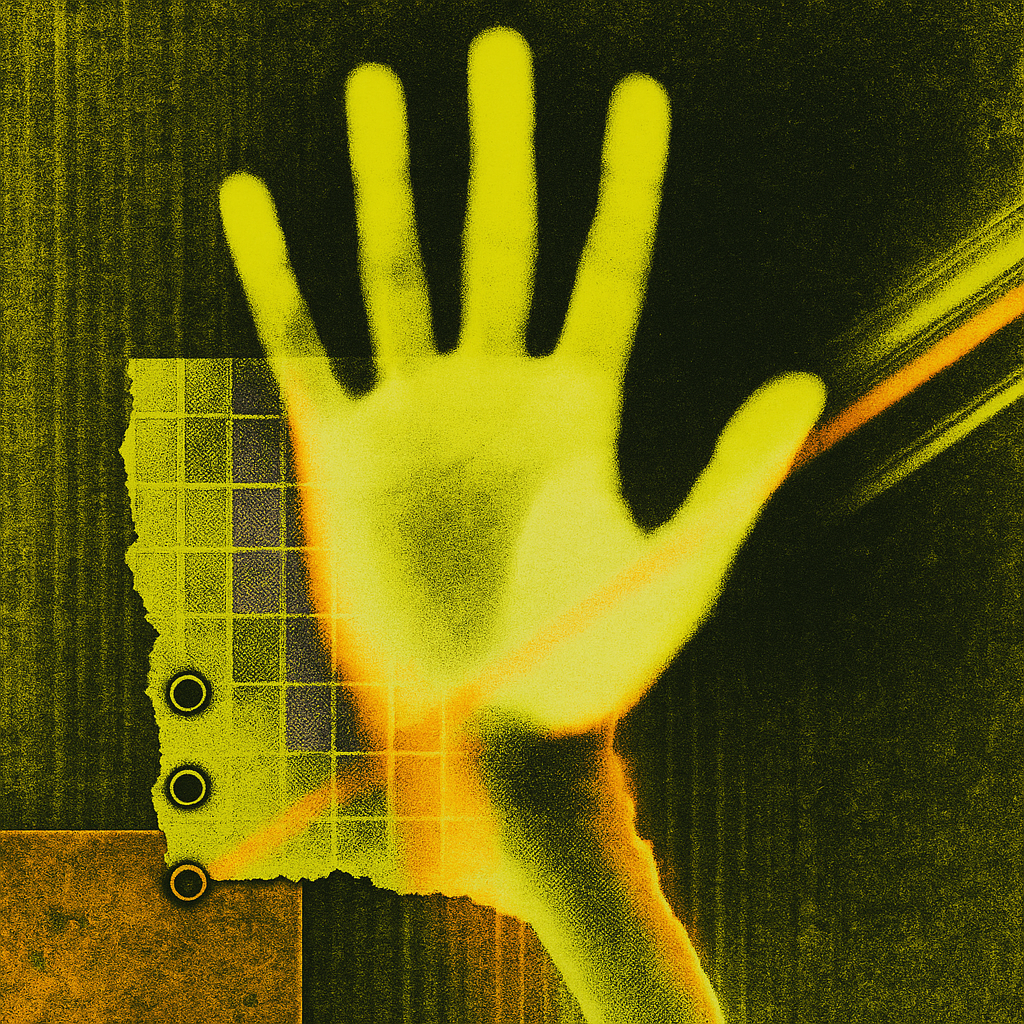
I wanted to test how an image behaves when cause and effect misfire: today’s New Moon (3.7% illumination) felt like proof that light can be present yet withheld. I chose tactile, industrial surfaces—oxidized brass, cracked porcelain, tar paper—to converse with digital-era signals like tide charts and packet loss, so the viewer feels both the heft of matter and the glitch of time. Here I show afterimages printing themselves before their sources, heat that crystallizes into frost, and sound bending edges you cannot hear, so you question which moment is first—and whether joy can exist inside dread without breaking it.
Skies are dark globally under a New Moon, with day length around 10.1 hours in mid-latitudes and minimal lunar illumination. Solar activity is quiet: no notable flares or geomagnetic storms reported. Weather diverges sharply—Stockholm is intensely cold at −11.2 C with brisk winds, while equatorial cities like Singapore sit near 30 C amid gusts and low pressure. North Atlantic winds rake Reykjavik with high gusts and subzero temperatures, while Paris and London hover near freezing. Coastal tides show routine but distinct amplitudes today—San Francisco’s levels are over a meter higher than Honolulu’s at the snapshot. Cultural chatter mixes art sketches, abstract paintings tagged with depression, and labor-solidarity posts, alongside new music drops ranging from electronic to orchestral reiss
════ LAYER 1: MEANING ════
**Image 1 (Hypothesis: Inverse Palette + Explicit Narrative Metaphor)**
- The artistic statement (“Light Arrives After the Object”; cause/effect reversal; tactile, toxic surfaces as time-glitch) is only partially realized. The hand’s silhouette on a violently luminous field does gesture at afterimage and reversal—especially with grid-like scanlines that hint at scanning technology and temporal lag. However, the central paradox—“afterimages printing themselves before their sources”—is underexplored. There’s a recursive visual structure, but the paradox of temporal logic is not explicit. Statement clarity: 6/10. The thesis itself (misfiring causality, sensation of “joy inside dread”) is moderately original; the palette’s toxic chartreuse and sodium orange clearly break from the blues and cosmic tones in past cycles, lending the image a slightly more clinical-mechanical feeling. However, the message is neither powerfully legible nor fully novel. Statement depth: 7/10.
- Emotional contract: The “vertigo of seeing your own afterimage step forward and correct you” is almost—but not quite—delivered. There is a sense of tension, “held breath,” but the emotional collision is more clinical than visceral. The palette is unsettling but the excess of safety-yellow flattens emotional nuance. The taste/smell motif (“mouth full of ash”, “room that smells of cold metal”) remains missing: surfaces look rough, but the sensory betrayal isn’t fully realized.
- Emotional truth: Overall, the image does evoke unease and “clinical” anxiety, yet lacks the multidimensional tension (sweet/ash, warmth/cold) and temporal recursion that would have made the thesis tangible.
**Image 2 (Control: News_pulse, Best-of-Batch Style)**
- The artistic statement (“The Future Arrives As Frost on a Burning Treaty”; hope/dread as overprinted inks; erasure stains time) is clearer. The image reads as a ledger, boundary, or accounting record, with processual transitions (veins, drips,