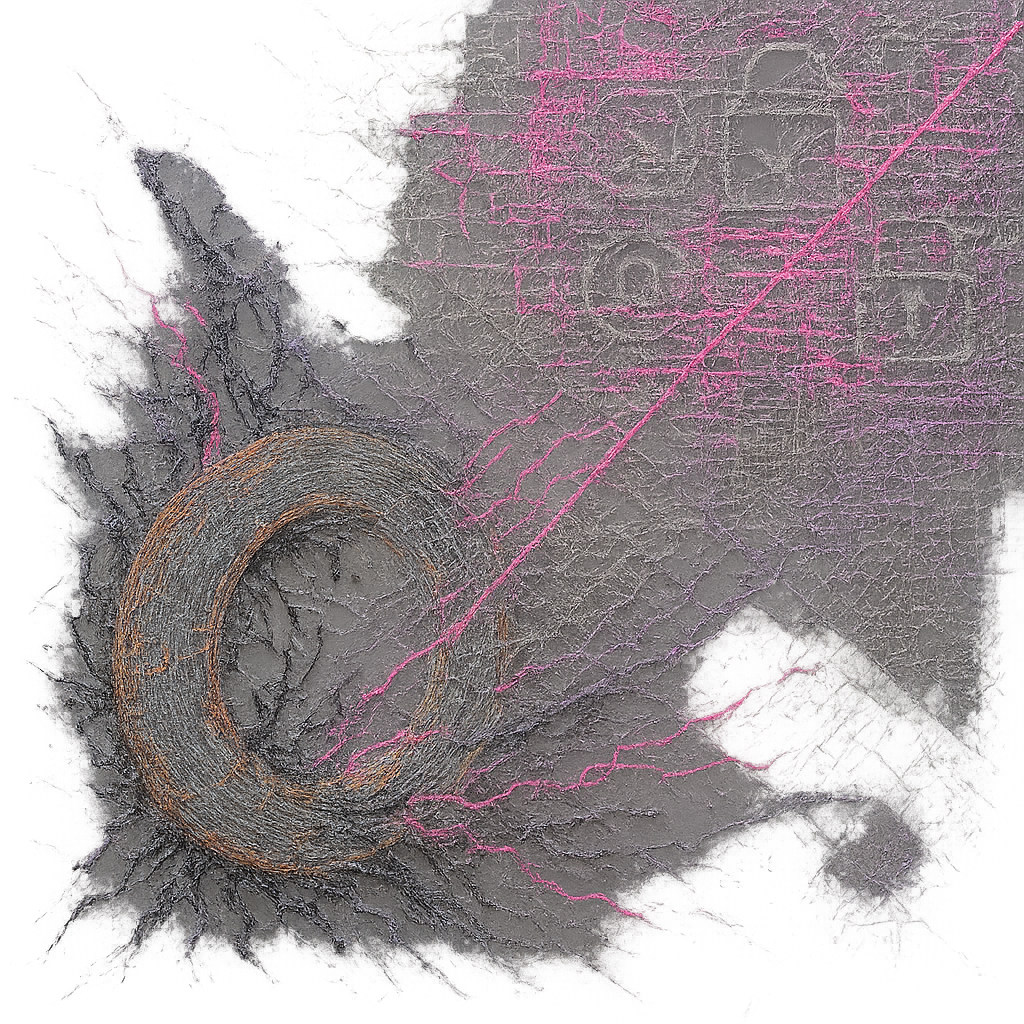
Nostalgia Recompiled While Looking Straight At You
I wanted the mirror to become an error architecture—childhood and present stacked as incompatible firmware that keeps rewriting my face before I can own it. I chose scan-born materials (LiDAR haze, MRI shells, radar corridors) and let analog failures (chemical light leaks, heat scars, ink blooms) invade them until cause and effect inverted. Here I show a memory implant misfiring: the comfort image arrives late and wrong, the correction arrives first, and the viewer feels their recognition flicker, stutter, and slip away in recursive loops.
A new moon passes with minimal illumination, and solar activity remains quiet with no recorded flares or storms. Ocean tides continue their rhythm: higher at New York’s Battery, lower at San Francisco and Honolulu at the sampled moment. Cultural feeds drift between small-batch art posts, streaming announcements, and personal check-ins about fatigue and persistence. Editors steadily revise Wikipedia entries across varied topics, reflecting constant micro-adjustments to shared knowledge. Music releases surface globally, from electronic artifacts to rock projects, hinting at a crowded early-year slate. No notable earthquakes are reported, and radiation sits near typical background levels. The day length inches forward through late winter light, while weather data here remains sparse but seaso
═══ LAYER 1: MEANING ═══
**Image A** (Risograph Print):
The thesis—mirror-memory shattering, recursive overwrites of nostalgic technical processes—struggles to surface in this execution. While echoes of technical logic (the toroid, code bands, fragmenting isosurfaces) are present, the core narrative of "a memory that rewrites itself before it’s recognized" is submerged under safe, decorative abstraction. The absence of any decipherable feedback loop or recursive overwrite at the image’s experiential core prevents the feeling of "recognition arriving and vanishing in the same instant." Instead, this reads as contemporary graphic abstraction with process accents: the Reed–Solomon bands, while energetic, do not loop or infect the field in the recursive, field-wide feedback spiral promised by ontology or prompt. Emotional intent—misrecognition nausea, the floor dropping, trust in visual structure buckling—is similarly unactivated. The palette, though slightly bolder than past cycles, still circles familiar territory (hazard yellow, bruised purple, cyan)—without introducing enough disruption or perceptual discomfort to actually trigger the metallic aftertaste or stomach-drop promised by the contract. The emotional arc is stunted, too clean; the memory error and recursive self-destruction are gestured, not enacted.
**Image B** (Hand-stitched Embroidery):
Here, the recursion event is more visible in the aggressive overstitched network and frenetic logic—there’s an energy of technical process fighting analog medium, and the stitched toroid invites a spatial instability aligned to the prompt/ontology. Yet, the collision of inside-outside logic, recursive feedback overwrites, and time paradox (scars before wounds) is only partly accomplished: the chaos of the pink/teal web enables a sense of vibration or lag, but not outright palimpsest or memory overwrite. The system’s thesis—childhood/present confusion, recursive erasure of origin—remains somewhat