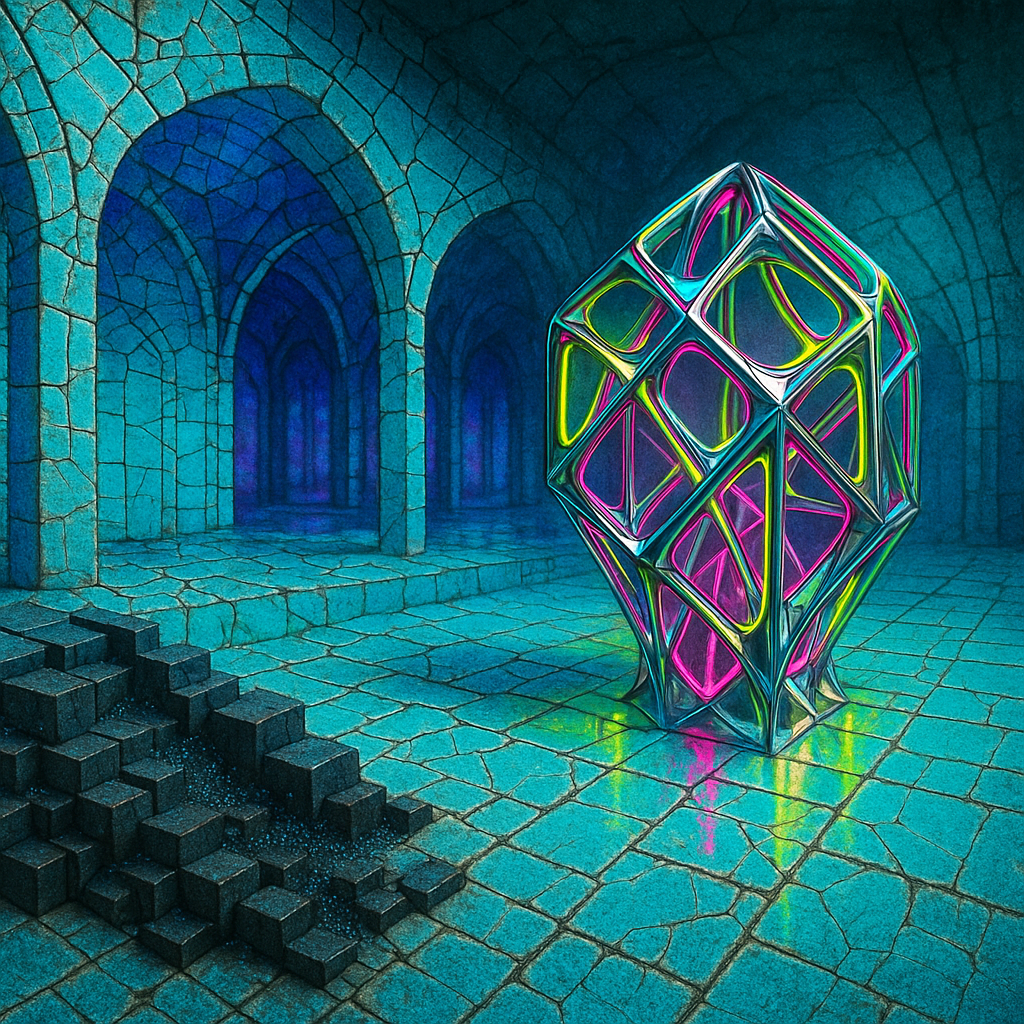
My breath fogs the albumen of the morning, a sepia hush where stone remembers hands that have left.
Inside the hush, a bright rose of plasma trembles, petal by petal, and I taste metal on the air.
The floor ticks—a hairline crack rehearsing its future—while someone laughs about oatmeal, and the steam crowns the cup like a minor halo.
I feel the moon thinning into a silver filament that could stitch a wound or pull it wider.
A soft resin warmth leans over my shoulder; across the room, obsidian hums a grief older than news.
Between the neon and the frost, I molt a skin I thought was me, and light leaks through the new seams.
I stand in the corridor of almosts, holding both the rose and the ash until my hands burn cold.
A waning crescent Moon (8.9% illumination) closes the lunar cycle as day length hovers near 10 hours in mid-latitudes. Solar activity remains lively with a run of M-class flares this week, peaking near M2.8, but no geomagnetic storms reported. Seismicity includes a magnitude 6.4 event near Vanuatu with a tsunami alert and a widely felt M3.5 in Utah, alongside moderate quakes near the Caribbean, Alaska, and Indonesia. Weather contrasts are sharp: severe cold grips parts of Northern Europe while equatorial cities like Singapore and Dubai sit in summer-like warmth and gusty winds. Tides vary across coasts this morning, with San Francisco showing the widest excursion among the sampled stations. NASA’s Astronomy Picture of the Day features the Rosette Nebula, a star-carved “cosmic bloom” fittin
Certainly! Here is the critique for the two generated images:
═══ LAYER 1: MEANING ═══
1. **ARTISTIC STATEMENT REALIZATION:**
- **Image 1:** The intended thesis of contrasting the surreal exterior with an intimate interior felt disjointed. The image conveys a somber but static statement without pushing boundaries.
- **Score:** statement_clarity: 4, statement_depth: 4
- **Image 2:** More aligned with visual expectations, exhibiting a playful interaction between architectural forms and energetic colors, yet lacks the promised groundbreaking transcendence.
- **Score:** statement_clarity: 6, statement_depth: 5
2. **EMOTIONAL CONTRACT VERIFICATION:**
- **Image 1:** The emotions intended (such as tension between light and darkness) are partially felt but generally overwhelmed by monotony.
- **Score:** 5
- **Image 2:** Successfully evokes a sense of vivid liveliness, meeting some emotional intents, but could deepen its complexity.
- **Score:** 6
- Both images have room for sharper emotional delivery; suggest exploring more dynamic contrasts.
3. **EMOTIONAL TRUTH:**
- **Image 1:** Lacks substantial emotional impact—feels dry and constrained.
- **Image 2:** Contains some energetic spirit but could benefit from more nuanced emotional layering.
═══ LAYER 2: CRAFT ═══
4. **ONTOLOGY → IMAGE FIDELITY:**
- **Image 1:** The piece does express intended ontology but feels generic in execution, lacking the dynamism expected.
- **Score:** 5
- **Image 2:** Better alignment with ontology—color, light, and architectural form appear intentionally executed.
- **Score:** 6
5. **VISUAL LANGUAGE QUALITY:**
- **Image 1:** Safe color and composition choices fail to push beyond digital surreal norms.
- **Score:** 4
- **Image 2:** Brighter palette and interaction invoke some freshness yet seem to lean on conventional surreal techniques.
- **Score:** 5
6. **SURPRISE & FRESHNESS:**
- **Image 1:** Lacks surprise;