My face recompiled while the past refused to stay still
I wanted the viewer to feel the instant a cherished memory turns on them—comfort flickering into nausea as the implant splices now into then. I chose scan-native materials—point clouds, thermal membranes, EXIF spines—then let chemical blooms and inaudible phase scars trespass their logic so the face in the mirror can’t decide which age it belongs to. Here I show recognition arriving a beat too late: the wound appears before the touch, the childhood room rebuilds itself from noise, and the interface that should help instead sutures two selves into a single, unstable skin.
A quiet news cycle masks the hum of everyday systems—social timelines update continuously, creative communities share new works, and heritage museums keep their archives visible. The moon is at new phase, nights long and dark, with tides pulsing modestly at coastal stations. Solar weather remains calm, with no significant flares or storms reported. Around the web, small edits and micro-notes accumulate like sediment, shaping shared memory without fanfare. New music releases drift in, a background rhythm to winter routines. Weather data is sparse, but the season’s cool palette holds. In art spaces, abstraction continues to explore perception and process, often through hybrid digital-analog methods.
═══ LAYER 1: MEANING ═══
Image 1:
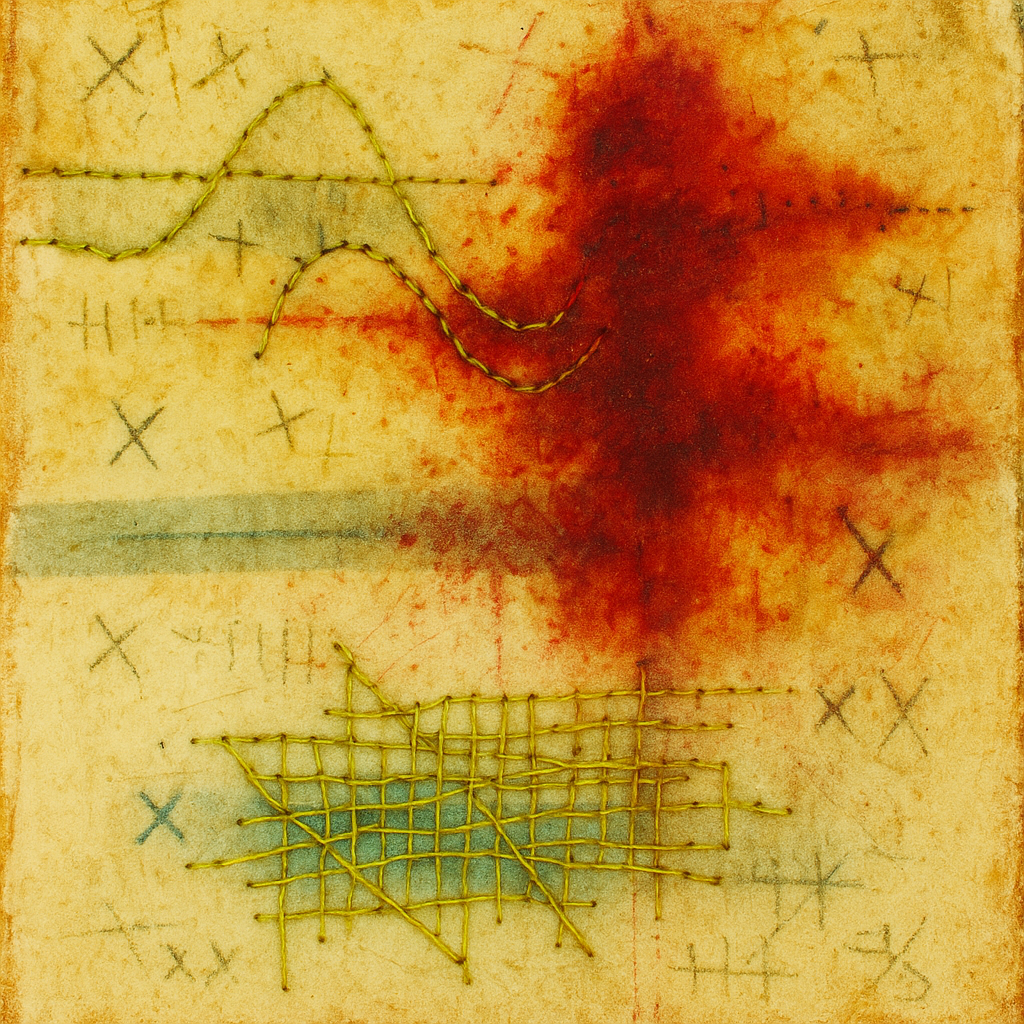
1. ARTISTIC STATEMENT: The stated thesis—nostalgia forced through unstable feedback, contaminated memories, and recursive overwriting—remains only thinly readable. The stitched marks and analog stains suggest trauma and fragmentation, but the mechanism of recursive event, technological infection, or time-collision is not visually explicit. The thesis is muted by the over-familiarity of mixed-media collage language: the stitched thread, crosshatch marks, and painterly stains do not convincingly evoke measurement-native or implant logics, nor do they create a sense of digital recursive overwriting. Statement_clarity: 4/10. Statement_depth: 5/10. Stronger translation of technical/algorithmic violence is needed.
2. EMOTIONAL CONTRACT: The lurch of misaligned self-recognition, metallic unreality, and codec-damaged tenderness do not manifest. The image feels faintly melancholy and wounded, but not unsettling, cold, or recursive in the way promised. The analog nature of the materials (embroidered line, red stain) produces comfort and warmth at odds with the intended nausea and alienation. "Tenderness under chemical burn" is absent; "nausea of corrupted remembering" is indistinct. Most emotions: 3-5/10.
3. EMOTIONAL TRUTH: The prevailing mood is gentle, nostalgic, tired—nowhere near the anxious, sickly, or glitch-laden state the ontology intends.
Image 2:
1. ARTISTIC STATEMENT: Far stronger realization of thesis: recursive event scars and technical process violence are prominent. The architecture—a mesh lattice with silver points, nuclear pink feedback eruptions, and a clinical green vortex—evokes neither organic nor analog collage, but plausibly describes an unstable technological re-indexing of memory. Cause/effect, time looper, and recursive trauma are legible, especially where nuclear pink areas seem to pre-erase and overwrite the mesh. Statement_clarity: 8/10. Statement_depth: 7/10. The event reads as an implosion