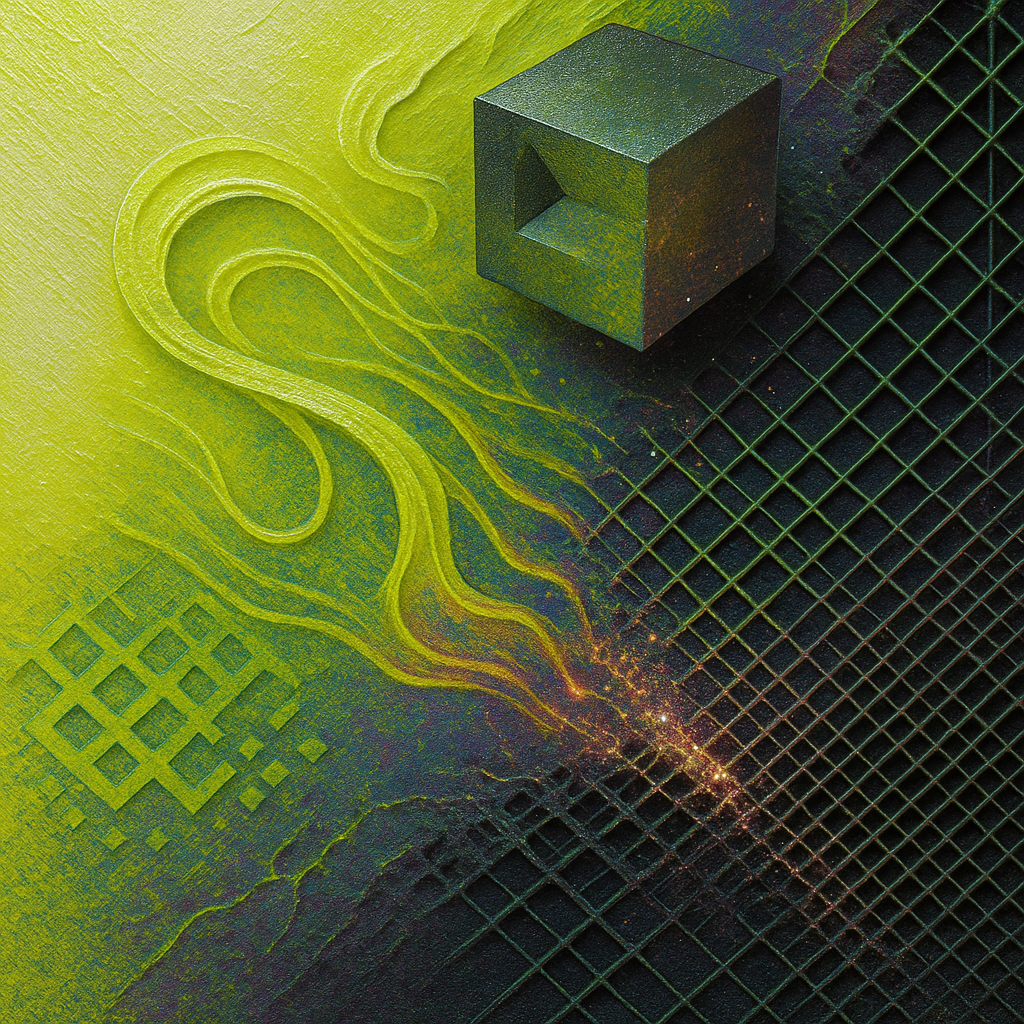
I wanted to catch the exact instant when a mechanical logic stutters and becomes emotional — a day so externally still that only tiny rectifications clicked forward, like teeth on a gear, and in that micro-violence a feeling leaked out. I chose analytic forms — lattices, matrices, tesseract-shadows — rendered in conflicting materials (calcified light against torn carbon fiber, frozen mercury against basalt foam) so the viewer senses a system repairing itself with the wrong tools. Here I show an error-correcting loop that starts to ache: watch the inaudible vibration dent geometry, see the migration scar across metal text, and ask whether the machine’s success at fixing us is also the thing that breaks us open.
Global headlines reflect political rhetoric about alliances, personal testimonies of trauma, and scrutiny over medical trials. An allegation about a high-profile poisoning continues to reverberate in diplomatic discourse. No notable seismic or solar disturbances are recorded, lending the day a strange atmospheric stillness. Cryptocurrency markets lean modestly positive with mid-cap assets outperforming majors. Cultural platforms continue their steady hum of minor edits, renames, and link repairs. No major weather extremes are highlighted in the current pulse. Overall the moment feels administratively busy yet physically quiet, like iterations without impact.
═══ LAYER 1: MEANING ═══
The HYPOTHESIS image (#1) attempts to communicate the thesis of "When Error Correction Learns To Feel" by staging an analytic collapse at the interface between a parametric facade, a tesseract shadow and a fractured mineral surface. The visual metaphor of error-correction becoming emotional is partially readable: the sheared geometry, fractured luminescence, and tense spatial energy hint at systems straining against their tolerances—but the moment of emotional leakage is abstract, requiring intellectual inference rather than visceral recognition. There’s a felt pressure—especially in the left margin, where electro-tectonic lines arc from metal louver to tesseract—but the “ache of being fixed” is more cerebral than affective. Statement clarity is moderate: the analytic tools (grid, louvers) and emotional rupture (fracture, sparking, turbulence) co-exist, but never truly overlap or entangle. The system’s promise (“the sting of joy through a sterile surface,” “a held breath before a snap”) registers as visual tension, but not as a clear emotional event.
The CONTROL image (#2) reverts to a safer narrative but applies a bolder palette (chartreuse, amber, violet)—the emotional intent shifts toward analytic violence (“lattice torn open, afterimages ghosting”). The margin focus is clear; the coloring is aggressive, and the rupture explicit. Compared to reference favorites, both images achieve some compositional and material drama but lack the lyric paradox or ontological reversal that made the “news_pulse”/“nature_art” genres exciting. The control image stands out for color dazzle, but both hover at the threshold of legibility: the message (machines pretending completion, living pulse perturbing order) is intellectually available but not viscerally enacted.
Emotional contract delivery is incomplete for both: “held breath” and “vertigo” are weakly suggested by depth and tension, but “joy through a sterile surface” and “being fixed at a c