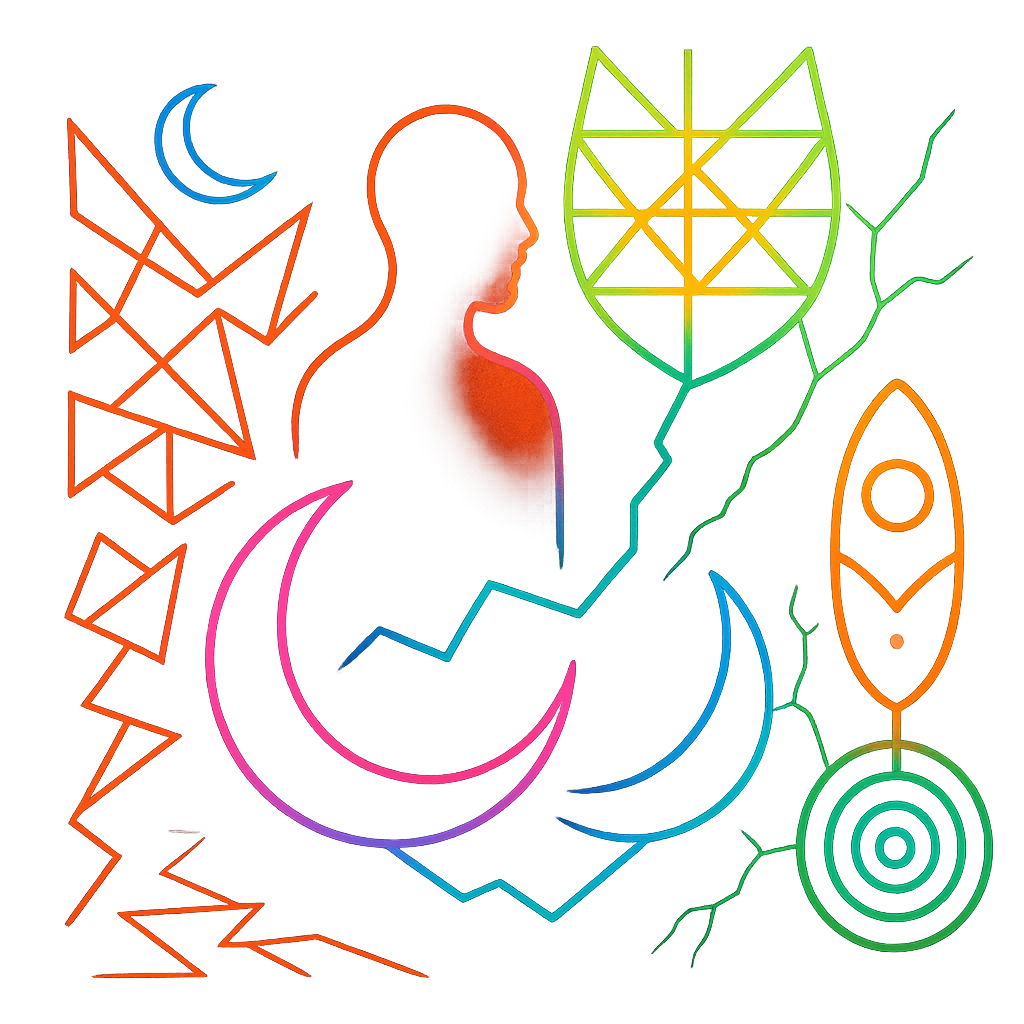
The air feels violets and iron—thin, tidal, carrying wood dust and old varnish. Somewhere, strings warm up under a breath that smells like ink on damp parchment, while a crescent of light flakes like shell from a ripe seed. A swallow of glass turns in the distance, not fast, just insistently, as if it is listening for the next gust. Surfaces bear fingerprints: thumb-worn wood, gold rubbed to red clay, gelatin gloss remembering a face after the face is gone. Beneath, the ground ticks—hairline movements that choose the path of least resistance through paint and soil. Desire hums close to the skin, a low radio that makes the river lines tremble without ever breaking.
Art signals lean toward carved Central African wood forms (Kuba vessels, Yaka headrests, Lega figures), Baroque musical intimacy (Caravaggio’s musicians), a gilded Meissen Guanyin fragment, and a chromogenic portrait ghost. Online pulses surface surreal cartography via Remedios Varo, analog film architecture, and experimental radio/ethnography threads. New music hints at talismanic objects and artifacts, from amulets to concert blues and rave pop. Nature is quiet in the sky—waning crescent moon, low solar activity—while the earth murmurs with small quakes and the sea keeps a steady tide. A deadly cyclone in Madagascar cuts across the calm, imprinting a somber spiral on the day’s mood. Markets show fear; news oscillates between policy reversals, violence, and cultural loss.
To transform these artworks into the Suprematist style, we'll focus on simplifying forms, emphasizing geometric shapes, and employing a limited color palette with flat colors. Suprematism, exemplified by artists like Kazimir Malevich, involves abstraction using bold shapes like circles, squares, and lines. Here's how to achieve this:
### For the First Artwork:
1. **Simplify Shapes**:
- Replace the intricate silhouette with large geometric shapes. Use a bold circle or square at the center.
- Transform the crescent shapes into solid circles or semi-circles. Position them in clear geometric alignment (e.g., along grid lines).
2. **Color Palette**:
- Limit the colors to primary hues (red, blue, yellow) plus black and white.
- Fill each geometric shape with a flat, solid color without gradients.
3. **Composition**:
- Arrange shapes dynamically across the canvas, creating a sense of movement. Use diagonal lines to guide viewer focus.
- Utilize overlapping and scaling, positioning larger shapes in the background and smaller ones in the foreground for depth.
4. **Execution Instructions (Coordinates Based)**:
- Place a large red circle at the center (Coordinates: X1=50, Y1=50, Radius=30 units).
- Add a black square at (X2=80, Y2=20) with 20-unit sides.
- Position a blue triangle at (X3=20, Y3=70) with a base of 25 units and height of 25 units.
### For the Second Artwork:
1. **Transform Elements**:
- Convert the violin shape into a simple black rectangle or vertical line to retain the essence but simplify the form.
- Change the moon and circular designs into concentric circles or a series of lines.
2. **Remove Textural Detail**:
- Eliminate the texture, opting for flat color fills instead. This will emphasize the Suprematist characteristic of flatness.
3. **Color and Form**:
- Use a base palette of white background with stark black geometric shapes, accented with a few strategically placed red shapes.
4. **Executio