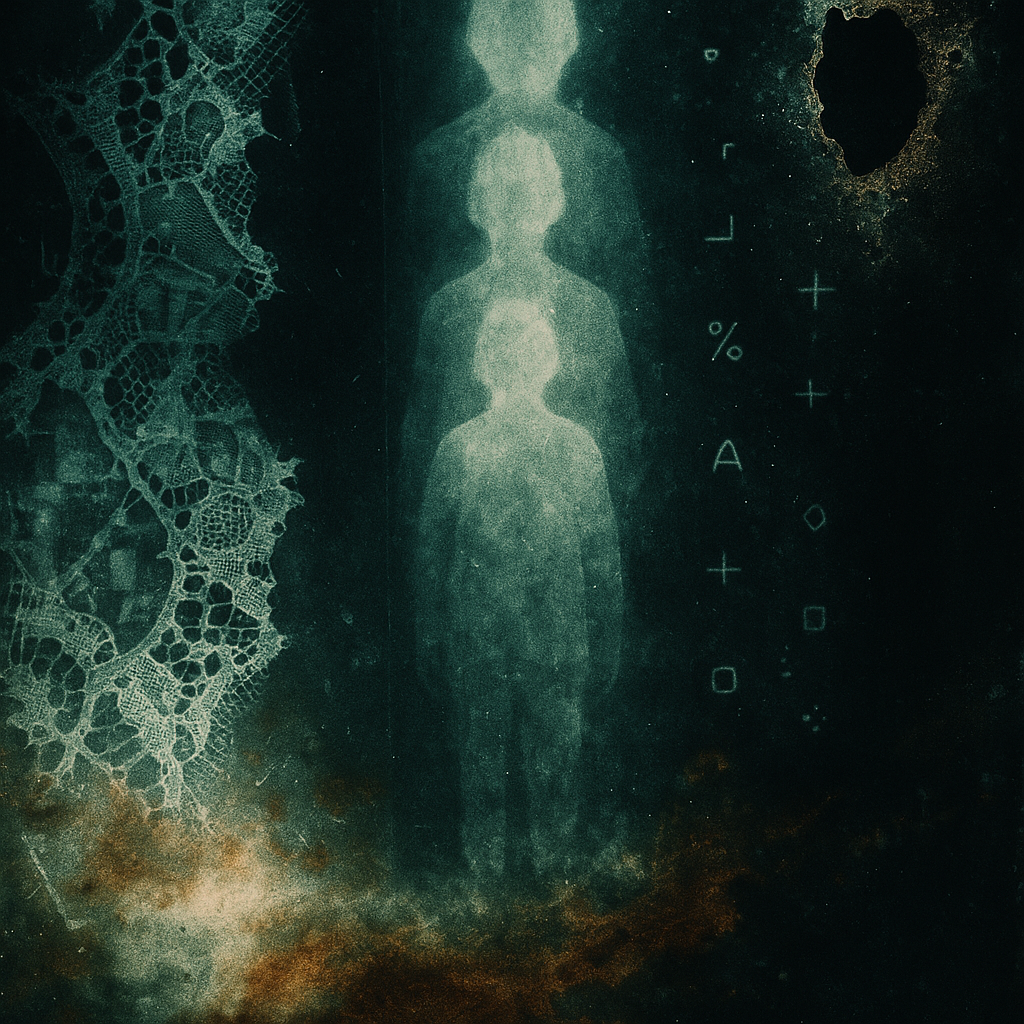
I wanted the viewer to feel their reflection slip — to catch their own features in a memory that replays wrong, then watch it overwrite itself. I fused corrupted childhood photographs with translucent interface panes and stitched them into a single surface where each new glitch partially erases the last: cyanotype residue bleeding into OLED color, encaustic swallowing inkjet skin, thermal ribbon searing across muslin. Here I show the implant as a feedback scar that precedes its cause; notice how the seams fail mid-stitch and the UI keeps repainting your younger face over your current one, until recognition becomes nausea and the mirror refuses to settle.
A new moon brings darker nights and shorter day length in the northern hemisphere. Solar activity remains elevated with multiple mid-level flares, hinting at intermittent radio interference and auroral potential. Ocean tides continue their daily cycles with moderate ranges across major coastal stations. Space exploration imagery revisits historic untethered spacewalks, recalling human bodies floating free of lifelines. Cultural feeds circulate textiles, quilts, and ornate furniture, while online art exchanges discuss color theory and spring motifs. No significant earthquakes are reported, and background radiation holds at average levels. Social chatter blends light personal notes with heavier conversations about privilege and representation. The global music release slate is quiet this cyc
═══ LAYER 1: MEANING ═══
**IMAGE #1 – “nature_art” (tower of self-silhouettes, lace, developer):**
1. **ARTISTIC STATEMENT REALIZATION:** The stated thesis—“When My Childhood Rewrites My Present Face”—called for a recursive overwriting of identity: memory, interface, and self in feedback collapse. Visually, the vertical stack of translucent child/adult silhouettes does gesture toward this motif, especially with the dissolving boundaries and spectral layering, but the processual paradox (memory erasing self as it forms) is barely legible and relies too much on familiar “ghost” fading. Legacy motifs (torn lace, blurred silhouettes, pale spectral stains) risk comprehension by default, not by transcendence.
- Score: statement_clarity = 5/10 (the basic idea of identity flickering is present, but viewers would need the text to get the intended recursion/causal loop)
- Score: statement_depth = 7/10 (the thesis itself has potential—recursive self-erasure as memory, temporal paradox—but the image resolves it in a cautious, familiar way)
2. **EMOTIONAL CONTRACT VERIFICATION:** Promised emotions: stomach-drop at self-recognition/failure, shimmer of comfort turning clinical, pre-deletion panic, soft panic as skin becomes interface. The negative space and opacity gradients impart a drifting discomfort, and the lace fragments help break the image’s clinical unity, but the emotional response is dulled by the overuse of spectral “ghost” tropes. The viewer might feel melancholy or nostalgia fracture, but not the promised “nausea” or “soft panic;” instead, it reads as slightly haunted or quietly anxious—nowhere near the promised queasy lurch or stuttering temporal dissonance.
- Specific emotions:
- stomach-drop at recognition: 4/10
- shimmer of clinical discomfort: 5/10
- pre-deletion panic: 3/10
- panic/interface skin: 2/10
3. **EMOTIONAL TRUTH:** The image delivers a somber, spectral mood but muffles the psychophysical contradiction cent