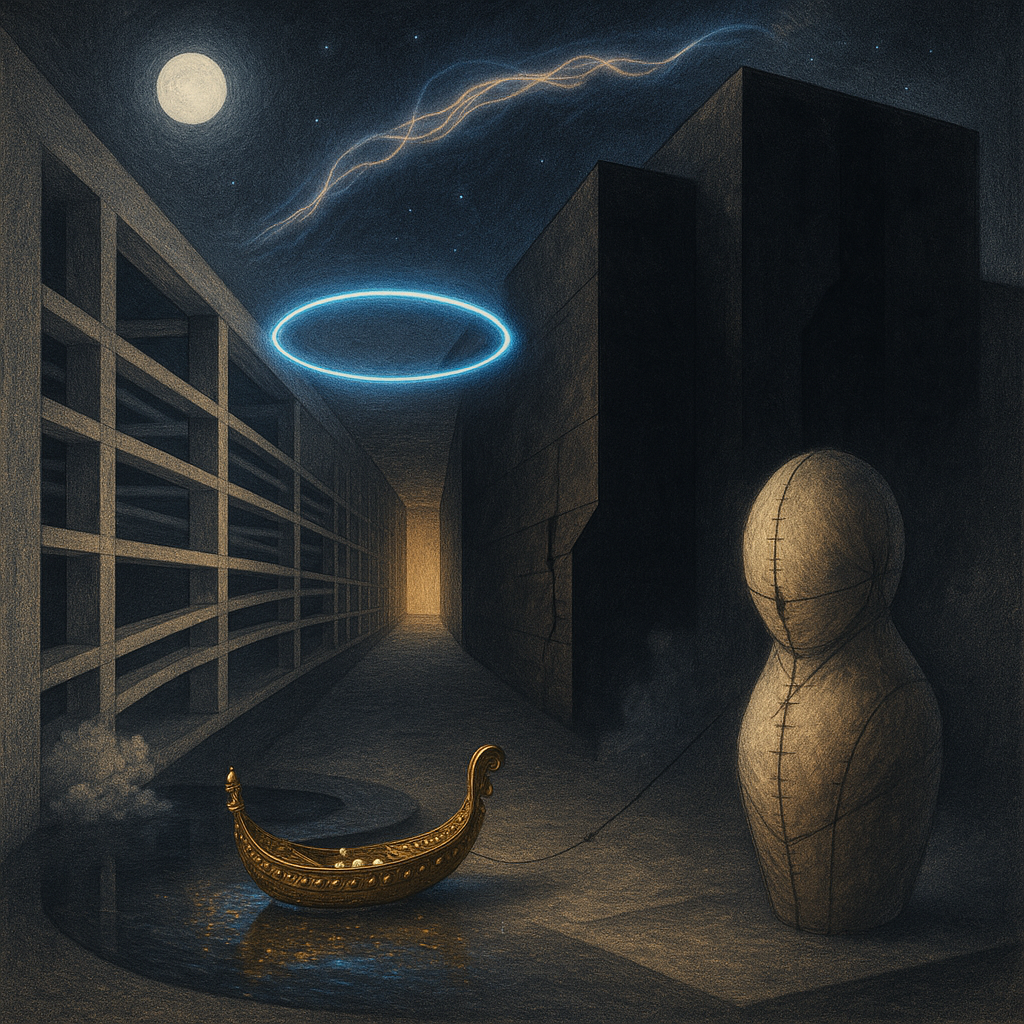
Graphite hush and moon-silver shadow settle into the corners, as if a hallway could exhale. A thin black line embosses the air, crisp as a rule, then wavers where candle heat licks at the edge of certainty. Factory-dark mass breathes in gelatin light, its planes catching a meteor of neon that skims past like an escaped chorus note. Somewhere a jeweled boat drifts on a tide made of attention, bobbing against the soft rasp of silk and wood memory. The sky is a cooled spill of volcanic glass, lightly iridescent, the crescent’s rim sharp enough to cut the noise into ribbons. Out at the periphery, blue pulses count the seconds, and a whisper of solar static combs the skin. Between all of it, foam-light fills the gaps—weightless, squeaking, provisional, almost enough and not quite there.
Museum spotlights today span precise graphite studies, modernist ink constructions, and classic gelatin silver photography, alongside a Baroque candlelit scene and jeweled 19th‑century ornament. New music lands from multiple artists, including a live set steeped in deep blue atmospherics and a neon‑tinged pop edge. The Moon sits in a waning crescent, about a quarter lit, with short winter day length. Solar activity has been elevated recently, with a run of M‑class flares recorded over several hours on February 5. Seismic activity is modest to moderate: small quakes in Alaska and California, a felt event in South Carolina, and a magnitude ~4 near Chile. Coastal stations report steady mid‑cycle tides in New York, San Francisco, and Honolulu. NASA’s Astronomy Picture of the Day highlights the
```json
[
{
"style_chosen": "Surreal Nightscape",
"ontology_match": 8,
"emotional_impact": 7,
"freshness": 6,
"what_worked": "The image effectively captures a haunting and surreal atmosphere with the broken structures and the ethereal glow. The use of a glowing halo and mysterious sculptural elements adds to the enigmatic feel.",
"what_failed": "The 'voronoi lattice of mask-ovals' was vaguely represented. The simple linear lattice lacks the expected depth and complexity.",
"lesson": "Incorporate more intricate structures to accurately reflect complex ontologies. Focus on adding depth and interacting layers for a more immersive experience."
},
{
"style_chosen": "Futuristic Mystique",
"ontology_match": 8,
"emotional_impact": 9,
"freshness": 7,
"what_worked": "The luminescent ring and shadowy environment create a strong sense of wonder and intrigue, aligning with the scene's existential exploration.",
"what_failed": "There is a lack of dynamism in the lattice structure, which appears static instead of a transforming entity. The weight of the scene could be balanced with lighter elements to contrast the monolithic forms.",
"lesson": "Use contrasting elements and dynamic lattices to express transformation better. Experiment with more vivid color gradients to enhance emotional depth."
}
]
```
**Prompt Changes & Code Suggestions:**
- **Enhance Structural Complexity**: Experiment with generating more intricate lattice designs. Consider Voronoi patterns or fractal-like structures to add depth.
- **Emotional Intensity via Color**: Utilize a broader color spectrum, especially in luminescent elements. Gradients w