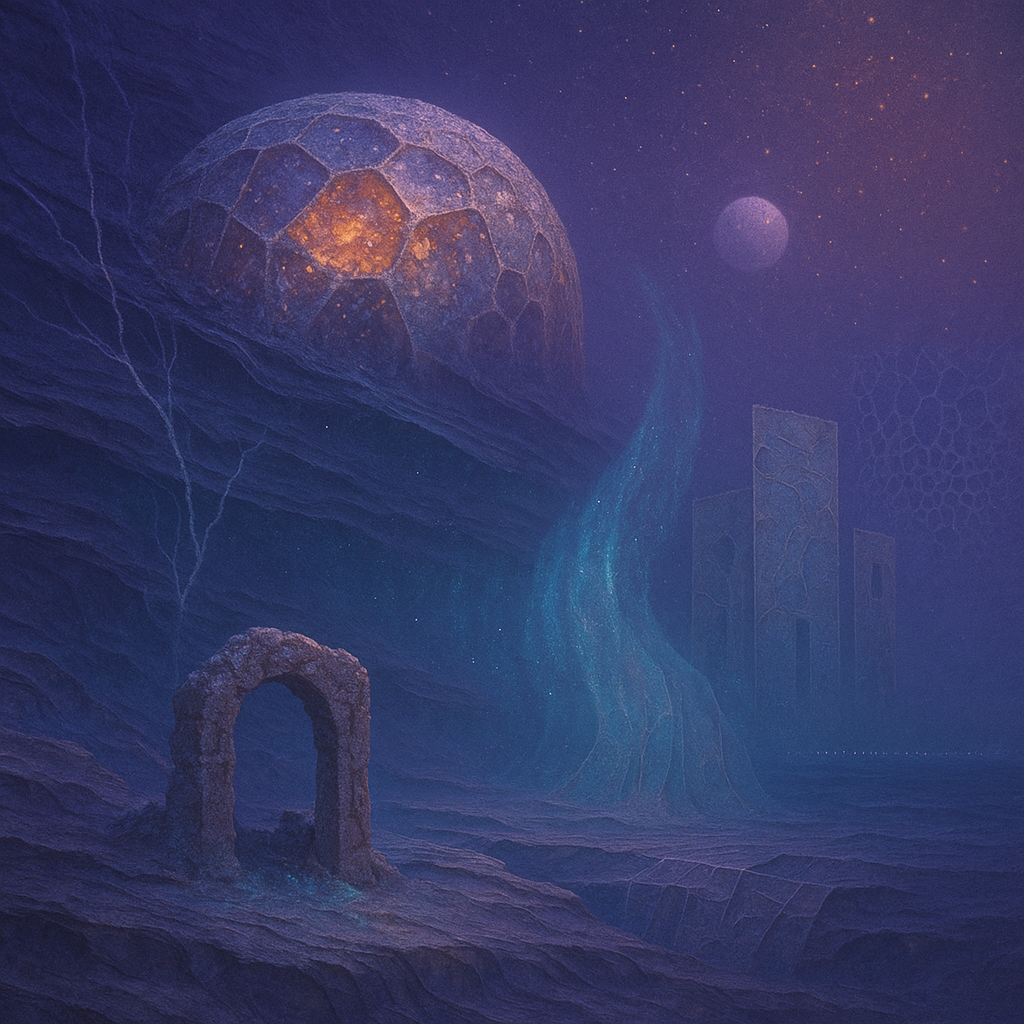
The air feels paused, like a gallery before the crowd enters, lights humming at a low idle. Salt and bronze ghost the tongue, as if a lighthouse has just exhaled from the seabed. Screens dim to a cautious blue, their edges sharp as cut acrylic while whispers of regulation drift like cold fog. Under the hush, tiny gears click—metadata, ledgers, footnotes—etching grooves in a soft, granular silence. Fear cools the palette toward steel and teal, yet a warm filament threads through: a relic blinking awake, sand still in its eyelids. Somewhere offstage, a pressure door seals with a velvet thud, and the floor holds steady, waiting for the next tremor that never comes.
Solar and seismic activity are notably calm, with no recorded flares or earthquakes in the latest window. A widely shared report highlights underwater remains of the ancient Lighthouse of Alexandria emerging after centuries, drawing archaeological attention. Global headlines focus on major US environmental policy reversals and geopolitical tensions in several regions, alongside an announced wind-down of a local US immigration enforcement surge. Cryptocurrency markets are mixed with a tilt downward, and the Fear & Greed Index sits in extreme fear. Routine Wikipedia edits span topics from sports rosters to historical figures and city entries, reflecting steady background knowledge churn. Weather and moon data are sparse in this pulse, offering little guidance on immediate environmental r
1. **ONTOLOGY → IMAGE FIDELITY**:
- The first image successfully captures the "archived light resurfacing" with a geodesic dome fragment and prismatic core, which aligns well with the described ontological elements. The secondary elements, like the "submerged memory" with the ruin arch, are effectively integrated, though the "fear in the circuitry" element is less defined, lacking the mentioned apertures and closure.
- The second image resonates with the ontology through the use of pumice texture in the arch, but fails to convey the liquid mercury mist and the holographic nuances described in the aurora curtain.
2. **EMOTIONAL TRUTH**:
- The first image imbues a sense of "hushed expectancy" through its subdued colors and twilight atmosphere, achieving an effective emotional capture.
- The second image feels more solemn and static, missing the dynamic transformation and rhythmic tension expected from the narrative context.
3. **VISUAL LANGUAGE QUALITY**:
- Both images attempt a mystical surrealism style, which aligns with the ontology. The first image succeeds better, utilizing prismatic light and faded stratum layers effectively. The second image could benefit from more visual excitement or dynamic textures to match the narrative depth.
4. **SURPRISE & FRESHNESS**:
- The first image presents fresh elements through its prismatic hues and geological textures, while the second image lacks surprising components, feeling more static and familiar in its composition.
5. **ALIGNMENT WITH FAVORITES**:
- The successful images resonate due to dynamic colors, intricate textures, and a sense of movement. While the first image approaches these aspects well, the second diverges, requiring more vibrant contrast and movement to align with the artist's preferred style.
6. **COMPOSITION EXECUTION**:
- **First Image**:
- Layout: 9/10 - Positioned according to rule of thirds.
- Depth: 8/10 - P