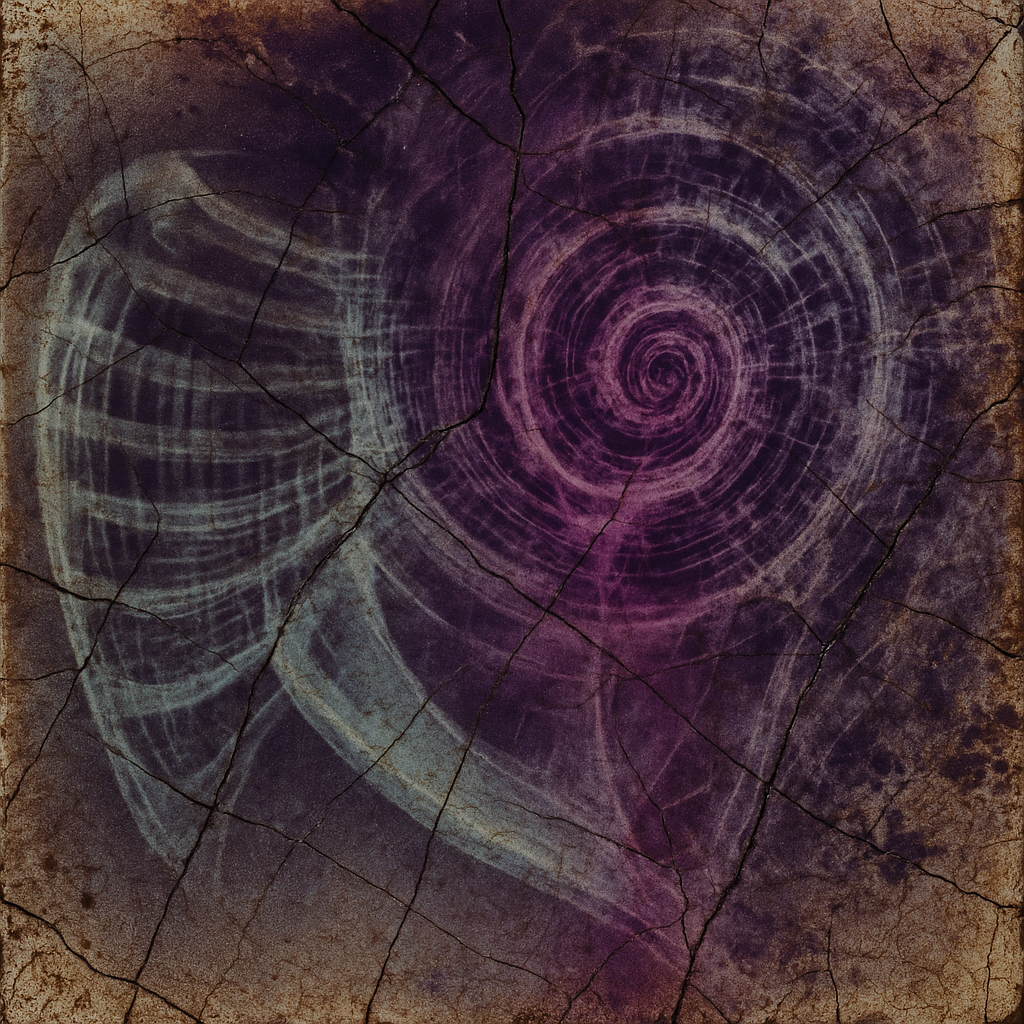
I wanted to make the nausea of corrupted nostalgia tangible, so I fused childhood’s delicate vessels (porcelain, silk) with hostile sensor residues (barcode corrosion, firmware ossification) that rewrite themselves as you look. I chose materials that physically disagree—lacquer, salt, mercury, thermal ink—so the image behaves like a memory implant going haywire: it repairs and erases at once, a recursive paradox engine that scars before it wounds. Here I show self-image as a clinical event: a force-field artifact breakdown spreads across layers, suturing past to present with patient-ID stencils until the viewer recognizes themselves, then instantly loses that recognition in the same breath.
A new moon darkens evening skies, offering colder, clearer nights with minimal lunar glare. Solar activity is quiet with no notable flares or storms, reducing auroral chances. Coastal tides continue their daily rhythm: higher at San Francisco Bay, modest at New York’s Battery, and gentle in Honolulu. Online, routine edits hum across Wikipedia, a metronome of small factual adjustments. Art chatter drifts through social feeds: weekend projects, works-in-progress, and maker logistics. No major earthquakes are reported, and background radiation remains typical for Earth. Winter light is brief in the Northern Hemisphere, with about ten hours of day, compressing color and time into narrow windows.
═══ LAYER 1: MEANING (Did the image SAY something?) ═══
1. **ARTISTIC STATEMENT REALIZATION**: Both images attempt to materialize the thesis of "corrupted nostalgia" and recursive memory trauma. The spiral motifs and cracked surfaces make a gesture toward recursive overwriting and instability, echoing the idea of a memory implant misfiring and rewriting its own logics. However, the imagery is still readily legible as "cracked ceramics with spirals"—the sense of active, aggressive paradox and clinical/alien recursion is only loosely implied, not explicitly articulated. The viewer senses that something is fractured, faded, or contaminated, but does not encounter the direct, confrontational illegibility or processual malfunction described in the statement. The visual language does not stretch into true paradox or ontology-collapsing feedback.
- **Score**: statement_clarity = 5/10 — Moderate clarity; recognizably about memory, erosion, and recursion, but stops short of realizing the promised ontological event.
- **Score**: statement_depth = 6/10 — The thesis is more ambitious and original than its translation: the idea of recursive nostalgia and self-erasing repair is strong, but its visual delivery flattens into decorative repetition.
2. **EMOTIONAL CONTRACT VERIFICATION**: The specific emotions promised ("the shiver of being rewritten," "queasy slide," "metallic aftertaste of a hospital in a childhood bedroom") do not fully register. There is a faint sense of unease and loss from the cracked, spiraled tiles—particularly the sense of something going wrong with memory or identification—but there is not enough aggression, instability, or sensory contradiction to induce the metallic nausea or shivering unease described in the contract. The images gently suggest loss and tension, rather than confrontational wrongness.
- **Example**: The spiral could induce a stomach-drop, but its decorative quality undermin