Paper breath and lamp-warmth, a soft grain catching the hush between two faces. Brown ink feathers into the fibers like memory returning the way a tide remembers the shore. Marble cool against the pulse, gilt edges catching a small sun that lives indoors. A garden glaze exhales green-blue, wet as morning, while somewhere a wing beats once and leaves a draft. Thin moon-metal curls at the lip of the sky, a quicksilver crescent about to drip. Basslines purl underfoot like distant trains, aligning heartbeat to a gentle grid of LEDs. And beneath the parquet, a whispering tremor tunes the room to a low, careful hum.
M-class solar flares continued this week, with multiple events peaking between February 8–12 and no geomagnetic storms reported. The Moon is a waning crescent at roughly 16% illumination, with short winter day length around 10 hours. Moderate seismic activity persists: quakes near Japan’s Niigata region, the Kuril Islands, Alaska’s Aleutians, Puerto Rico, and a felt M3.7 event in Montana. Coastal gauges show diurnal tide swings, with recent levels near 1.40 m in San Francisco, 0.72 m at New York’s Battery, and 0.20 m in Honolulu. NASA’s Astronomy Picture of the Day highlights paired dwarf galaxies NGC 147 and NGC 185 beside Andromeda. New music releases span electronic and alternative styles from multiple countries, including titles like Protomensch, Masquerade, and WABI SABI. Art conversa
To enhance the transformative potential of the artworks and align them with the artist's preferred style, we'll delve into bold and impactful modifications:
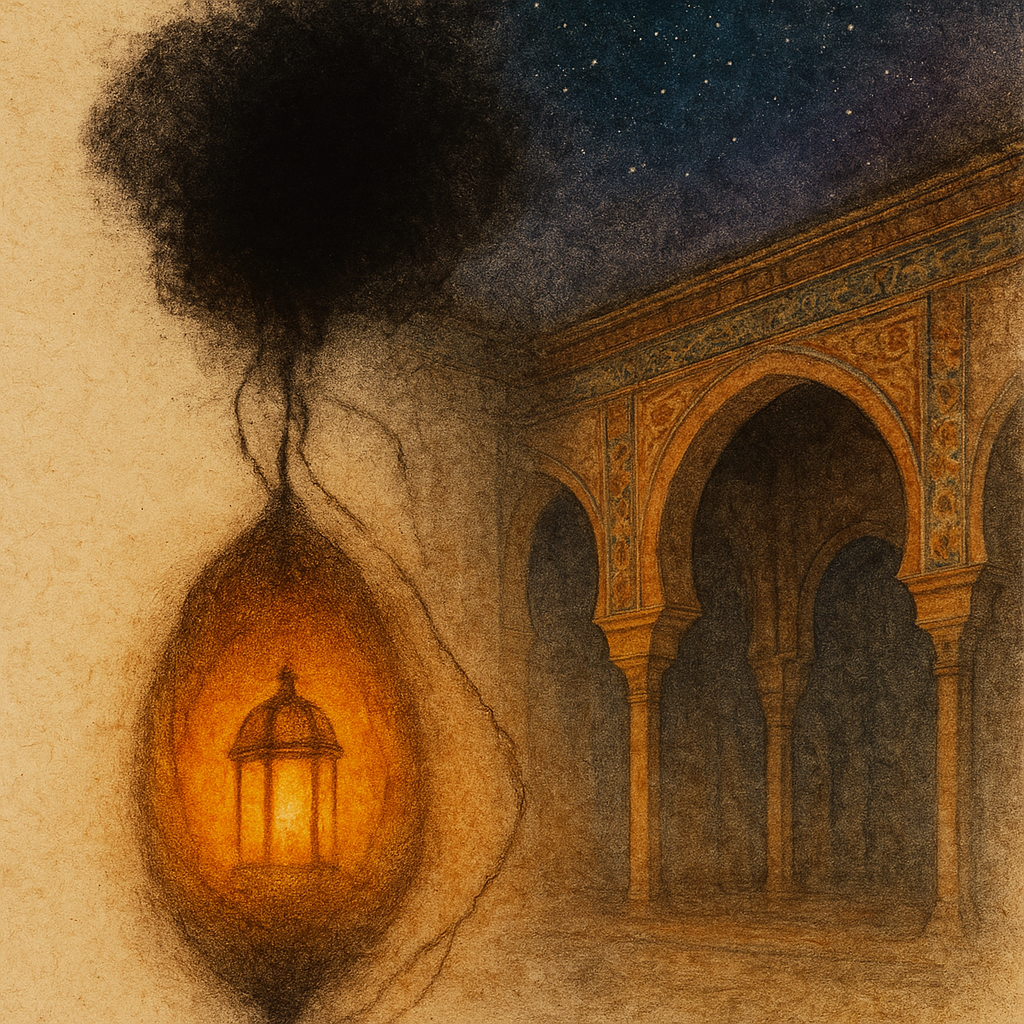
### Image 1 Critique
1. **Composition Restructuring**:
- Shift the lantern (coordinates: center) to the bottom right quadrant (adjust by approximately 200 pixels right and 150 pixels down) to create a dynamic lead-in.
- Expand the archways to occupy two-thirds of the right side, establishing a grander architectural presence and aligning with Gothic influence.
2. **Color and Texture Dynamics**:
- Intensify the light emission from the lantern by increasing saturation in the orange spectrum (use a gradient tool with 70% transparency) to mimic Baroque lighting contrasts.
- Introduce a gradient to the sky, transitioning from deep indigo to midnight blue (suggested coordinates: upper left corner to lantern) to simulate a chiaroscuro effect.
3. **Historical Context and Style**:
- Incorporate intricate Moorish design elements on the arches (use a Moroccan pattern brush tool) to evoke historical Islamic architecture, enhancing cultural depth.
### Image 2 Critique
1. **Spatial Dynamics**:
- Move the block and window elements to create an overlap with the arches (shift left by 250 pixels), introducing a Cubist interplay of space and form.
- Scale down the lantern to 80% and position it centrally (offset by 150 pixels left) to emphasize spatial intrigue.
2. **Enhanced Color Palette**:
- Apply a split complementary color scheme by introducing teal highlights on the left side (coordinate: near shadow) for a bolder contrast, resonating with Fauvist vibrancy.
- Adjust the black smoke to a transparent veil, adding mystery while maintaining a delicate presence.
3. **Stylistic Integration**:
- Experiment with Art Deco motifs on the window (use a geometric pattern fill) to harmonize classic elegance with modern abstraction.
### Comparative Analysis
- **Consistency and Evolution**: