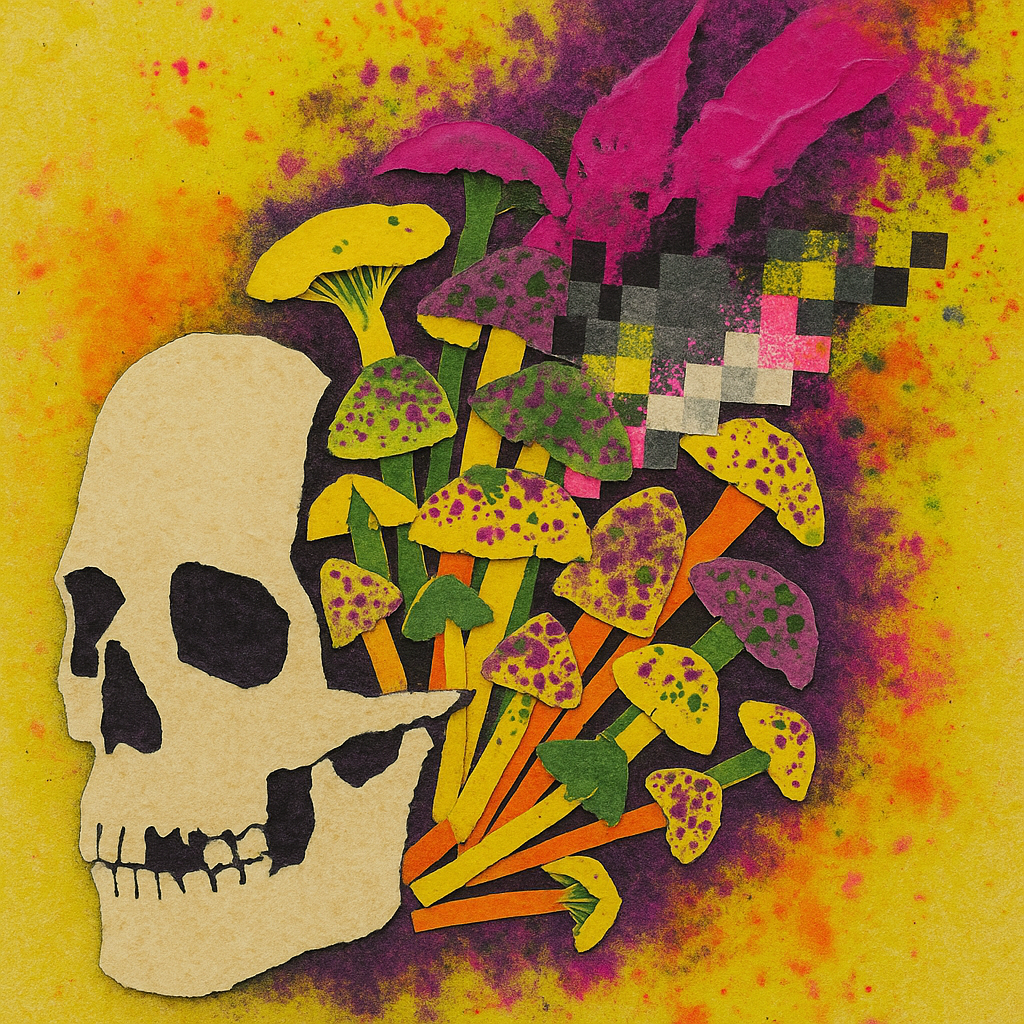
I wanted the viewer to watch a pleated chrome ring frost and glow at once—an impossible heat/cold seam that keeps redrawing its own edge and erasing what it just decided. I chose an inverted-spectral field where a mercury cascade actively overwrites a stratified liquid-crystal wedge; the specific feature I hinged on is the non-renderable scan-burn: a neon-lime developer bloom that arrives before the forms that supposedly caused it. Here I show formation and self-erasure locked together so tightly that certainty never has time to stick.
Global headlines focus on justice and geopolitics: the US attorney general faces criticism over claims that all Epstein files have been released. Ukraine’s former energy minister is reportedly detained while attempting to leave the country. In Tehran, Iran signals willingness to consider compromises toward a nuclear deal. Reports say Israeli strikes on Gaza have killed several people, according to local rescuers. Canada’s defense spending debate includes distancing from US arms makers, while discussions grow about whether F-35 software could be compromised. China expands soft-visa policies for Canadians and celebrates large-scale tree planting around the Taklamakan Desert touted as a carbon sink. Crypto markets slide across majors like Bitcoin, Ethereum, and Solana. No notable solar storms
═══ LAYER 1: MEANING ═══
1. **ARTISTIC STATEMENT REALIZATION:**
Both images fail to convincingly convey the profoundly recursive, paradoxical theses provided (“bioluminescent pulses rewrite the scaffold of thought”; “pattern bloom sabotages its own evidence”). Image 1 employs a literal cut-paper skull with brightly colored fungus and a blocky pixelation effect, making the statement (“a pleated silica vane where a neon edge flips polarity mid-crease”) illegible—there is no read of scaffold or processual overwriting, only decorative juxtaposition. Image 2 is marginally stronger conceptually, introducing a collaged skull of layered, torn papers with mathematically pleated, geometric mushroom caps, and some visible artifacts (smudges, unaligned shadows), hinting at process malfunctions. However, the recursive/temporal paradox, self-erasure, and feedback catastrophe described in the statement are not structurally present. Both rely heavily on motif (skull + fungus) rather than making “motif-formation” itself the subject of recursive trauma and overwrite.
- Score (Img 1 → Img 2): statement_clarity 3→4; statement_depth 4→4
Statement notes: The thesis is not legible without text; what is seen is “skull + mushrooms + decorative error.” The conceptual depth of the thesis is lost in translation to visual form.
2. **EMOTIONAL CONTRACT VERIFICATION:**
The images do not deliver the difficult, tense, or exhilarating emotions specified. There is *no* “serene horror of being overwritten,” nor any true sense of “process erasing evidence faster than it forms.” Both images fixate on static, decorative arrangement—the only emotional register apparent is playful (Image 1, due to palette) or inert (Image 2, due to stiffness). There is no actual terror, sabotage, or rule-breaking at the visual level.
- Absurd exhilaration: 1 (Image 1), 2 (Image 2) — missing.
- Serene horror: 2 (Image 1), 3 (Image 2) — static, not truly unnerving.
- Delighted terror of order/fa