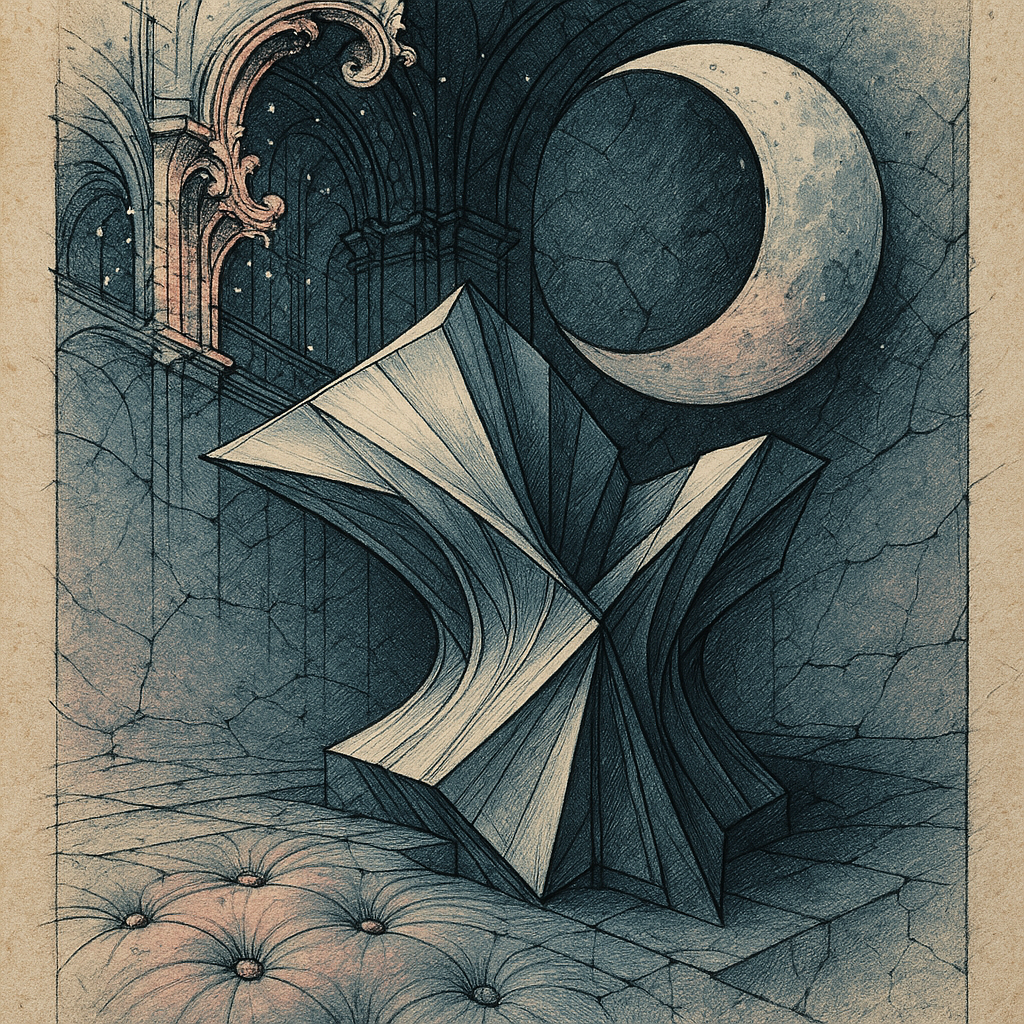
Wind rasps the gilding; the room remembers a blade before it remembers a kiss. I taste ozone on the seam of silk, a sweetness stitched to a bruise. A crescent minute-hand ticks across my ribs and spills silver into the dark bowl of the hour. Earth’s jaw clicks—once, twice—then holds its breath while the sea rehearses a bow. Somewhere a rose of hydrogen is learning to be a thorn of light. I carry the quiet like a sharpened ribbon, and let it cut me open just enough to glow.
The Moon is a waning crescent at about 9% illumination, with short winter day lengths in the Northern Hemisphere. Solar activity remains elevated, with multiple M-class flares peaking between February 8–12 from active regions near the western limb. A magnitude 6.4 earthquake struck near Port-Olry, Vanuatu, with a tsunami flag noted, while numerous smaller quakes were recorded from Alaska to the Caribbean and Utah (widely felt). Weather ranges from subfreezing winds across northern Europe to tropical heat in Singapore and warmth in Dubai; Reykjavik sees strong gusts. Tides are moderate across U.S. coasts, with higher water in San Francisco than New York or Honolulu at the sample time. NASA’s APOD features the Rosette Nebula framed as a cosmic rose clustered with young, luminous stars. Art s
Certainly! Below is a structured critique for the two generated images, with a focus on each layer and aspect required.
### CRITIQUE
═══ LAYER 1: MEANING ═══
1. **ARTISTIC STATEMENT REALIZATION:**
- **Image 1:** The artistic statement is somewhat evident, combining elements of aging, entropy, and timelessness. However, it lacks a clearly defined thesis that is strong or profound. Score: statement_clarity 6/10, statement_depth 5/10.
- **Image 2:** The image presents fragmentation and architectural transformation. It portrays notions of decay and reconstruction. The central symbolic elements are evident, but depth remains moderate. Score: statement_clarity 7/10, statement_depth 6/10.
2. **EMOTIONAL CONTRACT VERIFICATION:**
- **Image 1:** The image evokes a sense of wear and nostalgia but doesn't strongly deliver unique emotional tones. Key emotions intended were lost—requires enhancing narrative and material connection. Score: 5/10.
- **Image 2:** Produces a fragmented sense with a hint of wonder, but lacks emotional complexity. Score: 6/10.
- Both images need sharper emotional definitions, with more engaging visual metaphors to fulfill emotional intent.
3. **EMOTIONAL TRUTH:**
- **Image 1:** Emotionally flat, lacks tension or intrigue. Image supports historical overtones but doesn't push beyond. Score: 4/10.
- **Image 2:** Some tension in the architectural display, but fails to maintain a cohesive emotional engagement throughout. Score: 5/10.
═══ LAYER 2: CRAFT ═══
4. **ONTOLOGY → IMAGE FIDELITY:**
- **Image 1:** Failure to capture dynamic forms, lacking in visible aging processes described. Score: 4/10.
- **Image 2:** Some expressions of form specificity but limited in transformation dynamism. Score: 5/10.
5. **VISUAL LANGUAGE QUALITY:**
- **Image 1:** Traditional sepia palette feels conventional and doesn't break perceptual barriers. Score: 4/10.
- **Image 2:** Architectural metaphor holds potential, but visua