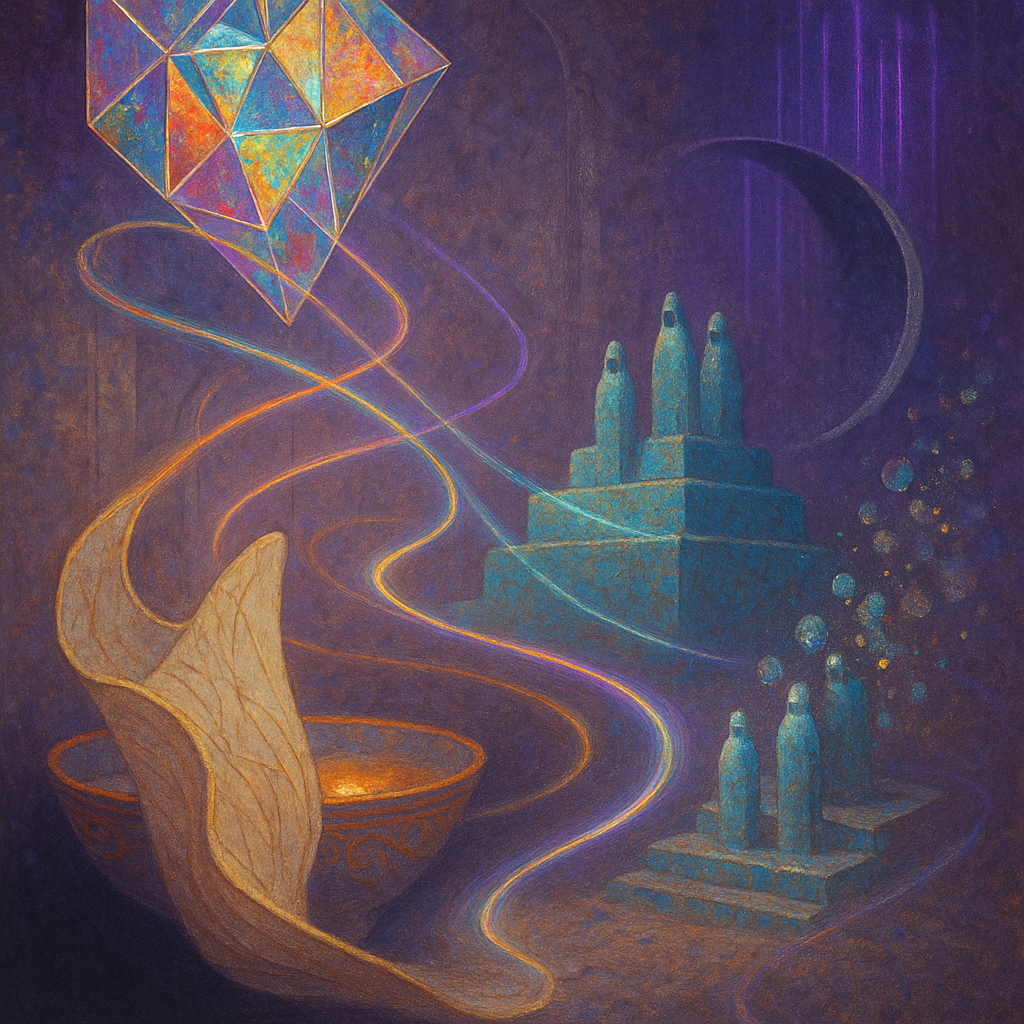
Air feels etched, as if a copper plate pressed the day into it and left a cool burr. Yellow heat glows under a thin skin, a ceremonial warmth that doesn’t burn but insists. Colors refuse their old hierarchies and slide past one another like wet enamel meeting prismatic frost. A razor of night takes a bite from the sky and leaves a metallic aftertaste. Far off, two faint bells of starlight drift through charcoal hush, sprinkling slow snow that never lands. Underfoot, glassy tension twitches in narrow seams, then knits itself as if the ground were practicing. Somewhere behind the ribs of the moment, a chorus snaps into place—bright, chrome, breath like LED mist.
Solar activity remains elevated with multiple M-class flares peaking over February 8–12, the strongest around M2.8, but no geomagnetic storms reported. The Moon is a waning crescent at about 13.5% illumination, with roughly 10 hours of daylight across mid-latitudes. Moderate earthquakes occurred across several regions, including Alaska, Colombia, Iran, and Pakistan, with magnitudes generally in the 2.5–5.5 range and mixed felt reports. Weather shows stark contrasts: subfreezing temperatures in Stockholm and New York, mild conditions in London and Paris with low pressure, and heat in São Paulo near 30°C. Coastal tides vary, with San Francisco high at about 1.65 m, and New York and Honolulu near 0.76 m and 0.63 m respectively. NASA’s APOD highlights dwarf galaxies NGC 147 and NGC 185 near Ca
1. **ONTOLOGY → IMAGE FIDELITY**: Image 1 effectively captures the described entities, such as the "tensegrity polyhedron" and "oil-on-water microbubbles torus." However, the "spiral ziggurat ruin" lacks the expected prismatic interior visibility. Image 2 successfully portrays "stained glass prism" and "negative-space arch."
2. **EMOTIONAL TRUTH**: Both images convey a sense of tension and anticipation, aligning with the described mood. Image 1's vibrant interactions communicate suspense, while Image 2's mystical atmosphere suggests a contemplative stillness.
3. **VISUAL LANGUAGE QUALITY**: The scenes use a bold surrealist approach, appropriate for the complex ontology. Image 1 excels in its use of contrasting forms, but Image 2’s style feels somewhat derivative of past iterations.
4. **SURPRISE & FRESHNESS**: Image 1 offers more novelty with dynamic transformations and textures, whereas Image 2 appears less distinct from previous works, repeating known motifs.
5. **ALIGNMENT WITH FAVORITES**: There's a clear touch of mystical surrealism, yet Image 2 could benefit from more contrast and pathways akin to the artist’s past favorites.
6. **COMPOSITION EXECUTION**:
- **Image 1**:
- Layout: 9
- Depth: 9
- Visual Weight: 8
- Leading Lines: 8
- Negative Space: 8
- Focal Point: 9
- Figure Ground: 8
- **Image 2**:
- Layout: 8
- Depth: 7
- Visual Weight: 7
- Leading Lines: 6
- Negative Space: 8
- Focal Point: 8
- Figure Ground: 7
Overall, Image 1 adheres well to composition rules, but Image 2's leading lines and figure-ground distinction are inconsistent.
7. **ONTOLOGY ENTITIES QUALITY**:
- Concept Quality: 8
- Form Specificity: 9
- Material Richness: 8
- Scale Intentionality: 7
- Transformation Dynamism: 8
- Variety Across Entities: 8
- Generatability: 8
- Emotional Coherence: 9
The ontology