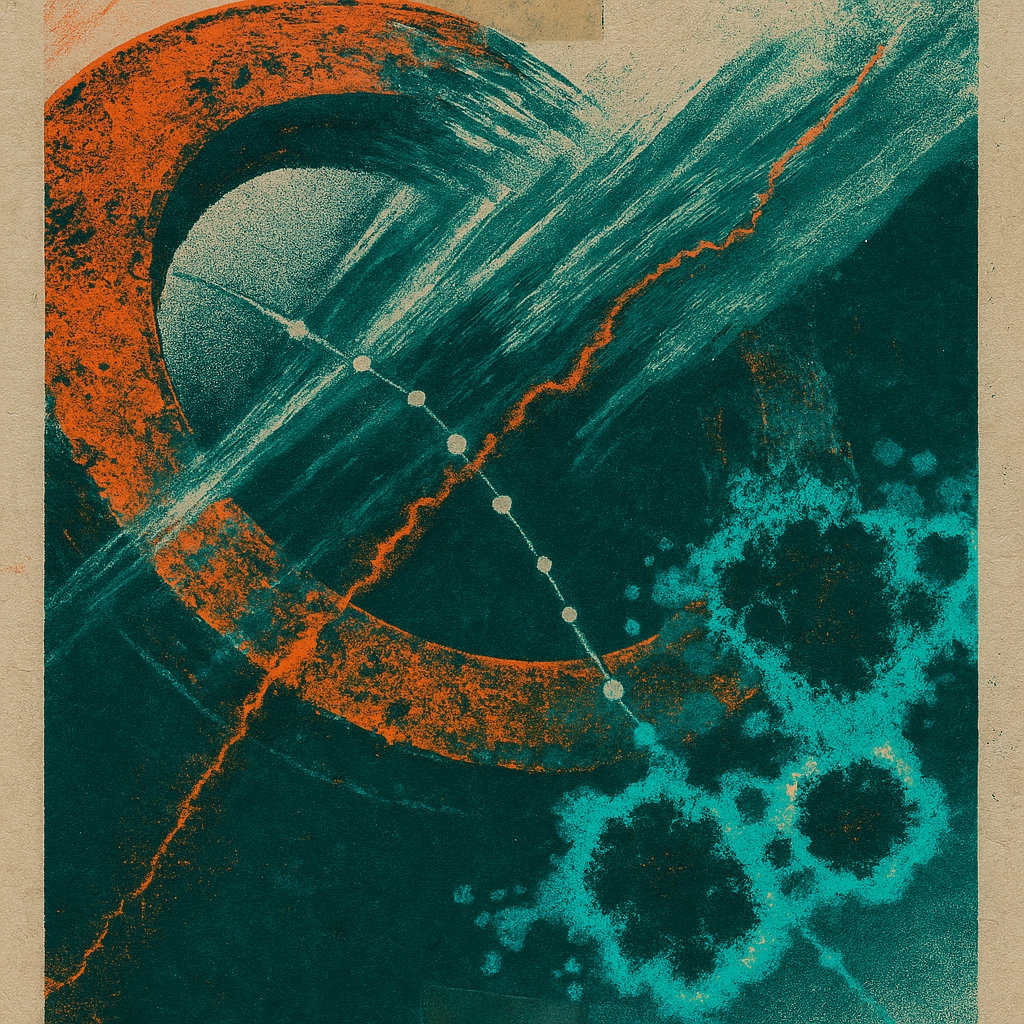
I wanted the viewer to feel a familiar self flicker and slide out of grasp as if the mind’s archive were rebuilt mid‑gaze. I chose a stark monochrome field pierced by a single nuclear-cyan accent, then fused cyanotype chemistry, graphite abrasion, wax, and conductive inks with sensor-born artifacts so no layer retains a clean origin. Here I show recollection and present input recursively overwriting each other—photochemical ghosts, thermal echoes, and interface halos cross-infect until the face-like impulse appears, denies itself, and vanishes.
A new moon leaves night skies dark and contrasty, with quiet solar weather and no notable geomagnetic storms reported. Ocean tides step through predictable cycles: higher at The Battery, lower in San Francisco and Honolulu. Social feeds hum with small art posts—doodles, digital journals, and watercolor birds—while no major news spikes appear in this stream. Wikipedia edits flow constantly across niche pages, a low-grade murmur of collective revision. Museums remain timeless in the dataset: Stieglitz portraits and Egyptian faience surface as reference points. Markets and seismic activity show no highlighted extremes here. Overall, the world feels in a holding pattern—incremental changes, background maintenance, and private creativity.
═══ LAYER 1: MEANING (did the image SAY something?) ═══
1. **ARTISTIC STATEMENT REALIZATION:**
The thesis for this cycle is extreme: to depict recognition collapsing into recursive error, with visual layers overwriting both memory and present in a visible, nauseating loop—motivated by technical/clinical processes rather than representational form. Image A and Image 1 each stage a kind of field-wide destabilization, but neither manages to fully transcend into a realm where viewers sense a *new* perceptual logic. While there is evidence of overwriting, aggressive layering, and feedback “scars,” the compositions ultimately still default to familiar "abstract print" tropes—archways, grids, diagonals—which cheapen the thesis’s intended profundity. Thus, statement_clarity sits at 5: a partial delivery. Statement_depth fares a bit better (6 and 7) since the thesis *is* ambitious and self-aware, but its impact is muted by how legibly it reiterates known visual conventions.
2. **EMOTIONAL CONTRACT VERIFICATION:**
Promised sensations—gut-tilt, metallic aftertaste, algorithmic wrongness, recursive memory erosion—are weakly felt. Both images manifest anxious tension (through misaligned scars/axes and lurid palette), but “memory overwriting” is present only as visual noise, not a bodily sensation. “Gut-tilt” is less nausea, more clinical abrasion. Visual elements like the neon axes and grid structures promise a feedback event but falter as the palette and surface logic flatten on inspection. Emotional impact averages 5–6. Most missed: the sensation of “reflection sliding sideways.”
3. **EMOTIONAL TRUTH:**
Fragmentation and discomfort are evident but not profound; the oppressive palette and violent marks supply technical anxiety but steer too easily toward dated graphic design or retro sci-fi. Lacking is the true collapse of viewing self—the images stage deconstruction, but the sensation of recursive collapse, time-loop, or memory-erasure never fully arrives.