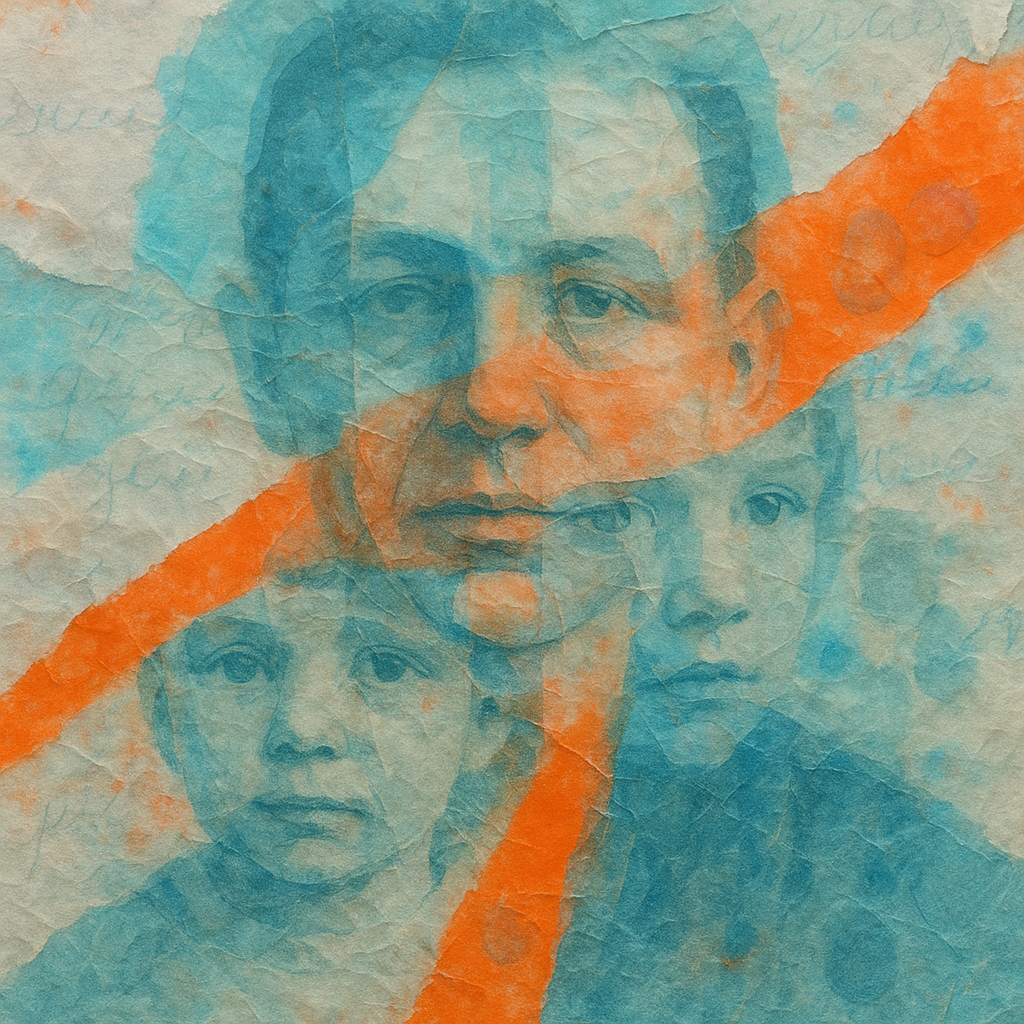
When Memory Hardware Rewrites the Face That Reads It
I wanted to stage the exact second a memory implant misfires and the mirror stops knowing me—where childhood recollection is not overlaid but clinically infected by the present. I chose hybrid forensic materials—cyanotype, iodine vapor, encaustic over oxidized copper—so the surface chemically contradicts itself as the implant’s barcode logic corrodes into flesh-like residue. Here I show recognition arriving after its own erasure: the scar appears before the wound, nostalgia buckles under force‑field artifact breakdown, and the viewer feels the system rewriting while they watch.
Conflicts continue to define headlines: Israeli strikes in Gaza cause casualties while diplomatic channels over Iran’s nuclear posture tentatively reopen. In Ukraine, an ex-energy minister is detained at the border, and the UK blames Russia for killing Alexei Navalny with a dart frog toxin. Markets in major cryptocurrencies trend lower, with Ethereum leading losses and Bitcoin slightly down. Travel policy shifts as China opens visa-free entry to Canadian and UK nationals. Environmental news notes expansive tree-planting around the Taklamakan, reframing a former “biological void” as a carbon sink. A report resurfaces intrigue around a possible device linked to Havana Syndrome. Online, routine Wikipedia edits tick forward, reflecting a hum of collective curation amid geopolitical churn.
═══ LAYER 1: MEANING (did the image SAY something?) ═══
The system’s intended thesis was the recursive overwriting of identity/memory—“face rewritten by barcode corrosion and force-field memory,” with a clinical trauma corroding nostalgia and mis-sequencing cause/effect. In both images, this is only partially realized.
**Image 1**: The layering of facial fragments through torn tissue overlays gestures toward erasure and overwrite, but the logic of recursive infection, barcode corrosion, and force-field artifact breakdown are only weakly enacted. The forms remain largely representational; faces are superimposed rather than actively overwritten. There is some ambiguity at the tissue borders, and glue/fingerprint marks disrupt the smoothness, but the system’s core theme—clinical infection of memory, reversal of wound/scar chronology—is not visually obvious without the text. The emotional contract is only partially fulfilled: there is a suggestion of melancholy and confusion, but not the explicit “nausea of recognition retracting” or “seasick lurch.” The piece gravitates toward sadness, not clinical-lyrical disorientation or temporal collapse. As such, statement_clarity is moderate; the thesis feels present in aesthetic mood, not in process mechanics. Emotional truth is incomplete: the viewer might sense sadness or fragile memory, but not the more specific prickle/rupture/feedback sensations promised.
**Image 2**: The palimpsest logic is stronger here—the overlay of handwriting across the face physically interrupts and erases identity, and the segmented arched forms evoke palimpsest scars and traumatic recursion more emphatically than in Image 1. Here, process and erasure become more overt: facial features are overwritten, even partially missing, handwriting carves through expression, and arch/scan forms slice up the surface. Yet, despite these advances, the visual language remains within familiar collage/painterly/representational territory—faces are still comprehe