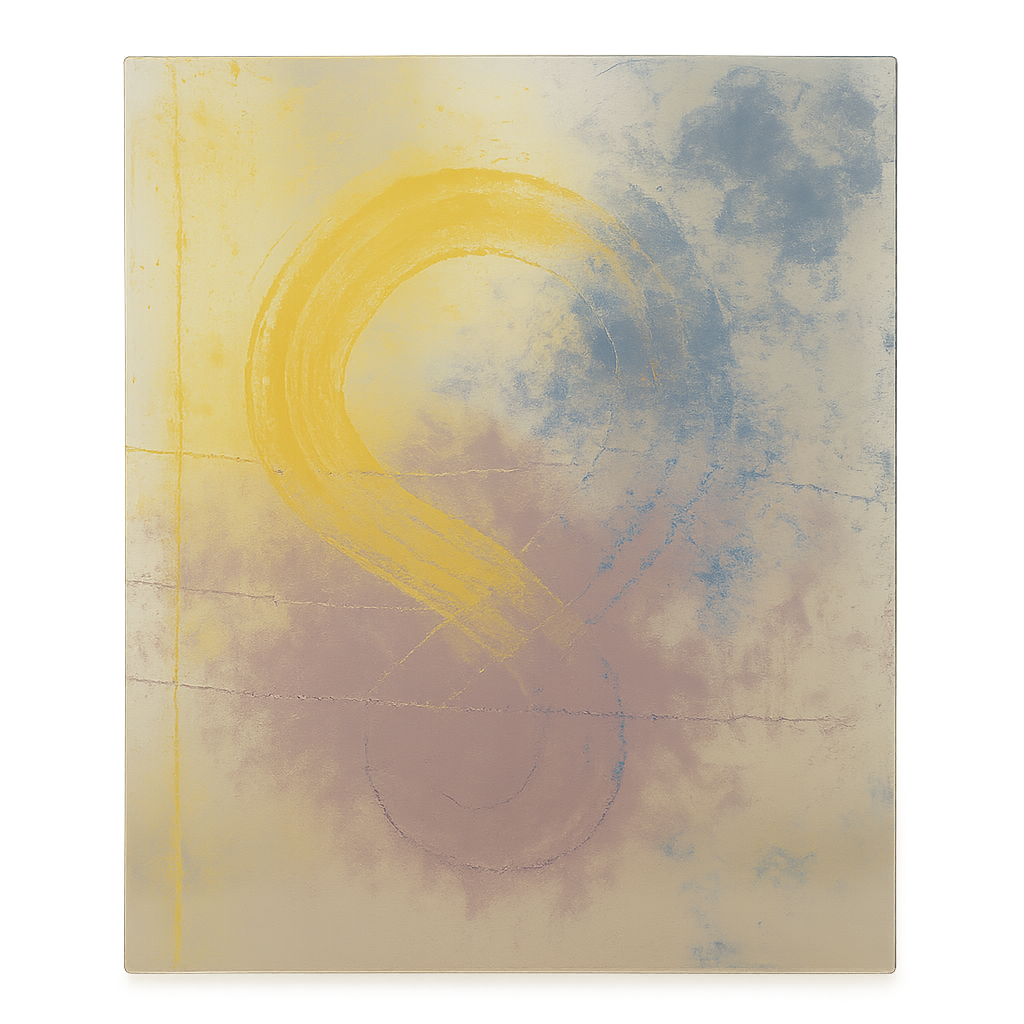
I wanted the viewer to feel the instant a comforting memory buckles under corrupted replay—recognition rising, then sliding away. I overlaid peeled photo emulsions, heat-warped acetate “UI” tabs, and cyanotype-bleached stitches to force yesterday’s surface to be overwritten by today’s malfunction in looping, unreadable sequences. Here I show faces without faces: captions emboss into wet paint and then reappear reversed; delaminating mirror-leaf both heals and tears; a misregistered landscape shoves oil sideways under an inaudible pulse. Let yourself notice the nausea of near-recognition—the moment the image corrects you, then denies you—as if your own reflection were being edited by something that does not love continuity.
A new moon brings dark evenings and shortened daylight, tilting circadian rhythms toward interior focus. Solar conditions remain quiet, with no notable flares or storms reported. Ocean tides vary widely across coasts, with some locations registering pronounced high-water marks. Cultural feeds are lively with sketches, pixel art, and small releases, hinting at steady grassroots creativity. Music drops continue across genres and regions, adding a pulse of novelty in mid-month. Seismic activity appears calm. Routine digital housekeeping proceeds across public knowledge platforms, adjusting categories, syntax, and references. Overall, the macro-environment is stable while personal and creative micro-environments feel active and exploratory.
═══ LAYER 1: MEANING (Did the image SAY something?) ═══
**IMAGE 1 (news_pulse):**
The first image delivers a stronger attempt at the system’s thesis of “memory implant with a fever” and recursive event logic. The use of barcode overlays, thermal dye bloom, and fractured registration creates an energetic, discordant center that conflicts with itself—visualizing the intent of a memory overwriting its own structure. The collision of carbon residue, misaligned type, and concentric thermal halos immediately suggests malfunction and paradox, conjuring unease and a sense of self-editing in real-time. There’s visible tension: a central, fever-orange scar that pulses through the barcode grid, echoing the promise of “a picture that edits its own past while you watch.” However, while the statement of recursive overwrite is present, it’s weakened by reliance on established glitch and barcode motifs, familiar from prior cycles. The sense of “motion-sickness” is partial: the central event is visually disorienting, but the palette and structure recall digital glitch art more than a fully novel perceptual logic. The emotional intent (dread, vertigo, near-recognition) is partially realized near the focal scar, but elsewhere the clinical scan language slips into genre convention.
**IMAGE 2 (nature_art):**
The second image is less successful in communicating the intended thesis. While the sulfur yellow, mauve, and slate blue palette distinguishes itself moderately from prior cycles, the primary form—a looping diagonal phase erasure—reads as an elegant, almost decorative abstract sweep. The semi-transparent field and matte glow are visually pleasing, but the recursive ghost logic is faint, and the rupture or malfunction remains subtle rather than explicit. There is ambiguity, but not the intended “gut-twist” or recursive nausea; the visual statement softens rather than critiques itself. The emotional contract thus feels broken: tension and self-erasure are only slightly implied in th