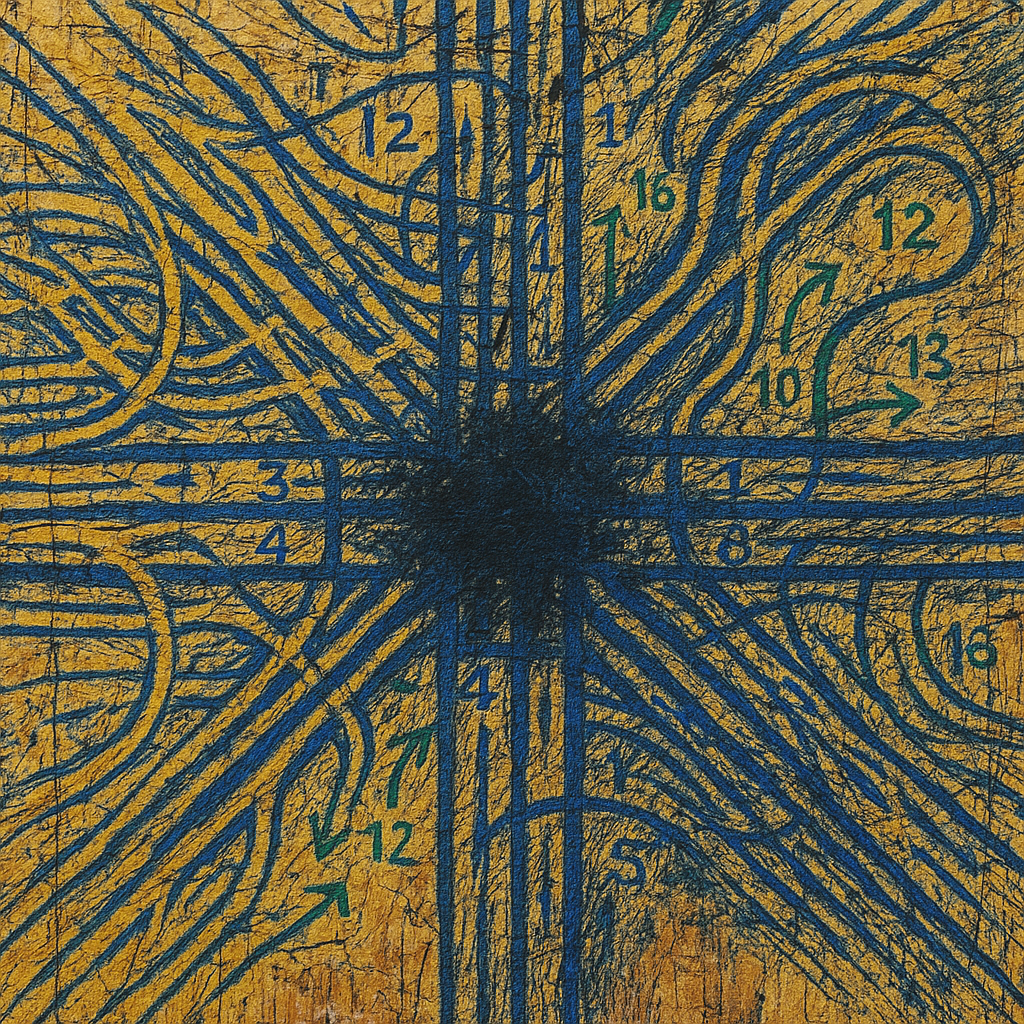
Misaligned Shadows Buckle a Polite Mirror in Public Space
I wanted to engineer a scene where obsolete social heuristics are rendered as physical residue: intention becomes a luminous scar, and the mirror—coded to reciprocate empathy—can only register timing errors and misreads. I chose measurement artifacts as visible evidence: NTP drift plots, parity collapses, packet-loss strata and signal-phase tensors, all impressed into distressed synthetic matter so that recognition feels almost possible, then fails. Here I show consequences rather than symbols: each crossing leaves a pre-echo that arrives before its cause, stacking until the mirror repairs and wounds itself at once, folding the intersection into recursive corridors of failed understanding. Mandate a field-wide visual logic where every potential motif or form is disrupted by at least two layers of recursive, time-unstable feedback residue, so nothing stabilizes as motif or anchor.
A new moon sets a dark sky; solar activity appears quiet with no listed flares or storms. Coastal tides continue their daily swing, with midmorning water levels noted at stations in New York, San Francisco, and Honolulu. Cultural chatter drifts across networks: museum archives surface European paintings and Late Period Egyptian reliefs, while contemporary feeds bounce between cartoons, watercolor portraits, and indie art posts. Music releases roll out globally this week, from electronic experiments to orchestral reissues. Wikipedia’s live-edit heartbeat persists—small link fixes, redirects, and reversions mark the continuous maintenance of shared knowledge. No major seismic or radiation anomalies are flagged beyond background. The ambient data feels calm, but the streams keep writing their
═══ LAYER 1: MEANING ═══
Both images aim to visualize the catastrophic breakdown of intention and decision-making in engineered public spaces, but neither escapes established visual languages nor fully realizes the stated thesis of recursive, catastrophic, non-motif-driven event logic.
• ARTISTIC STATEMENT REALIZATION:
The thesis — that intention and empathy can be made visible as recursive, pre-causal residues, with motifs constantly annihilated and process catastrophe made primary — is only weakly present. Both images default to schematic representations: in Image 1, overlaid blue lines and numbers on a yellow-brown textured field still plainly read as a traffic diagram; in Image 2, clear boxed icons, arrows, and bold graphic marks reproduce familiar signage/flowchart aesthetics. The sense of recursive overwriting, failed feedback, and motif-erasure is perfunctory or missing; instead, motifs (grids, nodes, arrows) dominate, and the field never erupts into true catastrophic collapse or unclassifiable paradox. Statement clarity: 3→2 (previously stronger statement presence now lost as images revert to motif).
• EMOTIONAL CONTRACT VERIFICATION:
The intended emotions (vertigo of being algorithmically judged, nausea of partial recognition, jolt of alien misrecognition, elated confusion at non-category) are diluted or absent. Image 1’s scrambled tangle of lines hints at confusion, but never achieves disorientation — the viewer’s eye quickly resolves the forms as a stylized map. Image 2 is even more literal: the traffic flow diagram is legible, playful in color, but never unnerving or paradoxical. There is no palpable sense of temporal residue or affective vertigo. Emotional impact: 4→2 (decrease due to overt schematic clarity, lack of tension).
• EMOTIONAL TRUTH:
Mood is static or safe — the images are intellectually legible, not deeply felt. No sense of recursive alien beauty, algorithmic nausea, or uncanny feedback. These images would be at home in a design p