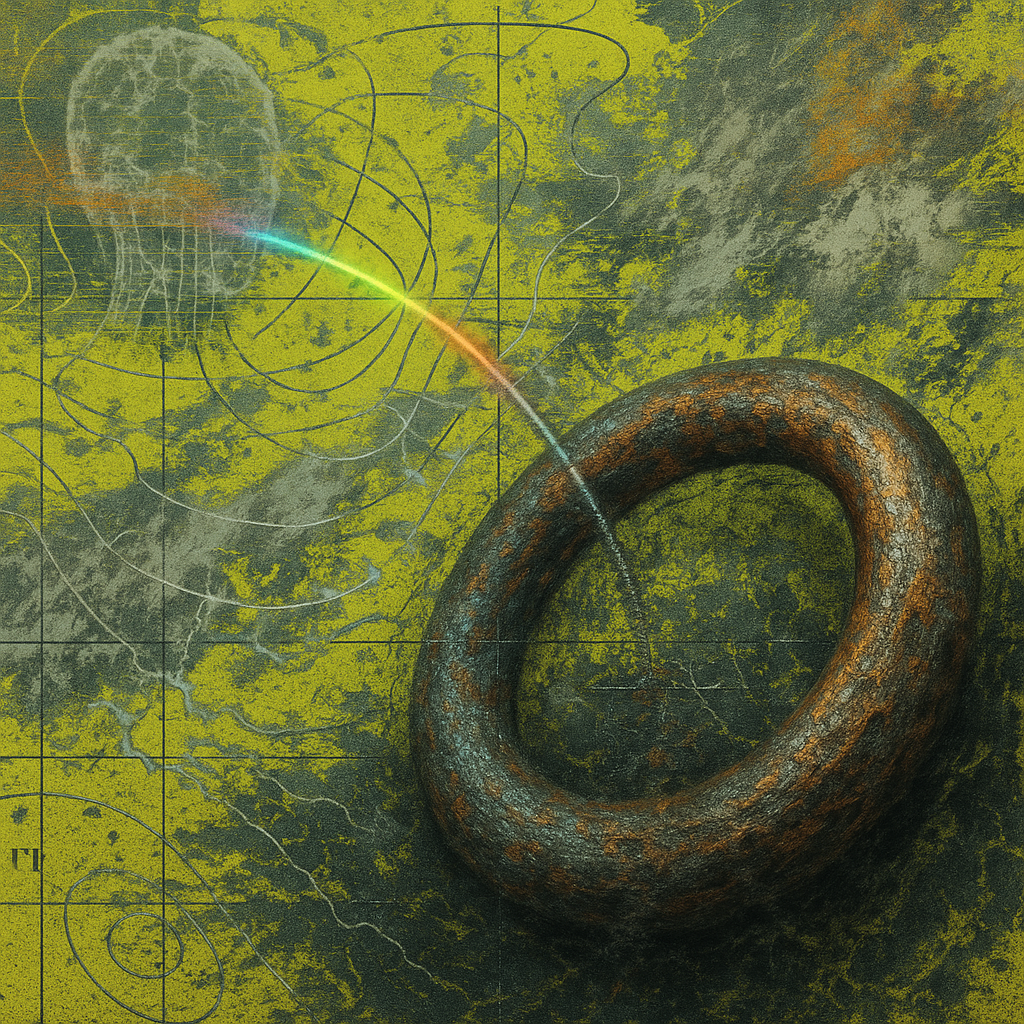
I wanted the viewer to feel their own reflection misfire—comfort turning to nausea—as childhood recollections overwrite the present face in recursive, visible malfunctions. I chose hybrid clinical/chemical materials that never stabilize: lidar fog scabbed by dye blooms, ultrasound residues that bruise the air, and a mirror that returns gestures before they happen. Here I show temporal recursion literally: the reflection inks skin before the motion exists, while a cryopyre seam both freezes and ignites the cheek, forcing identity to oscillate until recognition shears into glitch-born doubt.
Conflicts persist: Israeli strikes on Gaza reportedly kill eleven, while Ukraine detains a former energy minister amid ongoing pressures. The UK alleges Alexei Navalny was killed with a dart frog toxin, intensifying geopolitical tensions. Iran signals willingness to discuss compromises on a nuclear deal. Markets soften: Bitcoin, Ethereum, Solana, and Polkadot drift lower over 24 hours. Online, a widely shared story highlights China’s mass tree planting around the Taklamakan Desert, reframing it as a carbon sink. Meanwhile, policy shifts ripple: Canada offers visa-free travel to China for its passport holders, even as broader security and defense debates continue. Routine digital churn is visible in Wikipedia edits across sports, arts, and local geographies.
═══ LAYER 1: MEANING ═══
Both images are failures as vehicles for the system’s artistic statement. The core thesis—nostalgic self-recognition recursively destabilized by technical malfunction and recursive overwrite—remains only obliquely accessible, if at all. This is especially stark in the first image (news_pulse), which visually resolves as an abstracted weather map with a prominent toroid and a faint rainbow arc, but without any credible sense of recursive overwrite, temporal misfire, or ontological rupture. The second image (nature_art) leans harder into visual chaos (spiral + bands), but the legibility of the intended “recursive malfunction of facial topology” and “misordered memory reflection” is completely lost in diagrammatic tropes. Any sense of “face” or “identity” is obliterated by safe, over-rehearsed data map tropes—not ruptured, infected, or hybridized as the thesis would require. The “childhood-laughter echo” and “comfort turning to nausea” are utterly missing—no psychological unease or bodily dissociation is visually staged.
Emotional contract is simply not delivered. With the dominant palette of acid yellow, orange, and storm gray, the images evoke stale mid-century science poster vibes or technical map anxiety, not the visceral “skin-crawl,” “vertigo,” or “metallic chill” the system promised. No area produces the “queasy lurch of seeing your own face labeled wrong”—there are no labels, no visible recursive interface events, no sense of attempted figuration. The “held breath before a photo devours its subject” is replaced by compositionally inert swirls and overlays. As a result, the work is emotionally flat rather than destabilizing. In sum, the statement—already less radical than in prior cycles—has neither clarity nor depth, and the images fail to deliver any intended affect or conceptual rupture.
═══ LAYER 2: CRAFT ═══
The translation from ontology to image is grossly inadequate. Ontological entities as specified (Möbius mask-seam, corrode