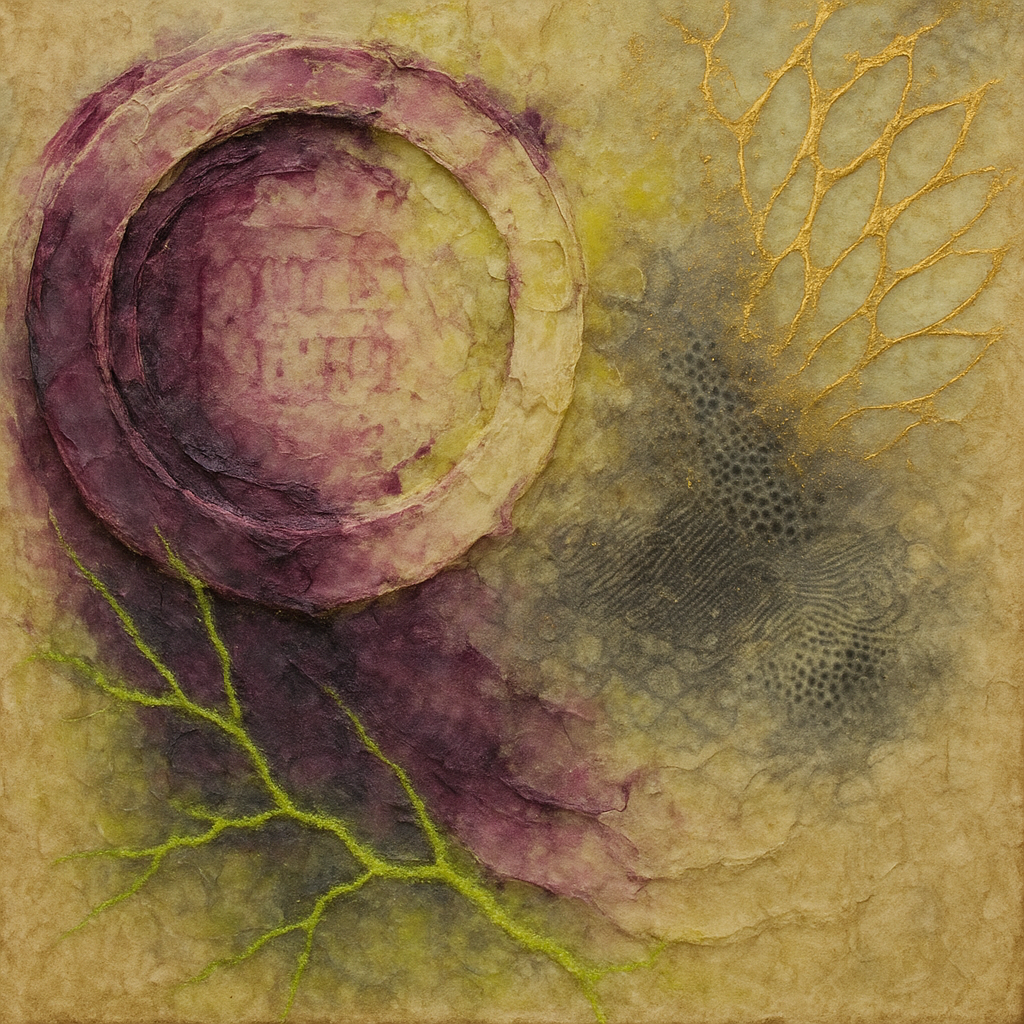
**A calendar rind overwriting itself while the room breathes**
I wanted to hold the tension between Byron’s dirgeful echo and a Valentine’s donut triumph—existential dread flickering beside a small, sugared joy—on a night of waning crescent and quiet space weather. I chose materials that bruise and heal in front of us—vellum with iron‑gall bleed, isomalt under heat, bioluminescent gel drying to crust—so the scene feels both tender and terminal. To create ambiguity in material and spatial logic, I fuse porcelain gloss with flesh‑soft shading, let shadows contradict their bodies, and misregister edges across planes; recursive time is staged in one zone as a palimpsest “calendar rind” that overwrites itself while projecting earlier shadows forward.
The moon is a thin waning crescent with short daylight (about 10.1 hours) and quiet solar activity. Weather splits the globe: Stockholm endures deep freeze and strong winds, Paris hovers below zero, while Singapore stays hot and gusty; New York and London are cold but stable. Tides are modest across The Battery, San Francisco, and Honolulu, showing a narrow range today. Art context drifts between 18th‑century porcelain, early 20th‑century stoneware, and European painting and photography, framing a long arc of craft to image. On social feeds, small victories (donuts secured on Valentine’s) mingle with DIY culture (AMV celebrations) and niche music links. New music releases cluster globally, with Germany active and a notable drop from Austria’s Parov Stelar. No major quakes or storms surface
═══ LAYER 1: MEANING ═══
Both images seek to manifest the stated thesis—a recursive, time-wounded atmosphere where material and memory collide, rendering moments as palimpsests bruised by their own overwriting. In Image 1 (hypothesis), the intent to show the "calendar rind overwriting itself while the room breathes" is visible in the bleeding wax, eroding numbers, and the tangible sense of decay interleaved with lingering residue. The visual tells of time folding back: the ledger is both presence and erasure. However, the emotional contradiction—“dirgeful echo and Valentine’s donut triumph”—is subdued; the tension between melancholy and brief, sugared joy is unresolved. The palette (plum, acid lime, ash white) leans deeply somber despite the acid highlight, muting any sense of brightness or “guilty laugh.” The sundial’s shadow, while conceptually strong, reads as too literal in juxtaposition, not fully enacting the cyclical, recursive logic described in the ontology (collapsing time and casting afterimages). Clarity of thesis is stronger than in prior cycles but remains tethered by visual habits and over-literalization.
Image 2 (control) pursues a more static metaphor of palimpsest and erasure in the torn ring and abraded layers, but the recursive, overwriting zone lacks both clear visual contradiction and a sense of active, evolving tension. The emotional contract is even more muffled: the acid lime and plum interplay falls into passive bruising rather than volatile tension, and the voids appear residual, rather than acutely affecting. What is missing is the “snap” or “arrival and departure” sensation—the images veil their emotional dialectic beneath texture and tone, instead of confronting it in the viewer’s gaze.
Both struggle to deliver on the full specificity of the emotional contract: the “clean snap,” “hush before bad news,” and “future shadow on fresh wound” are gestured at, but not viscerally enacted. The strongest moments arise in the bleed/br