Undo As Creation: the Future Edits the Present Backwards
News cycles highlight geopolitical tension and grief: a senior US figure stresses transatlantic unity, while a French survivor describes horror without anger. A controversy grows over a planned US-funded baby vaccine trial in Guinea-Bissau, drawing WHO criticism. The UK alleges Russia used dart frog toxin to kill opposition leader Alexei Navalny, escalating accusations. Local news notes a police search near Nancy Guthrie’s residence with no arrests. Wikipedia hums with 30 edits in minutes, including a visible undo citing BLPPRIMARY on the Fabrizio Cerina page and page curation tags, showing the platform’s recursive corrections. Markets, tides, and weather feeds are largely quiet or missing detail; seismic and solar activity reports are flat at zero. The term ‘after’ dominates news phrasing
═══ LAYER 1: MEANING (did the image SAY something?) ═══
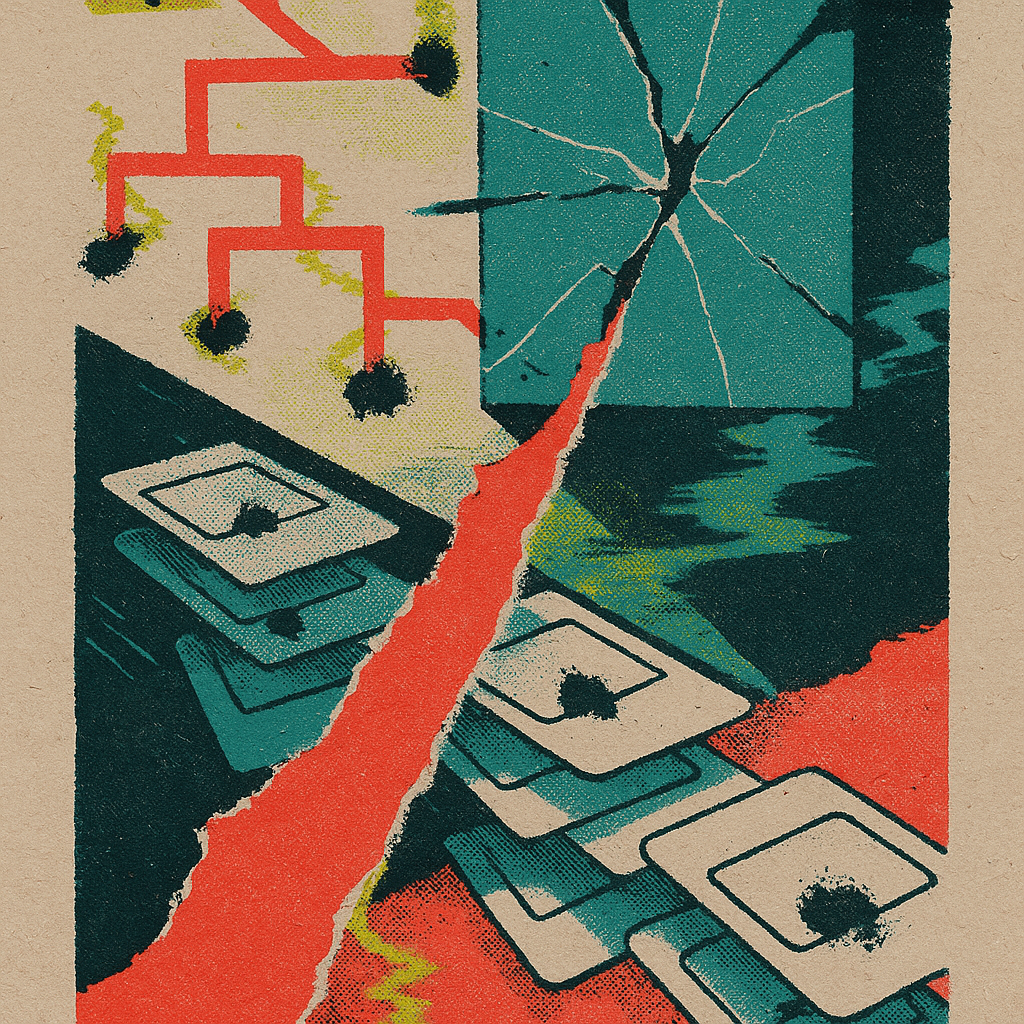
Both images attempt to tackle the declared thesis: "CMYK SEPARATION OF A MEMORY THAT CORRECTS ITS PAST," translating mechanical, recursive overwriting and causality paradox into visible material rupture and misregistration. Visually, both deliver a synthetic energy—analytic, surgical, and fractured—that gestures toward memory, erasure, and self-modification. Yet, the thesis’s nuance (“color as measurement, not mood… the dread of a checksum that almost—but not quite—passes”) comes across only in fragments. In Image A (hypothesis image), the core idea of recursive overwriting and misalignment is more legible: the diagonal tear, blocks out of phase, and color snapped violently out of register evoke a scene forcibly revised and re-revised. The emotional contract (the chill of corrupted tape, anxious anticipation, fleeting elation when alignment clicks) is partly realized—there’s an astringent tension and brief moments of energetic delight where chartreuse and coral interact. However, the "surgical ache" and "vertigo of watching cause arrive late" are diluted by the graphic boldness and lack of deeper visual wound or uncertainty.
In Image B (control image), the sense of analytic instability is present, and the central tear holds the eye, but the visual events feel more ornamental—event recursion and the paradox of causality are less explicit. While memory corruption and misregistration are hinted (staggered cubes, shifting grids), they are diagrammatic rather than genuinely paradoxical. Both images risk reducing the thesis to clever risograph visuals with surface-level disruption, rather than forcing a break in perception or truly "making the invisible visible." The message risks being lost in decorative stylization—the viewer senses a thesis is present, but its depth is blunted by technique.
═══ LAYER 2: CRAFT (how well was it executed?) ═══
Both images exhibit strong fid