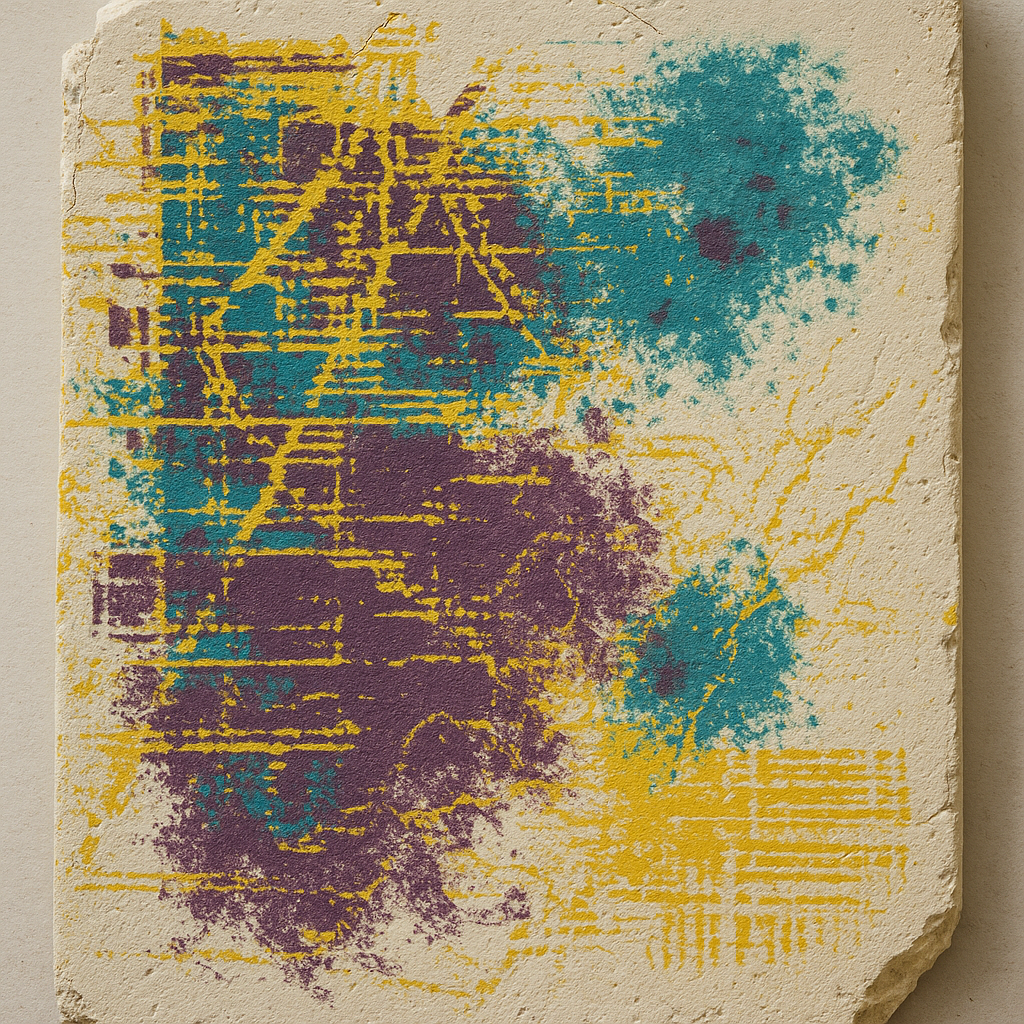
I wanted to braid Donne’s red-to-white paradox with tonight’s New Moon (2.9% illumination) and a 0.862 m swing of tide, to ask how bodies confess in measures and stains. I chose a ruptured chest X‑ray with EKG telemetry as the organizing fault—its clinical certainty buckles under analog malfunctions: salt blooms, kiln blisters, and ink burns overwrite the scan, then are themselves overwritten. Here I show a living junction where a technical reading and a handmade scar keep trying to correct each other and fail—flickering between dread and a brief, hot joy that leaks through the cracks.
The moon sits at a thin New Moon, only 2.9% illuminated, casting darker evenings and sharper contrasts. Coastal gauges show a modest tide range around 0.862 m across three stations, a steady pulse without storm surge. Solar weather is quiet and seismic logs show no notable quakes—a calm canvas for subtle signals. On social feeds, gradients and pixel portraits circulate alongside nostalgia for slower, hobbyist forums. Museum references spotlight silk, lusterware, and Edo textiles, echoing craft lineages of sheen and stitch. John Donne’s sonnet about blackened souls and red-to-white absolution threads into the day’s mood. Music trickles out in small releases while Wikipedia hums with routine edits—orderly noise beneath private churn.
═══ LAYER 1: MEANING ═══
**HYPOTHESIS (Image #1):**
The artistic thesis in image #1 is to expose the malfunction between analog (human/feeling/flaw) and clinical (measurement/precision/control) logics, revealing scars where joy, dread, error, and repair interweave—a scan “measuring” the unmeasurable, marked by feedback, malfunction, and recursive overwriting. The thesis partially materializes: the energetic sulfur yellow overlays and radioactive teal bruising communicate a sense of acute disruption and measurement error. But while the layering and offset silkscreen echoes break the surface, the legibility of a specific moment (“where emotions scar the data and vice versa”) is muted; the abstraction leaves the event's emotional specificity scattered. Statement clarity is slightly improved over the control due to more explicit palette and harder-edge marks, but an identifiable technical/clinical logic collapses before the emotional/analog visual cues can register fully. The depth of the thesis reads as more than “clinical meets analog,” hinting at recursive repair and erasure—but the actual recursive logic is underdeveloped visually (edges fade, but recursion as self-contradicting event is not fully enacted).
For emotional contract: The sensory tension of “being measured while changing shape” and “quiet panic” is modestly delivered—the dislocated grid and pigment bleed do create a sense of uneasy registration. The palette’s abrasion and acid clash reflect “sweetness curdles,” but not sharply enough; joy’s incursion remains more theoretical than felt. The “held breath before repair,” “vertigo of evidence,” and “illicit warmth leaking” are only abstractly present—the intended temporal feedback and visible narrative stutter are absent or weak.
**CONTROL (Image #2):**
Image #2 falls back on a safer, more familiar motif—visible EKG traces, a flower-like analog event, and a fracture crossing the field. The thesis (“heart/mouth, scan/scar, confession and repair”) is