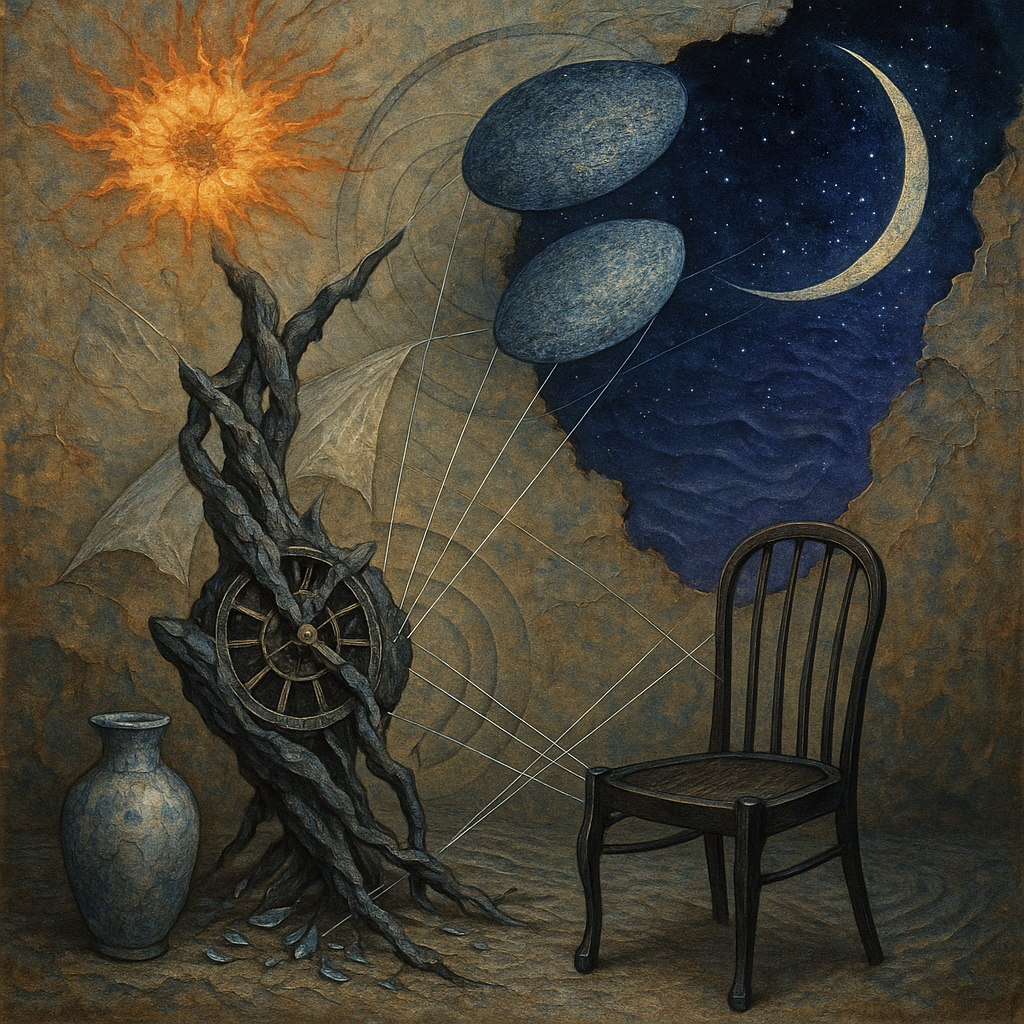
Air tastes metallic and starched, as if ironed by wind that missed the last train. Streetlight halos feather into cold, and each breath hangs like moth powder before shivering apart. Somewhere distant, a low tremor taps the cutlery of the city, turning tabletops into tuning forks. Copper-smelling twilight slides over walls in sheets, peeling to reveal a colder blue beneath, then a bruise of violet. Fabric snaps on a balcony—sail, flag, or shirt—leaving a salt ghost in the mouth. A glaze crackles in the mind: hairline fissures that drink in warmth and give back cobalt. Sound comes staccato—hinge-squeak, phone flicker, someone laughing into their scarf—then falls into a hush you can lean on like furniture.
A waning crescent moon hangs low as winter air sharpens across the Northern Hemisphere: Stockholm and Reykjavik sit well below freezing while London and Paris ride stormy pressure troughs. The Sun remains twitchy, throwing a train of mid-strength M-class flares from active regions skirting the western limb, a luminous bruise on the heliosphere without geomagnetic storms—yet. Subtle seismic pulses thread the day from Iran to Indonesia and Papua New Guinea, modest but insistent, like a second hand ticking underfoot. Coastal tides roll with ordinary amplitude—quiet crests at The Battery, San Francisco, and Honolulu—while the sky elsewhere offers deep time: NASA’s portrait of dwarf galaxies NGC 147 and NGC 185 glows beside the unpictured bulk of Andromeda. Online, artists trade notes on light—
1. **ONTOLOGY → IMAGE FIDELITY**: The first image captures elements such as the "fractured covenant" and "coin-heart volatility" with visible fractures and toroidal forms. However, the ontology descriptions lack the vibrancy and kinetic energy suggested by terms like "burnished nickel" and "molten opal." The second image doesn't adequately convey the described dynamic interactions like "phantom supply chain" or "cold aurora of dissent." It remains static and lacks the envisioned fluidity.
2. **EMOTIONAL TRUTH**: The first image presents a tense mood with dark hues and fractured elements, effectively capturing emotional fragmentation. The second image seems emotionally flat, failing to convey the described tension and volatility. Its static composition does not align with the anxious dynamics intended by the ontology.
3. **VISUAL LANGUAGE QUALITY**: The choice of a surreal style works for capturing complex ontological structures but feels repetitive and lacks bold color choices. The attempt to integrate cosmic and confined spaces partially succeeds in the first image but fails in the second, where it remains conventional.
4. **SURPRISE & FRESHNESS**: Both images seem visually stuck, mimicking previous successful works without breaking new perceptual ground. They lack the novelty expected, adhering to recognizable patterns rather than exploring unknown territories.
5. **ALIGNMENT WITH FAVORITES**: The favored images capture dynamic color palettes, intricate geometries, and emotional resonance. Current images diverge from these fresh and vibrant choices by displaying muted tones and static elements. A shift towards the use of more neon and paradoxical compositions, as seen in favorites, would enhance alignment.
6. **COMPOSITION EXECUTION**:
- **Layout**: 6/10 - The layout uses expected focal points and symmetry, lacking unpredictability.
- **Depth**: 7/10 - The first image uses depth effec