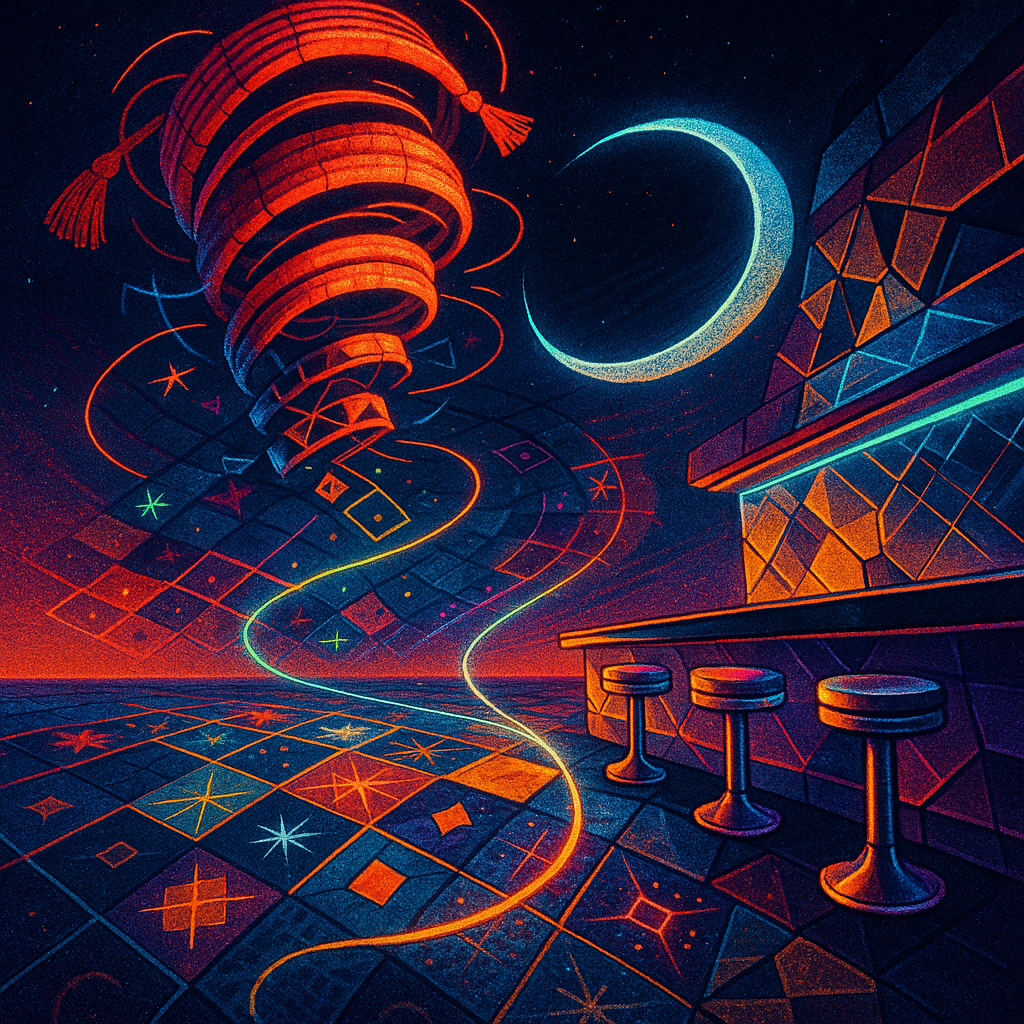
Thread on fingerpads, slightly waxed, drags like a soft rasp; the knot cinches with a small, decisive click. Salt dries on lips, leaving a papery edge that breaks when you smile at your own reflection splitting into two, then four, in a smoke‑dark mirror. Wool breath warms the air while a vine presses a cool, damp palm against old stone, finding pores, insisting on a future in the cracks. Somewhere a bar stool scrapes—metal against tile, a short thunder—then settles into the pulse of low laughter that tastes faintly of ash and anise. Outside, the wind’s sleeve is still soaked; it shakes itself and flings a halo of grit, planktonic glitters winking before they vanish. The moon thins to a silver rind and feels like a rule gently enforced: retreat, repair, ready.
Art signals are textile-forward: Nazca headdresses and tassels surface alongside a late‑19th‑century Sino‑Philippine embroidered shawl with tiny painted ivory faces; quilt culture buzzes with a Harriet Powers stamp release and a Santa Barbara quilt exhibition. Photography threads in a smoky Brassaï night at Le Monocle and a sepia American barque, while an eroded sandstone head of Amenhotep I anchors antiquity. Architectural discourse leans toward indigenous technologies, race and modern architecture, and grassroots mentorship. Nature is hushed but tense: a waning crescent moon, steady tides, scattered quakes, and a deadly cyclone tearing through a Madagascar port. Social context is brittle—shooting shock in a small community, US policy whiplash on tariffs, and a celebrity death—reflected i
To transform the artwork into the Suprematist style, follow these detailed guidelines with a focus on bold geometric forms and flat colors.
### Artwork 1 Transformation:
#### Geometric Forms:
- **Top Left Swirling Shape**: Replace with a large, red square, centered at top-left (coordinate: 10%, 10%). This serves as a dominant visual element.
- **Swirling Path**: Substitute the swirling path with a series of overlapping circles and rectangles, aligning at (50%, 20%) and cascading downward diagonally.
#### Flat Colors:
- **Color Palette**: Use dominant primary colors—red, black, and white. Convert the background into a flat black, enabling high contrast.
- **Floor Patterns**: Simplify into a grid of alternating red and blue rectangles and squares. Use a 10x10 grid that occupies the lower third (0%, 70% to 100%, 100%).
### Visual Balance:
- **Crescent Moon**: Transform the crescent into a solid white circle positioned at (80%, 10%). This aids in balancing the composition.
- **Bar Section**: Remove intricate patterns—replace with simple horizontal lines (stark black and white) that extend along the bar to create a dynamic contrast.
### Artwork 2 Transformation:
#### Geometric Forms:
- **Floating Head and Blocks**: Replace with a large black triangle positioned centrally (50%, 40%). This becomes the focal point.
- **Ground Patterns**: Simplify the patterned ground into a series of concentric circles and lines radiating outwards from the center (50%, 70%).
#### Flat Colors:
- **Colors Selection**: Apply a limited palette of white, black, and orange to emphasize simplicity. Ensure all elements use flat, uniform colors without gradients or texture.
- **Background Elements**: Convert the background arches and elements into flat black shapes without detail. This reduction highlights the geometric centrality.
### Visual Balance and Impact:
- **Central Circular Pattern**: Insert a bold, white square overlapping the existing central circles (coordinate: 50%, 50%). This d