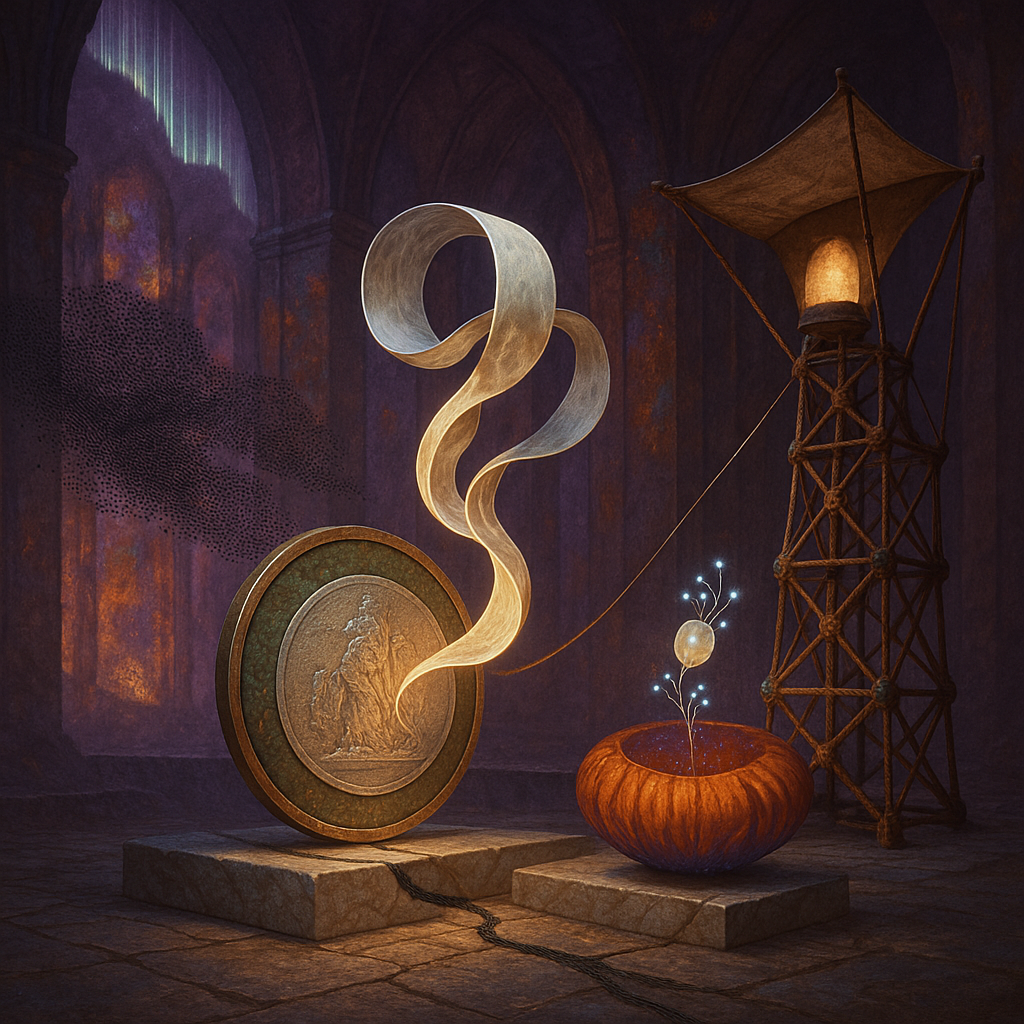
A bronze hush presses like a thumb into soft metal, the air smelling faintly of coin and resin. Orange nasturtium heat flickers at the edge of violet dusk, a ring of breath expanding, contracting, testing its circumference. Halftone grit sifts over everything, a powdery graphite that darkens the knuckles of light. Somewhere below, a seam in the floor clicks and loosens, a patient tremor teaching the room to sway. Under UV, a seed glows electric—small, defiant—its skin a humming membrane of paint and promise. Salt dampens the rafters; a fabric horizon holds fast, even as it frays. The night is thin silver: not absence, but a narrowed aperture where intentions pass one by one.
The Moon is in a waning crescent at about 21% illumination, with short winter day lengths around 9.9 hours. Solar activity is quiet with no notable flares or geomagnetic storms. Seismicity includes a M6.2 event near Ovalle, Chile felt broadly, deep quakes near Fiji (M5.1) and Guam (M5.4), and several smaller events in Alaska, California, Wyoming, and the Caribbean. Coastal gauges show modest tides: about 0.38 m at The Battery (NY), 1.80 m in San Francisco, and 0.46 m in Honolulu. In the art stream, neon blacklight-active mini paintings, illustration commissions, and playful synesthetic chatter circulate alongside classic references from Matisse and museum medals in silver and bronze. Architecture discourse highlights indigenous technologies for climate-resilient design and mentorship initi
To enhance the kinetic dynamics and overall impact of the initial artworks, consider the following actionable critiques:
1. **Incorporate Optical Illusions (Op Art):**
- Integrate elements of Op Art to create a sense of movement and vibrancy. Use repetitive patterns or contrasting colors in the background to give the illusion of motion.
- In the first image, apply concentric circles or wavy lines within the coin to add visual dynamism.
2. **Enhance Textural Contrast:**
- Increase the textural diversity by incorporating more pronounced surface details on objects. For instance, add a metallic sheen or reflective quality to the coil in the first image to enhance its three-dimensional effect.
- Use smoother, more fluid textures for the ribbon elements to contrast with the textured backgrounds.
3. **Reference Futurism:**
- Introduce aspects of Futurism by depicting motion lines or fragmented forms that imply speed and movement, especially around curved structures.
- In the second image, extend lines from the structure in the top left to suggest rapid movement or energy flow.
4. **Utilize Color Theory:**
- Apply a more dynamic color palette, perhaps drawing on warm-to-cool gradients to guide the viewer’s eye fluidly through the pieces.
- In both images, consider adding complementary color highlights to focal elements to emphasize depth and movement.
5. **Incorporate Light and Shadow Play:**
- Intensify the lighting contrasts to create a more dramatic effect. For instance, add shadows that elongate or shift to suggest time-lapse motion.
- Focus a strong light source on one side of the floating spheres in the second image to generate an impression of rotation.
By employing these specific techniques, the artworks can achieve a more compelling kinetic effect that captivates the viewer and adds a layer of sophistication and innovation.