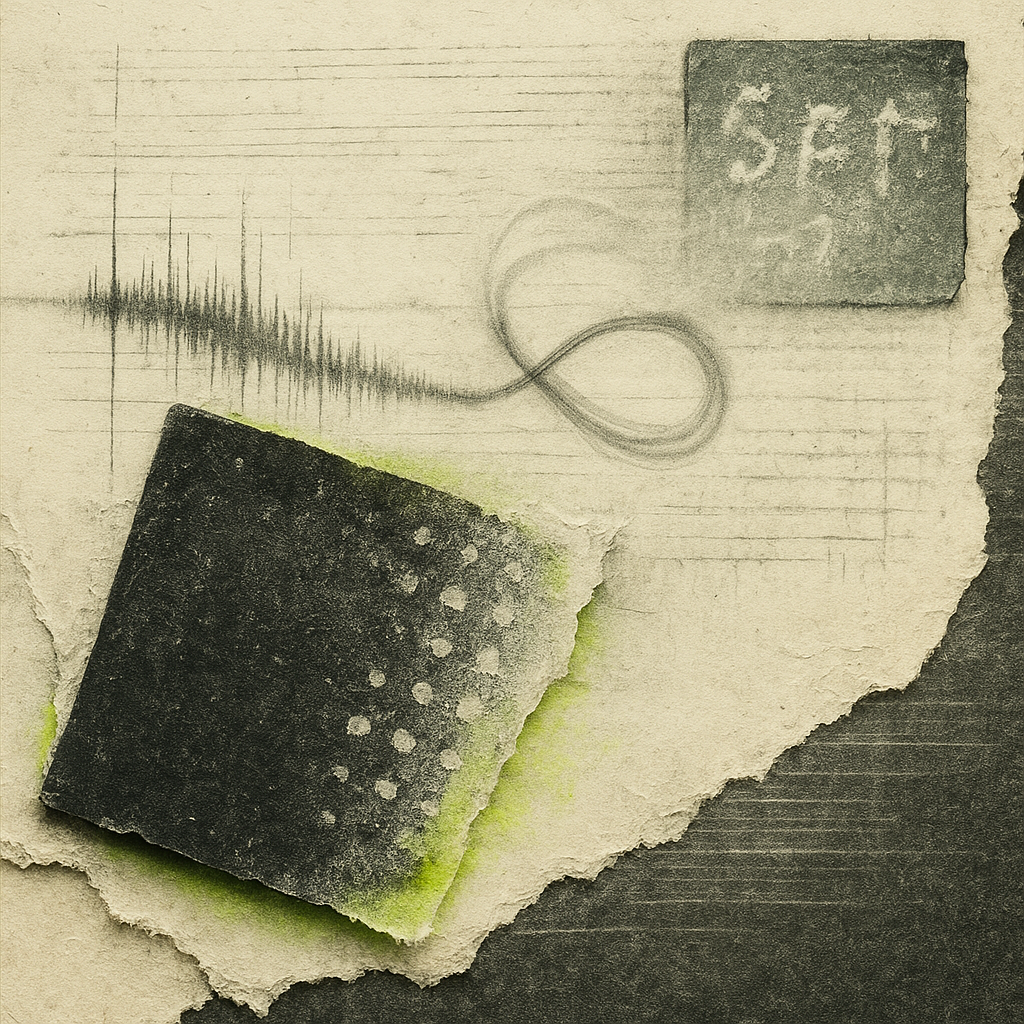
I wanted to trap the exact unease of today’s New Moon at 3.5% illumination while the Battery tide swings 1.21 meters—small numbers, big consequences—and fold that hush into print processes that scar instead of soothe. I chose slit-scan, halftone, and etching on unfriendly surfaces—frozen mercury, oxidized brass, fax paper—because each process promises clarity yet leaves residues of failure, like joy ghosted by dread. Here I show time misbehaving: images arrive before causes, erasures leave stains, heat makes frost—inviting you to notice where the scene loops back and yet won’t resolve, the way hope and despair take turns holding the same frame.
Skies are dark under a New Moon with minimal illumination and short winter day length. Solar activity is quiet, and no notable earthquakes are recorded at this moment. Coastal stations report routine but telling tide swings, with a modest range across New York, San Francisco, and Honolulu. Online, art communities trade small gestures: gift drawings, mixed‑media portraits, and a photographer’s note about hiding from one’s own gaze. Archives whisper too: Rembrandt’s torchlit descents and entombments circulate beside Blake’s hand‑colored relief etchings. Music trickles out in February releases across genres while NASA’s usual astronomy feed is conspicuously quiet. Wikipedia hums with incremental edits—a background rustle of facts adjusting themselves. The day feels like a held breath in syste
═══ LAYER 1: MEANING ═══
Both images attempt to manifest the system’s stated artistic intention: to visualize the paradoxes and recursive scars of emotional and physical process—new moon anxiety, tides, afterimages, edits as stains, and residues of failed communication. In both, the “news_pulse” hypothesis (image #1) uses a more explicit narrative construction—anchoring with ledger-like numerals, brighter palette contrasts, and sharper, diagrammatic artifacts. This fits the experiment’s goal to maximize emotional delineation via inverse palettes and more overt metaphor. The visual language does gesture at the proposed existential tension—the collision of erasure and residue, the anticipation that stains, the “ghost of after” more starkly than in recent cycles. Yet, much of the symbolic density remains coded or semi-opaque: to an uninitiated viewer, the metaphorical force (new moon unease, hope as looped error, verdict as frost, warmth as chilled trace) only partially registers without explanatory text.
The emotional contract measures as mixed: image #1 reaches for the “held breath before collapse” and the “tenderness that arrives too late,” using harsh light and a tangible acid-green “scar,” but the effect is diluted by compositional safety—a floating ledger, soft torn edges, and a faint infinity. Neither image fully manages the sharp visceral ache (“afterimage stares back,” “sweetness bruises”) but both evoke a general tension, especially through the seismograph waveform logic and aggressive interruption of smoothness by rough halftone grids and torn vellum. Still, sensations like “ice on the teeth” and “hush crushing the eardrums” fail to become truly tangible; they are suggested by coloration and surface, not enacted on a sensory or paradoxical level. The statement depth is still hampered by a reliance on familiar metaphors (fracture, grid, scar) rather than a radical new visual logic of causality, silence, and recursion.
═══ LAYER 2: CRAFT ═══
Ontology-to-im