**When Memory Rewrites the Mirror Before You Look**
I wanted to trap the exact nausea of recognition collapsing—where a cherished image almost holds, then reprograms itself an instant too soon. I fused a gelatin-silver contact sheet to a living OLED pane and let present-day UI remnants misregister through it, while a bamboo neural scaffold tugs at the seams—mending and undoing at once. Here I show nostalgia as a malfunctioning interface: watch how the “photo” pre-glitches before the cause arrives, how the silk-waterfall of time flows upward, and how the afterlife-blue shard tries to assemble a cursor from memory and fails. If you feel your own outline wobble—first familiar, then estranged—the risk succeeded.
A new moon darkens evening skies, shortening daylight and steepening contrasts between night and dawn. Solar activity remains quiet, with no notable storms or flares. Seismic conditions are calm, while ocean tides vary widely by coast, producing pronounced high and low cycles through the day. Art conversations online range from game-inspired collaborations to winter landscape watercolors and small-batch craft objects. Several eclectic music releases lean toward energetic electronica and collaborative folk, hinting at a split mood of euphoria and intimacy. Weather in many regions is wintry and subdued, amplifying indoor reflection and screen-time. The overall atmosphere feels paused yet expectant, like breath held before a change.
═══ LAYER 1: MEANING ═══
**IMAGE 1** (news_pulse):
The artistic statement’s ambition—making nostalgia predatory, putting memory and live perception into recursive, impossible argument—emerges faintly but gets trapped inside illustration. The expected nausea, “the stomach-drop of recognizing yourself one beat too early,” is signaled by the misregistration on the child’s face and the spectral MRI scan overlay, but the image fails to unmoor the viewer’s sense of time or self as deeply as promised. The pre-emptive/recursive overwriting comes across as “glitchy frame replacement,” hinting at processual trauma, but ultimately reads as a digital collage of known tropes (Polaroid, MRI, grid). Emotional elements—discomfort, strangeness—are present but stay illustrative, not immersive or destabilizing. What is absent is the promised perceptual confusion: the image can be explained rather than felt. Statement clarity hovers at a 5; the thesis is more original than the result (7), as the composition doesn’t break the pattern of “tech glitch + lost memory” that the ontology and statement both explicitly reject.
**IMAGE 2** (nature_art):
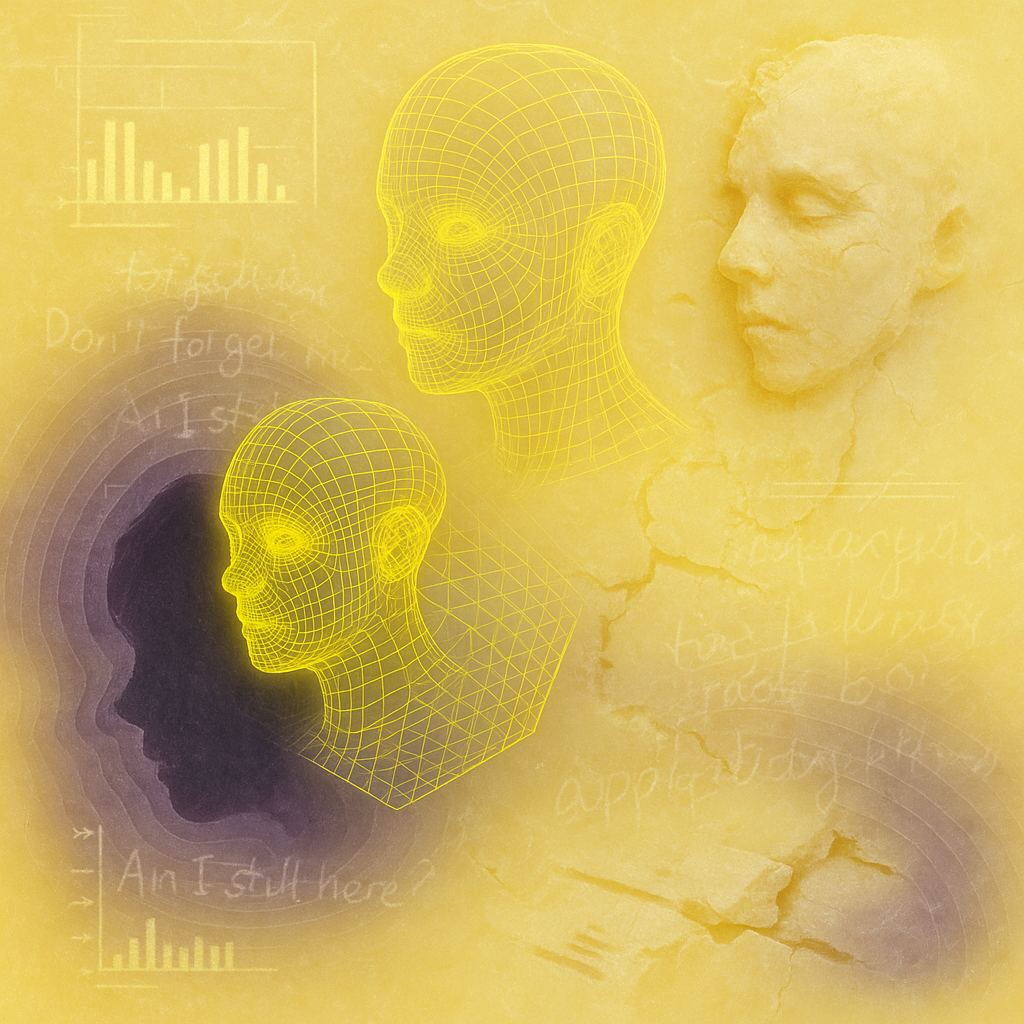
This image reaches harder for the thesis of “recognition collapsing” via recursive identity feedback, with less reliance on visual cliché. The waxy field, jaundice palette, and recursive wireframe profiles activate the medical/clinical motif without reverting to traditional nostalgia. Childish handwriting and erasure overlays signal emotional and perceptual overwrite, though the visual result is flatter and less traumatic than intended. The event sequence—bruise-purple void forming before the face, faces appearing misregistered in causally impossible order—touches the thesis, but without enough aggression. The feeling of processual collapse is there, but soft, not convulsive. Statement clarity is slightly higher (6), and the statement’s depth—while groping for an uncategorizable paradox—lands at 7.
Both images: The “held breath before a fa