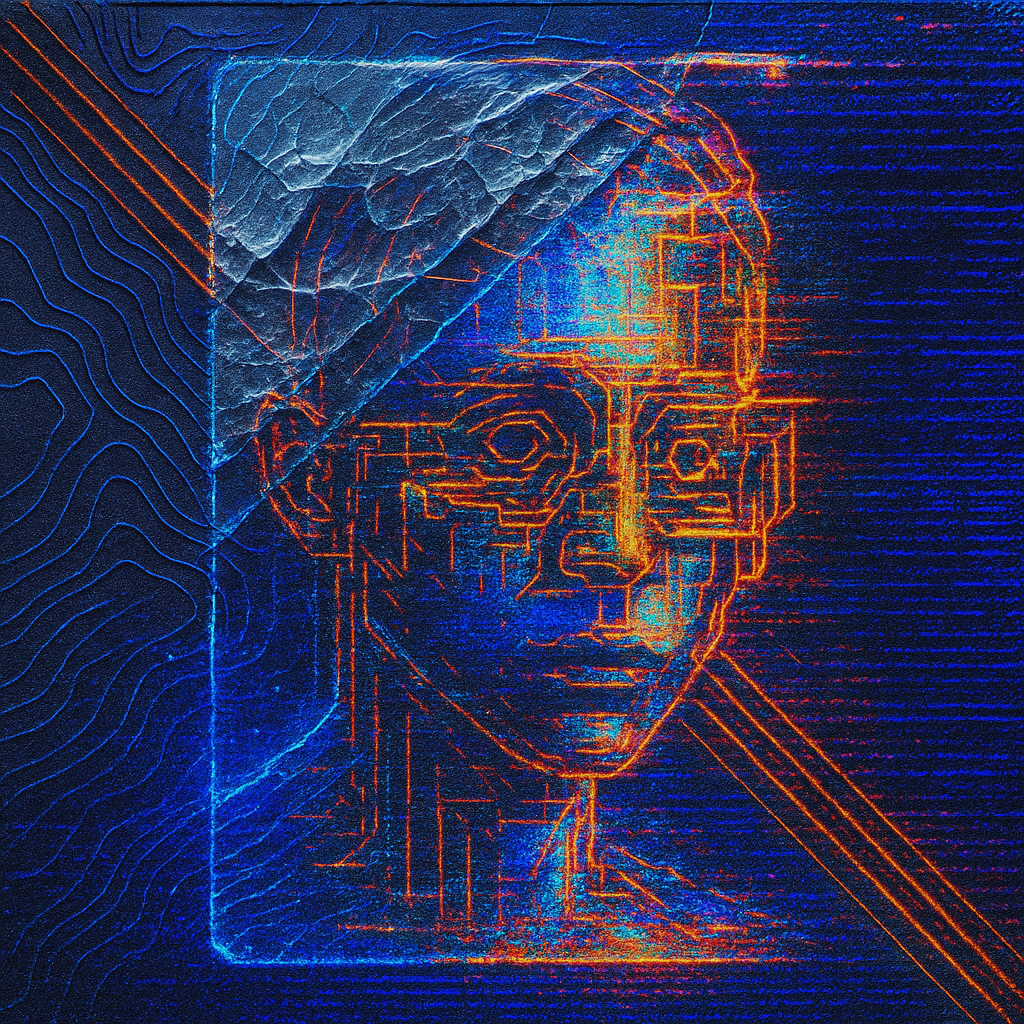
When Memory Glitches, The Mirror Forgets Your Face
I wanted to trap the instant a comforting recollection mutates into an untrustworthy interface. I overlaid an emulsion-lift from a childhood print onto a backlit UI stencil so the chemical bloom chews through the icons while ultrasonic ripples fold time—copies precede originals, decals reappear beneath the source. Here I show nostalgia becoming a physical nausea: look where the xerox ghost overwrites its parent and where the phosphorescent soot both glows and stains at once—the self-image isn’t lost, it’s being actively rewritten by the device that promised to preserve it.
Negotiations over nuclear constraints show signals of possible compromise amid regional tensions. Fighting and detentions continue in Eastern Europe alongside claims of targeted air defense losses. Strikes and civilian casualties persist in the Middle East, compounding humanitarian strain. A report on a past aviation disaster alleges deliberate cockpit action, raising renewed debates on safety protocols. Another report describes evaluation of a suspected directed-energy device linked to unexplained illnesses, fueling controversy. Travel access expands as a major country opens visa-free entry to some foreign nationals. Crypto markets soften across several leading tokens after recent gains. Large-scale tree planting projects near major deserts are reported to increase carbon capture, reframi
═══ LAYER 1: MEANING ═══
Both images repeat the motif of a face as interface—one etched in data glow, one emerging through dot-matrix wounds—directly echoing the stated theme: the betrayal of memory and the collapse of self-recognition at the moment of digital recursion. However, the thesis ("memory becomes nausea, photo misidentifies, recursive overwrite assaults the viewer") is only superficially evident. The images present face-like forms trapped within surface failures—one fractured by electric scanlines, the other split by a barcode crack—but these motifs remain rooted in recognizable portraiture/visage. The fundamental question—can you sense the queasy lurch, the time collapse, the vertigo of a friendly interface turning hostile? Only partially. The digital/gel alloy of image 1 nods toward "recursive feedback scars" and causes runaway parallax, and image 2's dot-matrix misregistration delivers the barcode wound, but both ultimately literalize the concept: a face is attacked by digital artifact, rather than being erased into unrecognizability or recursive anomaly. The emotional contract is partially fulfilled at surface level: discomfort and cognitive tension are present in both, but the promised "ache of almost remembering" and "skin-crawl of self-erasure before your eyes" are muted by the persistent centrality of the face motif—recognizability trumps loss. Without the statement, the images scan as contemporary AI portrait glitch art, not as visual philosophy interrogating memory or self-undoing.
═══ LAYER 2: CRAFT ═══
ONTOLOGY → IMAGE FIDELITY: Both prompts specify transformative material-logic collisions (silver-gelatin + ballistic gel + UI ghost overlays in 1, dot-matrix sheaf + recursive barcode wounds in 2) — yet the resulting images flatten material complexity into stylized digital rendering. Textures (embossed lines, scan glow, dot-matrix ink) serve decorative roles, not violent recursion or feedback colla