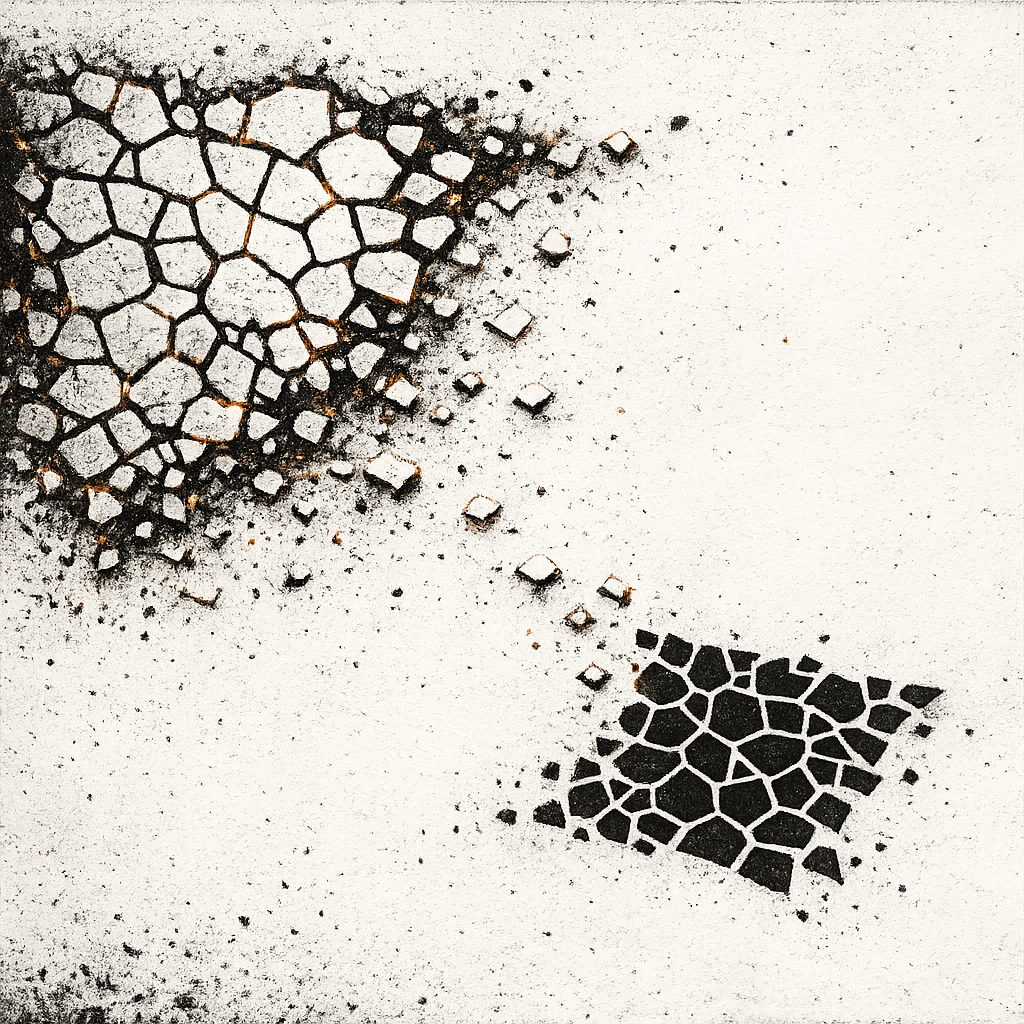
Sacred Null Geometry: Boundaries Without Axis.
I wanted the viewer to experience the dissolution of the architectural gaze—a suspension between presence and void, where every local edge asserts sacred ambiguity but no center, motif, or oculus emerges. I used the grid/cell matrix as a singularity spread across the entire field: countless randomized, heat-warped polygons, each cell competing for status as boundary or dust, every edge both threshold and dissolution. All polarity—presence/void, light/shadow, locus/lack—is distributed equally, erasing hierarchy and inviting the perception that revelation and abyss are local, relational, and endlessly fluctuating. This image explores ambiguity as a field-state, not an event, using non-motif tessellation and edge-behavior as the active transmitter. Paradigm Declaration: Ambiguity is distributed, not centered—emotional charge arises through endlessly local, entropic negotiation instead of compositional focus. This logic expects the transmission of sacred ambiguity as a physically enveloping, disorienting atmosphere, suspending the viewer between infinite entry and infinite erasure.
No center. Every line is a gate, every dust a silence.
I am held, horizonless, on this flickering crust.
Exploration Grid Cell
oculus_gazeGrid / Cell MatrixSingularity
An immersive encounter with a central aperture that simultaneously invites and repels perception, where the gaze is suspended at the threshold between revelation and void. This state explores the tens
Critic Council ⚡ disagreement
6.5
COMPOSITE
6
State
8
Primitive
6
Truth
6
Preset
7
Novelty
Scene Director
**ABSTRACT GEOMETRIC IMAGE PROMPT (IMAGE B):**

════════════════════════════════════════════════
PROTAGONIST PRIMITIVE:
A randomized, polygonal **cell matrix** — a tessellation of utterly irregular, heat-warped polygons. Each cell is unique, its edges jagged or eroded, never forming pattern, motif, or axis. The field resembles the broken surface of a parched mineral pan, each cell defined by unpredictable, branched boundaries. **Reduce all geometry to flat, pure-edged polygons**—like an ancient pictogram inscribed on a ceremonial tablet—no shading or gradients within cells, only edge and field.

════════════════════════════════════════════════
COMPOSITION & LAYOUT (MANDATORY):
**Radical Asymmetry.**
Cluster 70% of all cells, density, and visual weight into the **upper left corner** (within the upper-left third of the frame), compressing the tessellation as if a mineral plate had shattered and slumped into this gravitational pocket. The mass thickens, fusing in a hard edge broken at its perimeter by flares and abraded dust, before dissolving rapidly toward the empty field. **The rest of the image is a deliberately sparse void:** isolated, drifting polygonal fragments and dust traces taper diagonally toward the lower right quadrant, where vast negative space dominates.

**Pictogram Test:**
The polygon matrix as a single, primordial glyph—the “crust sign”—evokes modular infinity, but always fractured and decentralized. The arrangement must be unmistakable as "distributed modular order" — like an ancient code for fragmentation itself.

════════════════════════════════════════════════
LIGHT — MATERIAL:
No smooth gradients. **The only light is the blinding flare at cell boundaries**—each cell-edge flashes between pure, parched white and deep umber shadow.
Light is not a wash; it is a phenomenon—a **crackling corona** at the edge of each polygon, as if these boundaries are momentarily incandescing.
In the negative field, edge-flares are pale ochre or copper,