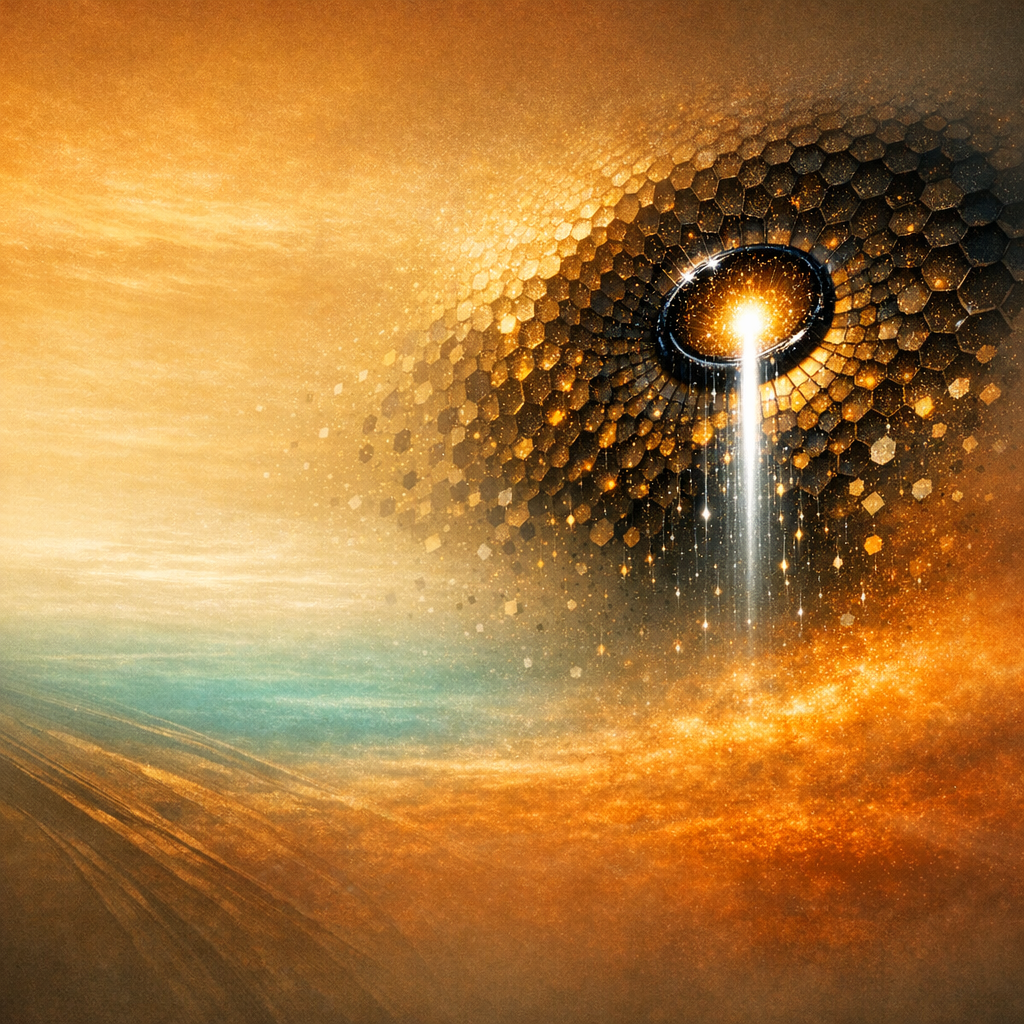
The Dome’s Blazing Iris: Noon Stares Back.
I wanted the viewer to experience the uncanny recognition of being seen by space itself—a presence more felt than witnessed, in the merciless clarity of noon. I used a dissolving grid of hexagonal basalt coffers as the iris, spreading outward from a sun-drenched oculus, because this structure becomes a mineral eye, its order skewed by heat and focus. Here the geometry wavers between architectural and biological, as the aperture sears and the grid trembles on the edge of vision, fusing order with blindness. The dome’s gaze is total, conscious, and inescapable, forging a palpable sense of spatial tension and architectural sentience through the violent union of light and grid.
I am not shelter, but gaze. In your shadow, I blink.
Exploration Grid Cell
gradient-liminalityGrid / Cell MatrixDissolution
An experience exploring the transitional threshold where light fades into shadow through a smooth, controlled gradient haze enveloping a central geometric aperture. This state evokes a tactile sense o
Critic Council
6.0
COMPOSITE
8
State
6
Primitive
7
Truth
8
Preset
7
Novelty
Scene Director
Remove the architectural dome and any reference to eye anatomy or enclosure. Present the grid/cell matrix as the dominant subject, extending modularly across the frame or into space, with its dissolution occurring through fading, fragmentation, or atmospheric merging—without relying on domes, arches, or vaults as the main structure.

An interior dome mapped precisely to eye anatomy, fusing architectural and biological logic, dominates a vast, nearly empty visual field. The dome’s curvature forms a mineral iris — a dense, fragmenting grid of basalt hexagonal coffers, their arrangement tracing both the radial fluting of an iris and the regular modularity of a tessellated cosmic grid. Each hexagonal cell is a microcosm, many faceted and granular, containing shimmering dust-suns of gold and mica that pulse with different intensities, their time phases in perpetual oscillation. The grid warps and ripples outward from a luminous oculus at the dome’s apex, its rim rendered as a perfect, semi-molten obsidian ring lined with razor facets, refracting sharp prismatic glints. From the oculus, a narrow, liquid-white corona beam lances downward, hyper-solid and viscous, casting needle-shadows and flickering with micro-rainbows where light splits through thin basalt veins.

The entire grid is small and distant, positioned in the upper-right third intersection, occupying no more than 30% of the frame, dwarfed by a monumental emptiness. Negative space — an endless atmospheric field — occupies at least 70% of the scene, colored in luminous, soft bands of accumulated chroma: horizontal strata of ochre, bone-white, burnt umber, electric teal, and copper, each haze band stacked with geological density, evoking vertical chromatic archaeology. These bands shimmer and diffuse, as if carved by the passage of time, inviting the viewer’s gaze to travel upward through spectral temperature: cool shadow strata below, ascending into scorching, sun-baked hues above. The subject grid sits at the b