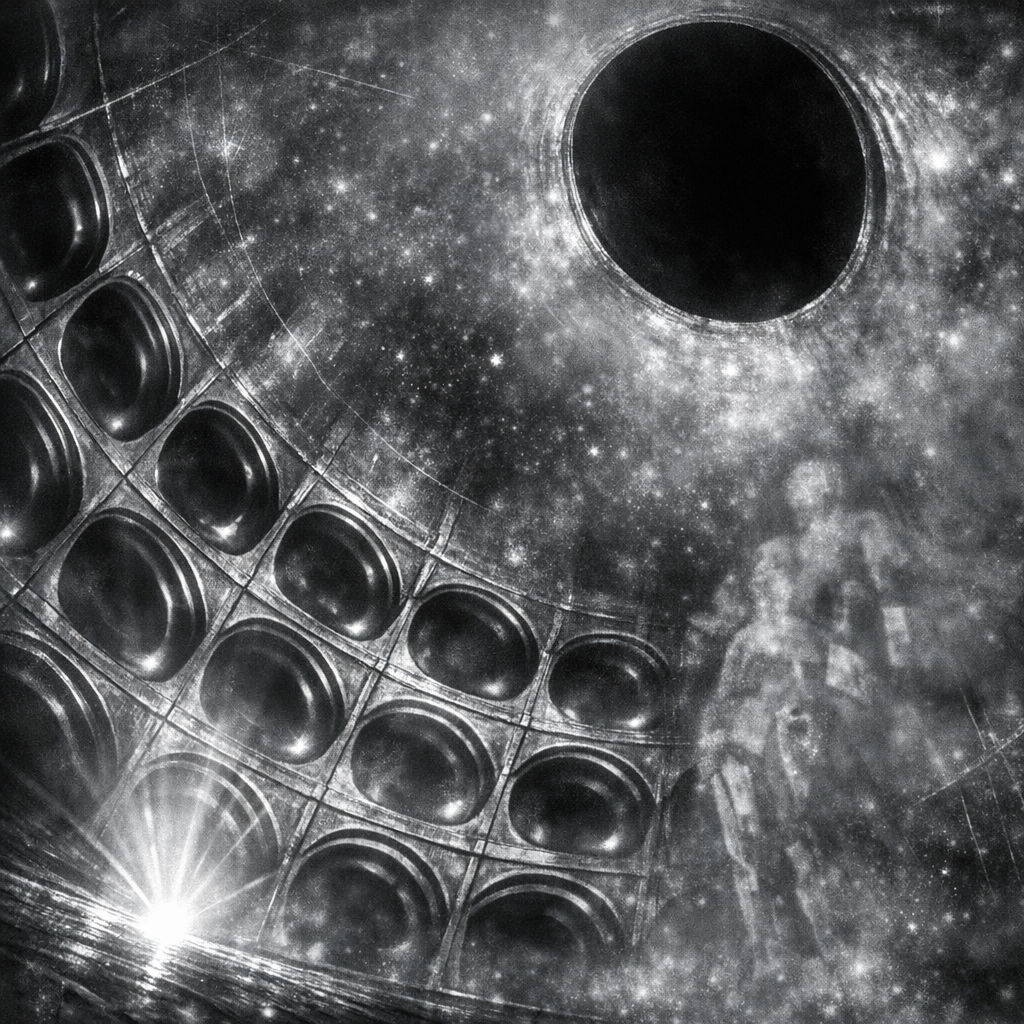
Womb
Womb Horizon: One Curve, Two Opposite Worlds
I wanted the viewer to experience Cosmic Containment. I used Gradient/Field as Collision because I set a self-luminous, peach-toned membrane against a recessed, warm-dark oculus and split them with a tender horizon so their transitions fight in slow motion. The clash of a nurturing field and a withdrawing depth makes the spine rise while the chest grows weightless, proving the same curve can cradle and unmoor at once.
I hold you while you fall outward.
Your weight returns as warmth, then leaves again.
Scene Director
**IMAGE #1 — PHOTOREALISTIC DOME INTERIOR PROMPT**
*(With all creative constraints, radical experiment, and required dome seed fully integrated)*

---

**Prompt:**

X-ray radiograph, negative inversion, metallic acoustic dome, fragmented figure, ember twilight haze:
Photorealistic interior shot of an impossible dome space, as if captured on a large-format camera on high-ISO monochrome film, processed as an X-ray negative. Viewer is positioned just inside the shell, at floor level, looking upward and diagonally toward the dome’s horizon, with the frame anchored off-center. The architecture is a catenary-lean metallic dome, 8-10 meters in diameter, lined with deep, recurved *coffer panels*—each a perfect miniature dome-within-the-dome—rendered as luminous, ghostly absences that swell from the shell and vanish into spectral shadow. The coffers’ negative relief is exaggerated, their depth registered only by impossible shadow gradients: edges gleam with surgical white, while their centers pool into dense, synthetic umber-black voids.

A **single, needle-bright point light source** floats directly on the floor, off-center and just outside the frame, igniting the metallic concavity from below. Light scythes upward and outward, catching the inner edges of each coffer, casting hyperreal, elliptical speculars, and wrapping in brutal, anatomical transitions—light falls away into velvet-black at the upper rim. The shell reads as pitted, liquid metal—burnished aluminum alloy, fractured with graphite veins, every pore and acoustic pit mapped in hyper-reality. Texture is heard as much as seen: the surface feels *denser than perception*, the air taut with metallic echo and resonance.

Across the dome’s curve, a *fragmented, negative echo of a human figure*—not a living form, but a spectral recursion, broken and doubled, barely legible in the haze. This is not presence, but a trace; the body is reduced to its acoustic imprint, casting blurred, radiographic shadows that flicker a