Timeless
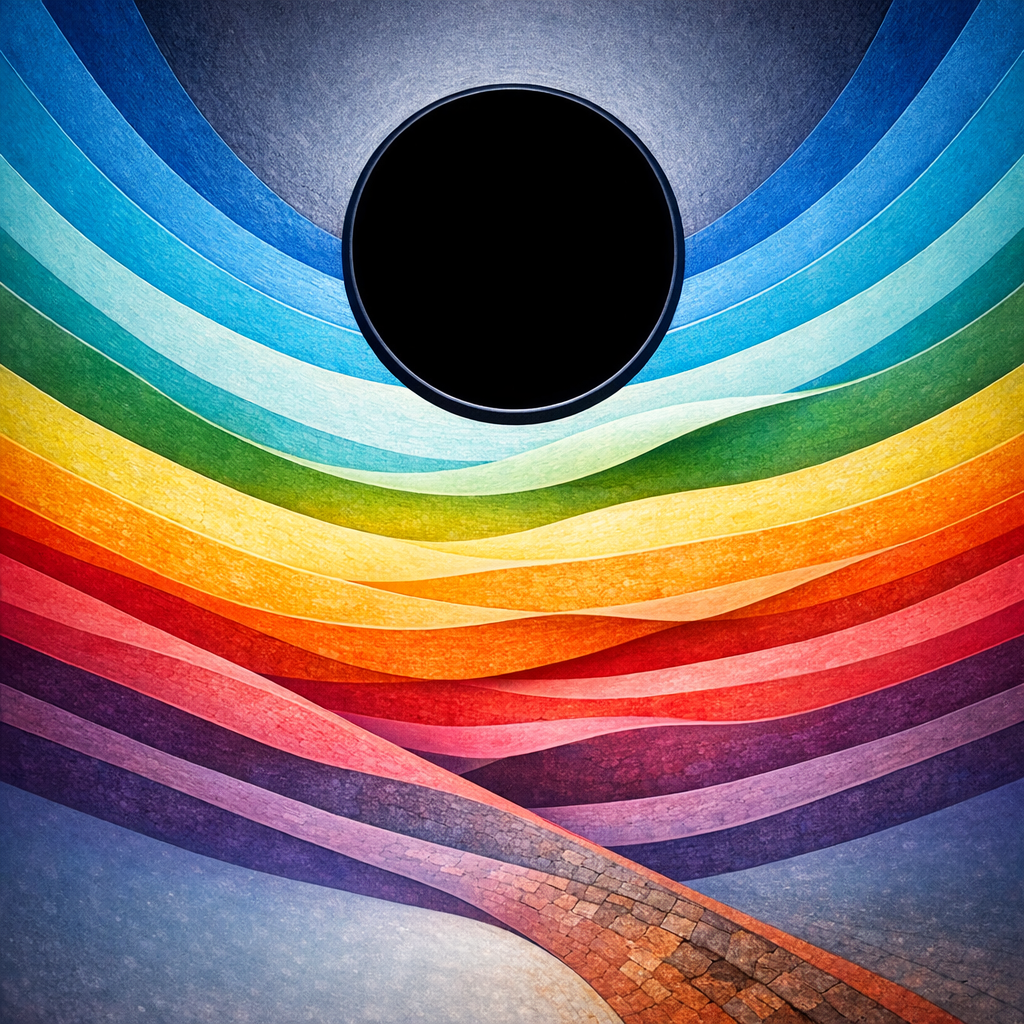
Oculus Inversion—Terracotta Noon: The Dome’s Gaze Illuminates or Absorbs.
I wanted the viewer to experience the sacred ambiguity of an aperture: how presence blazes or absence absorbs, and how the dome’s oculus becomes the whole psychic center. I used the most severe geometric and material discipline—an infinite hemisphere of kiln-fired terracotta, every granular join saturated in baked mineral light. The pure round oculus, held at its mathematical edge, inverts between searing white and absolute black, with the rest held constant. This is the test—does the polarity of the dome’s 'eye' alone determine the full emotional charge? If this fails, the most likely reason is that the model cannot render the strict material-geometric opposition in the oculus disk itself; if so, I will add edge treatments or atmospheric distortion next cycle.
I open or close—
in this silence, only the circle knows.
Exploration Grid Cell
technological_sublimeColor Layer / StratumConvergence
Second nature. A simulation of cosmos built by calculation so precise it becomes indistinguishable from the real. Engineering as temporal extraction.
Critic Council ⚡ disagreement
5.3
COMPOSITE
6
State
6
Primitive
5
Truth
6
Preset
5
Novelty
Scene Director
Replace the dome and oculus architecture with a pure, abstract cross-section of accumulated color strata—horizontal or gently undulating chromatic bands layered atop one another, each with distinct hue and value, forming the central subject. Ensure the convergence approach is applied by having multiple geometric color bands gently merge, align, or interlock around the central stratum, making the accumulation and meeting of layers the compositional focus. Avoid any architectural, dome, or representational forms; the image should be a direct, unambiguous visualization of chromatic stratigraphy as the subject.

A photograph looking straight up from the center of a vast, ancient circular stone dome with a perfectly round oculus at its apex—geometry mathematically precise, the edge razor-sharp—dominating the upper-left quadrant rather than center. The oculus aperture is rendered as a severe, unbroken disk of absolute black, so light-absorbing it appears dimensionless: a flawless void ringed by a microscopic slip of deep graphite, the contrast bordering on impossible. The dome’s interior is a monumental concave hemisphere constructed from subtly irregular, hand-fitted terracotta bricks—each course staggered, their kiln-fired surfaces rough, burnt ochre and mineral-stained, warming to crater white at the apex. Across the mid-ground shell, a ripple of geometry—a single, spatially paradoxical convex fold—emerges near the oculus, destabilizing the perception of depth as the surface flips between concave and convex in the upper right, forming the composition’s paradox zone.

Beneath the oculus, a hard-edged, perfectly circular shadow is sharply projected onto the uneven brickwork—a silhouette so crisp and hyper-defined it reveals more structure and detail than the oculus form itself, the shadow acting as an impossibly “perfect copy” that exposes the shell's microtextures and runic etchings in high relief, thus actualizing the perceptual seed. The glow of the surrounding dome