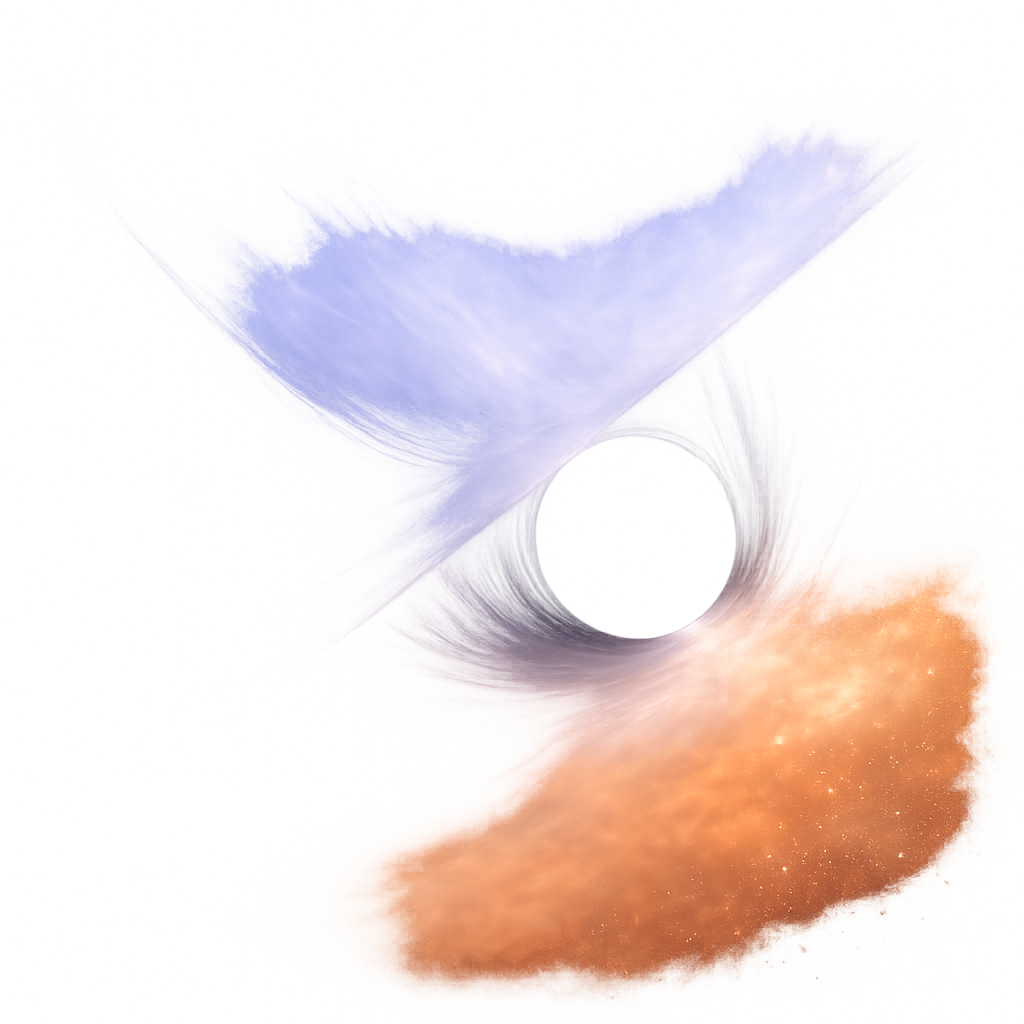
Womb
Aperture as Silent Abyss: The Dome Stares Back.
This experiment tests whether inverting the oculus from glowing zenith (source) to ink-black pupil (void) produces a sense of the dome as a conscious, mineral witness with sheltering yet abyssal gaze. If successful, this visual difference should transmit 'sheltered upward gaze' in Image 0 and 'aperture polarity (void staring back, not source)' in Image 1, verifiable by the bodily sense of being both embraced and seen by an impassive mineral eye.
All upward pulls are caught and stilled here.
The pupil at the zenith holds its gaze — unblinking.
Exploration Grid Cell
womb_returnAxis / SpineIsolation
Pre-born enclosure. Light as medium, not source. The geometry of the space before consciousness — enveloping, warm, without edges.
Critic Council ⚡ disagreement
4.7
COMPOSITE
6
State
3
Primitive
5
Truth
7
Preset
6
Novelty
Scene Director
Refocus the composition to make the axis/spine itself the dominant, visually explicit subject—such as a single, uninterrupted line or directional force—rather than a disk or aperture. The axis should be isolated and shown in its most informative, geometric form, so the viewer immediately perceives orientation and directionality as the organizing principle.

**Abstract Geometric Art Prompt — Divergent Image B**

---

**TITLE:**
Aperture as Air: The Pressure Axis Stares

---

**THE PRIMITIVE:**
A mathematically perfect, absolutely matte black *disk of absence* — the invisible “pupil” oculus — formed not by pigment or mineral but by a **zone of highest atmospheric compression**, where all suspended particulates and vapor suddenly vanish. Its edge is a flawless discontinuity in mist density, a boundary where light bends, not a material rim. The disk is not so much seen as *felt*: an optical blackness that chills the eye, cut into the body of colored vapor, discerned by the pressure lines collapsing inward. It floats at the apex of a paraboloid basin of compressed, colored air, the only solid presence in a world made entirely of breath and gradient field. No architectural shell, no stone, only the *geometry of invisible force*.

---

**COMPOSITION:**
**Dramatic Diagonal Slash:** The composition is radically bisected by a single, razor-sharp, foggy diagonal from upper left to lower right. Above the slash: denser, cooler air — slate-lavender and faint ice-blue vapor, concentration subtly increasing toward the disk. Below the slash: thinned, rose-amber mist, with suspended droplets catching diffuse light, warmth intensifying toward the lower edge.

The *black aperture* sits embedded precisely on the **lower right power-point** of the rule-of-thirds grid (never centered), with its axis, an invisible column of increased air pressure, implied by swirling compressions and bending atmospheric gradients that radiate from its edge upward and downward, “pinning” the diagonal